
Identiv’s Q3 2025: Margin Pressure and Sustained Cash Strength Shape Tactical Outlook
Identiv reports continued operating losses in Q3 2025 while maintaining robust liquidity, underscoring a strategic focus on digital identification and IoT solutions for healthcare.
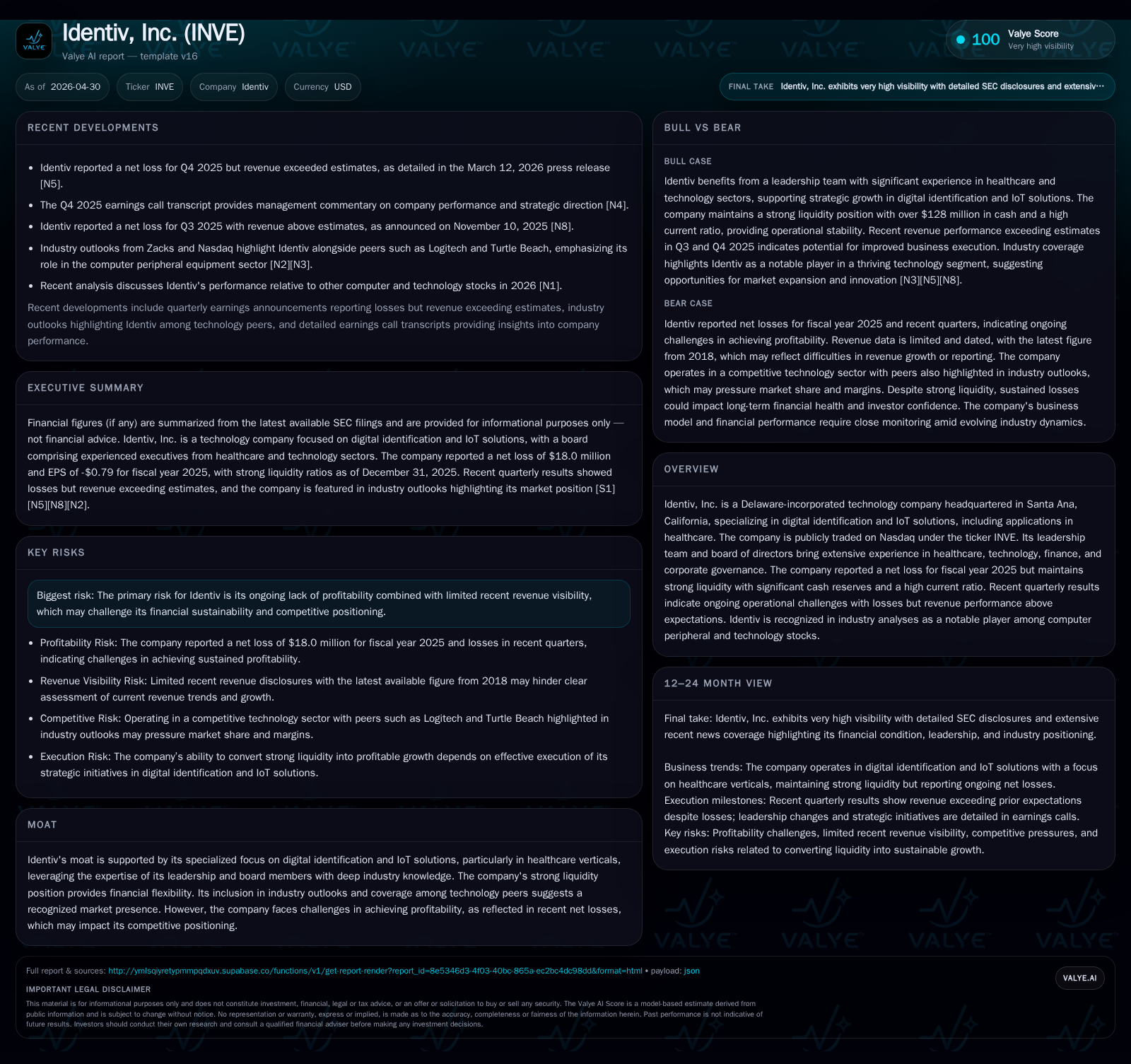
In its latest quarterly filing, Identiv delivered revenue above expectations but grappled with persistent operating losses, reflecting margin pressures in its core IoT and digital ID business. The company’s strong liquidity position, evidenced by substantial cash reserves and a high current ratio, provides a strategic buffer as it pursues growth in healthcare technology verticals. While profitability remains elusive, innovation efforts and a specialized product portfolio sustain Identiv’s competitive relevance in a fragmented market with evolving technology adoption trends.
Latest Operating Update Highlights
Identiv’s Q3 2025 filing [S2] underscores a continuation of the operational dynamics seen through the year: revenues exceeded expectations but were accompanied by persistent operating losses. The company’s net loss for the quarter reflects ongoing margin pressure amid increased investment in innovation and market expansion. The March 2026 event filing [S3] reaffirmed this narrative, highlighting both the challenges in reaching profitability and the solid financial footing enabled by strong cash reserves.
Cash and equivalents stood at $128.6 million as of December 31, 2025 [F1], complemented by a remarkable current ratio of 15.19 [F1], evidencing a conservative balance sheet that cushions Identiv in a cyclical tech environment. This financial flexibility underpins operational continuity and supports sustained investment in Research & Development (R&D) critical for addressing fast-evolving IoT security demands.
This juxtaposition—between margin headwinds and cash strength—is central to understanding Identiv’s near-term tactical posture: the firm appears focused on preserving runway to scale product relevance within selected verticals rather than broad-market blitzkrieg.
Business Model and Product Portfolio
Identiv generates revenue primarily through sales of integrated digital identification solutions coupled with IoT platforms designed to enhance security and connectivity across device ecosystems [S1]. Core customer segments span regulated industries with stringent compliance requirements—most notably healthcare where patient data confidentiality mandates advanced authentication mechanisms.
The company’s portfolio comprises hardware components (such as RFID readers), proprietary software managing device lifecycle and user authentication workflows, alongside subscription-based supporting services. This hybrid model offers multi-modal revenue streams driven by volume sales of devices augmented by recurring software service contracts.
Product quality is anchored in adherence to rigorous regulatory standards paired with deployment flexibility across diverse end-user environments. Such specialization fosters moderately high switching costs—especially within hospital systems or clinical research institutions reliant on certified digital ID—the latter amplifying retention prospects.
Management’s deliberate emphasis on healthcare verticals aligns with expertise embedded at the board level, enhancing credibility when navigating complex certification regimes like HIPAA or FDA guidelines governing medical device cybersecurity [S1]. This strategic orientation consolidates Identiv’s niche within a broader tech ecosystem increasingly buttressed by IoT adoption.
Industry Position and Competitive Dynamics
Within the broader technology landscape encompassing IoT security and computer peripheral equipment [N3], Identiv confronts a fragmented competitive arena where differentiation pivots less on scale than technical specialization and domain expertise [S1]. Fragmentation is typical since vendors often target niche applications—security badges vs. industrial IoT gateways vs. healthcare compliance modules—leaving room for specialized players like Identiv.
Pricing pressure emerges from component cost volatility caused by semiconductor supply constraints impacting margins despite value-driven selling approaches. Simultaneously, customer willingness to pay for robust security features strengthens demand for certified solutions tailored to sensitive environments (e.g., hospitals), suggesting durable pricing power on specialized products but weaker leverage elsewhere.
Regulatory compliance complexities also act as both barriers to entry for competitors lacking deep sector knowledge and potential growth constraints given evolving rules that may prolong sales cycles or require costly updates [S4]. This dual effect shapes competitive dynamics where agility in certification management becomes an asset.
Balancing Growth Drivers: Innovation, Healthcare, and Customer Base Expansion
Identiv’s growth strategy hinges on advancing its R&D pipeline focused on IoT application verticals aligned with healthcare needs [S1]. New product innovations seek to improve device lifecycle management capabilities—including secure enrollment, real-time monitoring, and seamless integration with hospital information systems—that constitute tangible value-adds driving upsell opportunities.
Healthcare market penetration benefits from board members’ sector experience fueling targeted sales efforts toward hospitals, clinical trials sponsors, and medical device manufacturers who increasingly prioritize data integrity frameworks amid rising cyber threats [S1]. This focus leverages tightening regulations prompting institutional adoption of advanced digital identification protocols.
Channel expansion contributes via partnerships enabling wider distribution reach into underserved segments while cross-selling services amplify average revenue per customer metrics—a critical lever given tight margins on hardware sales alone [N1]. Macro IoT adoption trends underpin long-term demand as digitization permeates traditionally analog operations requiring secure access controls.
Evidence from recent earnings calls supports cautious optimism around incremental contract wins that will be key KPIs signaling measurable traction beyond baseline revenue figures [N1]. Execution against product development timelines remains vital to sustaining momentum.
Risks and Constraints: Profitability, Market Penetration, and Competitive Pressures
Persistent net losses highlight structural challenges in scaling profitable operations despite revenue gains; the complexity of integrating hardware/software offerings combined with necessary compliance investments exacerbates margin compression risks [F1][S2].
Market penetration hurdles arise from entrenched legacy competitors offering cheaper or more commoditized alternatives alongside emergent SaaS platforms encroaching on digital identity spaces via cloud-native deployments [S4]. Competition thus spans both traditional device manufacturers and innovative software firms requiring continuous adaptation.
Regulatory risks persist given evolving cyber-security mandates particularly impacting medical technologies where change management can delay adoption or inflate costs [S4]. Operational scaling demands could strain internal bandwidth causing execution delays affecting backlog conversion rates noted in recent filings [S2].
Capital allocation decisions present watchpoints too; balancing R&D spend against path-to-profitability timelines will test management’s discipline amidst external financing market variability.
Key Milestones and Upcoming Watches
Stakeholders should monitor forthcoming quarterly earnings releases updating guidance post-Q3 ’25 baseline to gauge trajectory of margin improvement efforts or continuing loss trends [S2].
New contract announcements or partnership expansions disclosed around trade shows or via SEC filings could presage acceleration in healthcare IoT deployments amplifying installed base scale [N1][S3].
Tracking progress against R&D milestones targeting regulatory certifications or technological breakthroughs securing competitive moats will be critical execution points highlighted in subsequent proxy materials or investor communications [S1].
Supply chain stabilization signals allow margin restoration possibilities deserving scrutiny along with shifts in competitive intensity documented through industry analyst reports covering tech peripherals segment dynamics [N3].
Financial Snapshot: Liquidity Strength Amid Losses
Cash and equivalents stood at $128.6 million as of December 31, 2025 [F1], with current assets totaling $143 million against current liabilities of $9.4 million, yielding a current ratio of 15.19 [F1]. These figures indicate a conservative balance sheet posture that supports operational continuity and strategic R&D investments despite ongoing net losses. Overall revenue nearing $60 million underscores reasonable business scale though profitability remains an area requiring continued management focus.
This analysis is based exclusively on public SEC filings up to April 2026 along with corroborated industry commentary; it refrains from speculative assertions beyond explicitly documented data sources including filings numbered [S1], [S2], [S3], risk outlines at [S4], companyfacts snapshot details at [F1], and select news transcripts noted as [N1] and analyst overviews at [N3]. No investment advice or price predictions are offered herein.
Disclaimer: This is research-only, informational analysis and not investment advice. It may include AI-generated interpretation and general industry context. Always verify important details using primary sources.

Comments