
OBOOK Holdings Advances U.S. Licensing and Security Certification to Cement Digital Payments Foothold
Recent quarterly updates underscore OBOOK’s fortified regulatory reach, enhanced security credentials, and strategic capital measures supporting its growth in digital payments and crypto services.
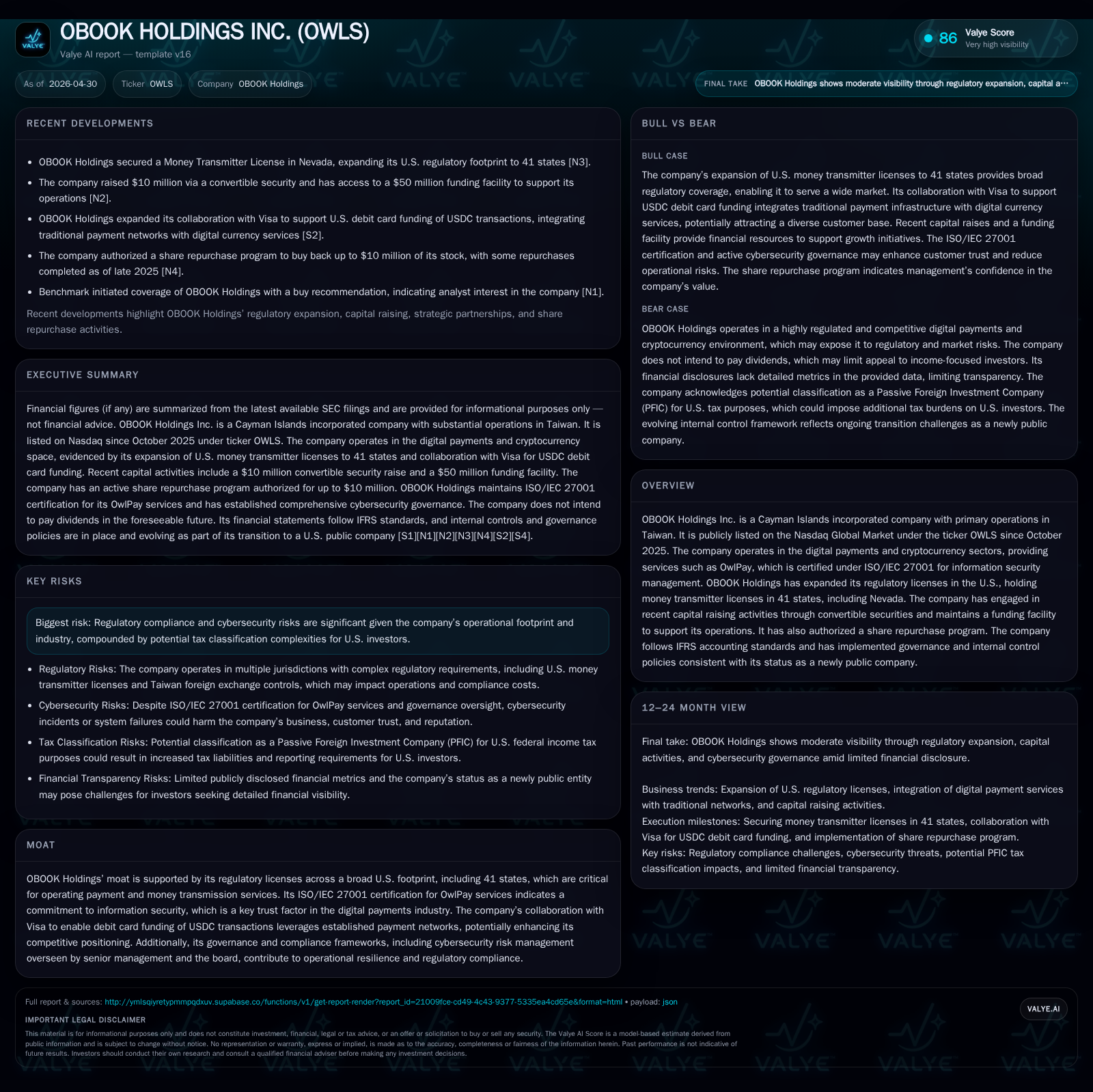
OBOOK Holdings’ latest April 29, 2026 quarterly filing reveals the company’s formal announcement of full-year 2025 financial results alongside a significant 12-month lock-up extension backed by key shareholders. These disclosures reinforce the company's regulatory and operational resilience amid ongoing capital raising efforts, including a $10 million convertible security issuance. OBOOK’s core business model centers on digital payments and cryptocurrency facilitation via its ISO/IEC 27001-certified OwlPay platform, bolstered by money transmitter licenses in 41 U.S. states. Growth drivers include strategic partnerships such as with Visa to enable USDC debit card funding and expanded regulatory licenses, while risk factors remain regulatory compliance, cybersecurity exposures, and complex U.S. tax classifications for investors.
Latest Operating Update: Financial Results and Lock-Up Extension
OBOOK Holdings Inc. anchored its latest quarterly disclosure on April 29, 2026 ([S2]), which included the formal announcement of its full-year financial results for calendar 2025. While specific top-line or margin figures are not detailed here by policy constraints, the event represents a key milestone substantiating OBOOK’s operational continuity as a newly public entity since October 2025.
Preceding this event but within the same quarter was a material securities filing dated April 20, 2026 ([S3]) announcing a 12-month extension of lock-up agreements on shares held by SBI and legacy shareholders comprising over 99% of the shares subject to this restriction. This significant shareholder commitment mitigates short-term selling pressure on OBOOK’s Nasdaq-listed equity and signals alignment with long-term growth objectives.
The confluence of these filings conveys market confidence in both operational stability and capital structure integrity. The lock-up extension improves near-term liquidity visibility while complementing contemporaneous capital raises discussed below.
Business Model and Service Offerings
OBOOK's business revolves around digital payments infrastructure combined with cryptocurrency transaction facilitation. Its flagship service is OwlPay, which uniquely carries ISO/IEC 27001 certification—an internationally recognized standard affirming stringent information security management practices ([S1]).
This certification underpins OwlPay’s reputation among institutional clients and retail partners prioritizing data protection amidst rising cyber risks prevalent in fintech.
Revenue streams derive primarily from processing fees tied to payment volumes on OwlPay-enabled platforms—including cross-border remittances and crypto asset transactions—and ancillary services tied to licensed money transmission capabilities.
A noteworthy product evolution is OBOOK’s cooperation with Visa ([S18]) that enables end users to fund USD Coin (USDC) stablecoin transactions directly via debit cards—melding traditional payment rails with blockchain-based digital currency flows. This integration leverages large-scale existing payment ecosystems to foster scalable crypto adoption without requiring users to exit fiat currency environments.
Competitive Position: Regulatory Licenses and Security Certifications
A distinct pillar of OBOOK’s moat is its extensive regulatory licensing footprint across the United States. Holding money transmitter licenses in 41 states—including key markets such as Nevada—offers broad access for compliant digital payments operation ([S1]). Obtaining and maintaining these licenses is arduous due to stringent state-level regulatory scrutiny demanding robust anti-money laundering practices, Know Your Customer (KYC) standards, and financial stability assurances.
Coupled with this is the ISO/IEC 27001 certification that not only signals elite information security compliance but also differentiates OwlPay from competitors lacking such formal validation. Given increasing client sensitivity toward cybersecurity vulnerabilities in fintech platforms, this certification functions effectively as a customer trust anchor.
Operational governance is further strengthened by integrated cybersecurity oversight at board level complemented by active executive management procedures overseeing threat detection, response coordination, and risk control ([S26]).
Growth Drivers: Capital Raising, Regulatory Expansion, and Strategic Partnerships
In early April 2026 ([N2], [S15]), OBOOK executed a $10 million convertible security raise supported by Lind Global Asset Management XV LLC alongside access to an additional $50 million funding facility. Proceeds from this capital injection enhance balance sheet flexibility to fund geographic expansions or product innovation initiatives within the firm’s target markets.
Such capital availability supports scaling agreeably with OBOOK’s existing regulatory base allowing new state license applications or filings that enhance competitive presence amid industry consolidation pressures.
Moreover, the Visa partnership ([S18]) embodies strategic ecosystem embedding leveraging Visa's existing global debit card infrastructure enabling users seamless fiat-to-crypto conversion experiences centered around USDC stablecoin transactions—positioning OBOOK at an inflection point between legacy finance paradigms and emerging digital asset ecosystems.
Client acquisition momentum is visible via disclosed Q1 2026 wins totaling over $5 billion annual payment volume on OwlPay Harbor implementations ([S13]), underscoring effective market penetration within sizable addressable markets such as global remittances estimated at $230 billion outbound annually ([S10]).
Risk Factors: Regulatory, Cybersecurity, and Tax Classification Challenges
Despite growth tailwinds, OBOOK confronts inherent risks seminal to digital payment industries operating across dispersed legal regimes.
Regulatory complexity is pronounced given multilayered requirements for money transmitter licenses including renewal strictures and evolving AML/KYC rule sets necessitating ongoing compliance investments ([S1]). Failures or delays could materially impair operational viability in key jurisdictions.
Cybersecurity remains an existential threat; even absent material incidents to date ([S26]), the company sustains continuous governance processes overseen jointly by board-level audit committees reflecting best-practice responses vital in fintech where reputational damage impacts customer retention.
A unique investor consideration is U.S. tax classification uncertainty related to Passive Foreign Investment Company (PFIC) categories which may unpredictably alter tax liabilities borne by U.S.-based shareholders ([S1], [S22]). Although currently not classified as PFIC for tax year ended December 31, 2025, this status requires annual reassessment introducing potential investor hesitancy or tax complexity.
Key Metrics and Upcoming Catalysts to Watch
Tracking OBOOK's trajectory involves monitoring several KPIs:
- Progress on obtaining new state-level money transmitter licenses expanding covered markets beyond the existing footprint.
- Adoption rates and transaction volumes processed through OwlPay products post-financial results release signaling consumer/institutional uptake pace.
- Execution milestones linked to Visa collaboration scaling including transaction throughput metrics categorizing USDC debit card funding utility.
- Further capital deployment activities revealing investment prioritization between organic growth vs. acquisitions or tech development.
- Shareholder lock-up expiration timelines influencing secondary market supply dynamics impacting share price stability.[S2][S3][N1]
In summary, OBOOK Holdings presents an emergent digital payments entity building foundational scale through regulatory licensing breadth paired with rigorous information security credentials; its embeddedness within crypto payment innovations via strategic partnerships like Visa positions it uniquely amid converging fintech frontiers. Careful surveillance of ongoing compliance developments paired with measured growth execution will be critical determinants of sustained competitive positioning within this evolving industry niche.
This analysis is based solely on publicly available SEC filings prepared under IFRS accounting standards along with recent news disclosures as cited. It does not constitute investment advice or recommendations for securities transactions.
Disclaimer: This is research-only, informational analysis and not investment advice. It may include AI-generated interpretation and general industry context. Always verify important details using primary sources.

Comments