
Imperial Petroleum Expands Fleet with Robust Capital Position and Adaptive Chartering
The company advances fleet growth while maintaining strong liquidity and flexible charter strategies amid a cyclical shipping market.
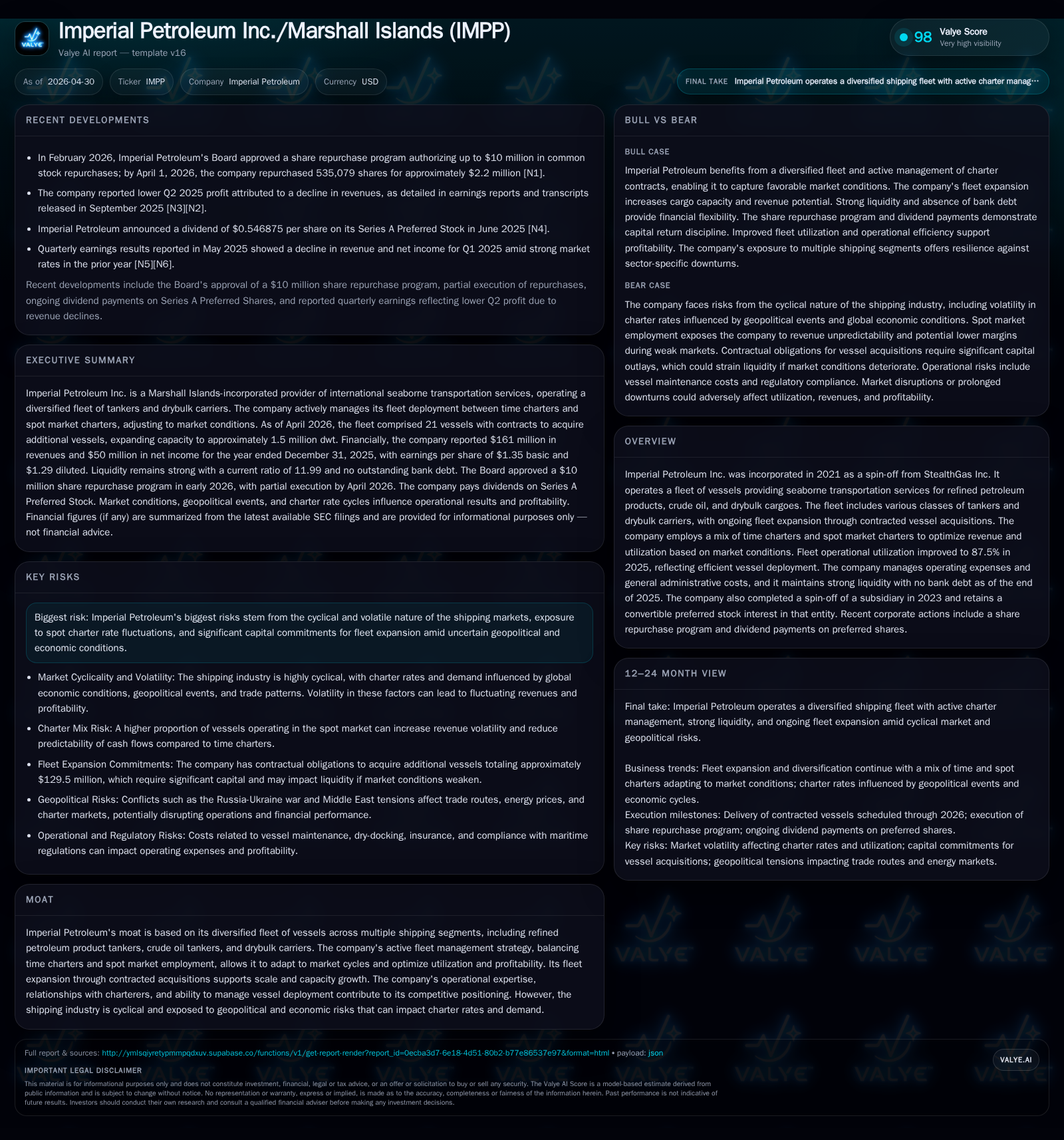
Imperial Petroleum's latest quarterly update highlights substantial progress in fleet expansion with two new vessel deliveries in early 2026 and contracts secured for five additional vessels through Q3 2026. The company operates a diversified fleet across refined product tankers, crude oil tankers, and drybulk carriers, optimizing revenue through a dynamic mix of time charters and spot market employment. With no outstanding bank debt and over $5.7 million in cash equivalents, Imperial maintains a strong liquidity profile supporting growth investments and recent share repurchases. However, cyclical industry volatility, dependence on spot charter rates, and capital intensity of fleet acquisitions pose ongoing risks to operational stability.
Latest Quarterly Operating Update: Solid Growth and Fleet Expansion Progress
Imperial Petroleum's March 2026 interim disclosure unveils continued fleet buildup with two vessels delivered early this year—one in January and another in April—out of seven vessels contracted at $129.5 million total consideration [S1][S2]. The remaining five are slated for delivery through the third quarter of 2026, demonstrating a disciplined capex cadence aligning with growth ambitions. These include three drybulk carriers initially agreed in August 2025 (for $51.6 million) with an equity component payable via common shares, alongside four additional units—three drybulk carriers plus one product tanker—contracted in December 2025 at $77.9 million fully in cash [S1].
Fleet operational utilization rose meaningfully to 87.5% in 2025, signaling adept deployment amid challenging freight markets [S1]. Notably, the company operates entirely without bank debt as per the December 31, 2023 position, supporting a strong liquidity cushion with over $5.7 million cash equivalents and a current ratio close to 12x [F1][S1]. Furthermore, the Board initiated a share repurchase program with up to $10 million authorized; by April 2026, management had repurchased approximately $2.2 million worth of stock covering more than half a million shares—underscoring confidence in the balance sheet strength amid ongoing fleet investment needs [S1][S2].
Business Model Overview: Diverse Vessel Fleet and Market-Sensitive Chartering
Imperial Petroleum generates revenue through seaborne transportation services spanning multiple cargo segments: refined petroleum products (gasoline, diesel, jet fuel), crude oil, and a broad array of drybulk commodities including iron ore, coal, grains, bauxite, phosphate fertilizers among others [S1]. Its asset base includes seven medium-range (MR) refined petroleum product tankers, two suezmax crude oil tankers, plus a range of handysize through post-panamax class drybulk carriers—four handysize, five supramax, two kamsarmax, and one post-panamax—with contracted additions expanding the total fleet to approximately 26 vessels by late 2026 commanding around 1.5 million deadweight tons (dwt) capacity [S1].
Revenues depend critically on the blend between time charters—multi-year employment contracts offering stable but often lower-margin cash flows—and shorter-duration spot charters ranging from one to six months that offer upside during favorable market cycles but entail earnings volatility [S1]. Imperial’s deployment strategy actively shifts vessels between these modes based on current market assessments to balance predictability against margin enhancement opportunities. Currently, notable portions of its bulk carriers operate under short duration time charters while several tankers remain spot-exposed or under fixed contracts ending within the next year or beyond [S1]. This tactical flexibility enables adaptive revenue management that is crucial given shipping’s intrinsic cyclicality.
Competitive Environment: Multi-Segment Fleet with Adaptive Revenue Strategies
The company’s diversified presence across key liquid bulk (refined products/crude oil) and drybulk segments provides a competitive advantage through geographic reach and cargo variety management—a critical differentiation among shipping operators often concentrated in narrower niches [S1]. Management leverages operational expertise to optimize vessel utilization metrics via dynamic scheduling between period charters and spot markets tailored for each vessel class and sector demand.
Fleet composition ranges from MR tankers (well-suited for regional refined products trade) through suezmax vessels targeting large-scale crude flows capable of accessing Suez Canal routes efficiently to diverse drybulk carrier classes sized for major bulk raw materials transport across global trade lanes [S1]. Operational efficacy is further enhanced through relationships with charterers including commodity producers and trading firms requiring reliable logistics solutions in fluctuating market environments. While this spread reduces segment-specific dependency risk somewhat, it also exposes Imperial Petroleum to macroeconomic sensitivities such as global GDP growth trends influencing industrial commodity demand as well as geopolitical developments affecting maritime routes or environmental regulations impacting operating costs.
Growth Drivers: Contracted Acquisitions and Dynamic Utilization Management
Imperial’s primary near-term growth vector is anchored in its significant contracted vessel acquisitions totaling about $129.5 million with scheduled deliveries concentrated through late Q3-2026 [S1][S28]. Deliveries of newly acquired drybulk carriers (including handysize classes) augment both fleet capacity measured by dwt tonnage and cargoes addressable by service offerings. This scale enhancement can induce better economies across voyage execution costs per ton while broadening appeal to large charter counterparties seeking multi-vessel solutions.
Simultaneously, optimizing fleet utilization remains an ongoing focus: cycling assets between time-chartered commitments ensuring baseline revenues while opportunistically deploying others into spot trades allows management to capture favorable freight rate environments without full exposure to downside vacillations seen during downturns [S1]. Sustaining high utilization ratios—as evidenced at 87.5% in calendar year 2025—is vital for fixed-cost absorption efficiency.
Financially supported primarily by internally generated operating cash flow augmented periodically by equity raises, Imperial avoids excessive leverage currently and maintains a strong liquidity position as reflected in its cash balances and current ratio [F1].
Risks and Constraints: Market Cyclicality, Spot Exposure, and Capital Commitments
Imperial Petroleum operates within inherently volatile shipping markets marked by unpredictable swings in charter rates driven by macroeconomic cycles, energy demand shocks, environmental regulations impacting fuel cost structures or trade patterns, and geopolitical events such as sanctions or supply route disruptions [S1]. Exposure to spot freight markets—integral for margin uplift during favorable markets—simultaneously creates downside risk if rate collapses force vessels into low-revenue employment periods.
Executing integration of new assets without diluting operational efficiency or incurring escalated management fees represents another challenge.
Additionally, changes in regulatory regimes pertaining to emissions control zones (ECAs), ballast water treatment compliance requirements necessitating periodic drydockings (noted at fourteen vessels planned for drydocking including retrofits in 2026), or international maritime laws could elevate operating expenses unpredictably affecting profitability margins [S23].
What to Watch Next: Vessel Deliveries, Chartering Trends, and Capital Management
Key upcoming milestones include the delivery schedule completion for remaining contracted vessels—with particular attention on the four units due by year-end along with three earlier August deliveries—to validate planned capacity growth projections [S1][S28]. Monitoring shifts in charter employment between time versus spot contracts will be critical for assessing how Imperial balances revenue stability against margin opportunities amid evolving freight rate dynamics.
Financially, tracking ongoing share repurchase program utilization provides insight into management’s confidence level regarding capital structure flexibility versus reinvestment needs; repurchases thus far have been moderate totaling $2.2 million suggesting cautious optimization amidst growth phase demands [S2][S24].
Operational KPIs such as fleet utilization percentages remain important leading indicators reflecting commercial success managing supply-demand imbalances typical of shipping sectors.
Financial Snapshot: Liquidity, Debt-Free Balance Sheet, and Share Repurchases
Latest financial snapshot
| Metric | Value | Period |
|---|---|---|
| Cash & equivalents | $5.77M | |
| 2025-12-31 | ||
| Current assets | $199.0M | |
| 2025-12-31 | ||
| Current liabilities | $16.6M | |
| 2025-12-31 | ||
| Current ratio | 11.99x | |
| 2025-12-31 |
Source: SEC companyfacts cache [F1].
Imperial Petroleum maintains no outstanding bank debt as per last disclosed figures at year-end 2023 coupled with strong working capital demonstrated by nearly $200 million current assets against modest current liabilities resulting in an approximately twelve times current ratio—indicating considerable liquidity headroom supporting operational expenditures along with strategic vessel acquisitions [F1][S12][S13]. Operating income reached roughly $39.9 million while net income stood at approximately $50 million for full-year ending December 31, 2025—a profitable foundation facilitating growth capex funding primarily via internal cash generation complemented by equity contributions from public offerings totaling above $56 million net proceeds plus warrant exercises supporting incremental financing needs during the expansion cycle observed since incorporation as an independent entity post-spinoff in late 2021 from StealthGas Inc. [F1][S1].
This analysis is based solely on publicly available information up to April 29–June 2026 filings including SEC disclosures referenced herein. It does not constitute investment advice or recommendations but aims to provide a clear operational and strategic perspective grounded on verified data.
Disclaimer: This is research-only, informational analysis and not investment advice. It may include AI-generated interpretation and general industry context. Always verify important details using primary sources.

Comments