
Pagaya Technologies' AI-Driven Credit Platform Scales with Record 2025 Earnings
Pagaya leverages proprietary AI models to disrupt credit underwriting, growing revenues by 26% in 2025 amid expanding product coverage and improving profitability.
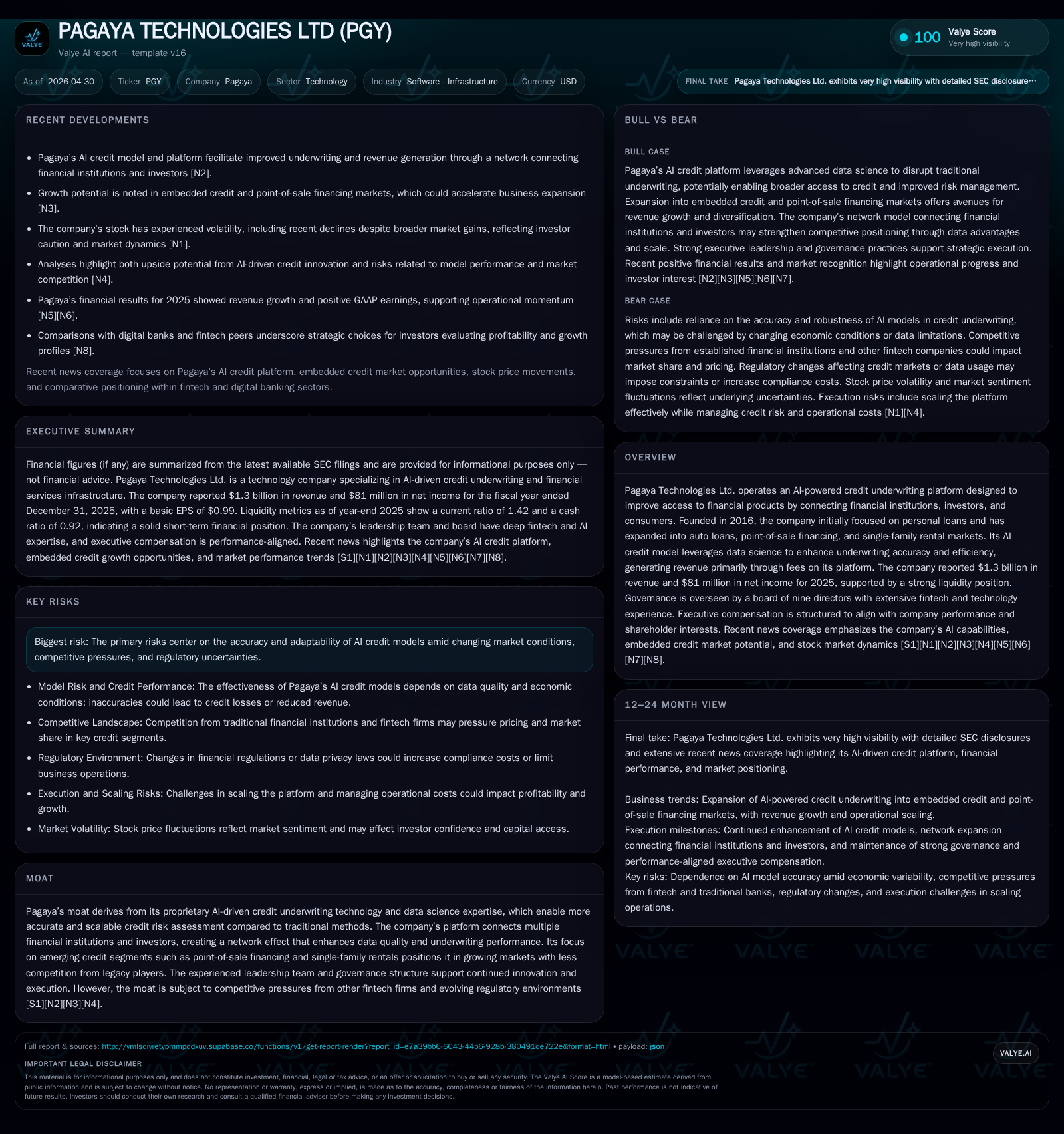
Pagaya Technologies Ltd. reported strong full-year 2025 results, with revenue rising 26% to $1.3 billion and net income turning positive at $81 million. The company’s AI-powered credit underwriting platform connects financial institutions, investors, and consumers, enabling scalable and accurate credit risk assessment across personal loans, auto loans, point-of-sale financing, and single-family rentals. Pagaya’s growth is driven by expanding data networks and entrance into emerging credit segments. Its competitive moat lies in proprietary AI algorithms that deliver underwriting precision and operational leverage, although risks tied to model accuracy and regulatory shifts remain. Executive compensation aligns management incentives with operational performance, supporting long-term value creation.
Recent Operating Update
The latest quarterly filing dated November 10, 2025 [S2] and the amended annual report filed April 30, 2026 [S1] establish a clear trajectory of strong operational execution for Pagaya Technologies Ltd. In full-year 2025, the company achieved total revenues of approximately $1.3 billion, a substantial 26% increase year-over-year [F1]. This revenue growth was accompanied by a notable improvement in profitability: operating income rose nearly threefold to around $264 million while GAAP net income swung from a prior loss position to an $81 million gain [F1][S5]. These financial outcomes reflect progress in both expanding fee-generating volume on its platform and controlling expenses amid normalization from impairments.
The Compensation Committee linked executive bonuses to these specific financial metrics—total revenue, net income, and adjusted EBITDA—to tighten alignment between management incentives and shareholder value creation [S23]. No material changes to disclosed risk factors occurred through Q3 2025 [S2], suggesting stable operating conditions.
Business Model
Pagaya Technologies operates an AI-centric credit underwriting platform designed as a marketplace intermediary among financial institutions (lenders), institutional investors, and consumer borrowers [S1][N1]. Founded in 2016 with an initial focus on personal loans, Pagaya has significantly broadened its scope into auto loans, point-of-sale (POS) financing embedded at checkout points, and the burgeoning single-family rental (SFR) lending market [S1].
Revenue emerges predominantly from fees earned on assets it facilitates underwriting for investor partners—essentially taking a cut of the financed loan volumes flowing through its system [N3]. The core product is its proprietary machine-learning-driven credit risk assessment engine which leverages extensive alternative data beyond traditional credit scores to provide more granular borrower evaluation. This improved precision enables better pricing of risk and volume scaling without compromising portfolio quality.
Customers primarily comprise financial institutions seeking enhanced underwriting capabilities as well as institutional investors purchasing asset-backed securities or whole loans structured through Pagaya’s platform [N1]. The underlying value proposition rests on reducing lending friction while improving yield compared to legacy credit models.
Industry Structure and Competitive Position
Within the broader fintech landscape targeting consumer and asset-backed lending segments, Pagaya distinguishes itself through:
Competitive pressures arise mainly from other emerging fintech lenders using AI-based tools (e.g., Upstart, Affirm) as well as legacy banks upgrading their digital offerings. However, Pagaya’s depth in algorithmic credit modeling combined with its ecosystem-scale data offers differentiation [N2][N3].
Milestones to monitor include client onboarding velocity in newer verticals such as SFR lending and updates on embedded finance partnerships driving volumes.
Risks / Watchpoints / Growth Constraints
Despite promising fundamentals, several watchpoints persist:
- Model Risk: Accuracy degradation due to shifting macroeconomic conditions or structural changes in borrower behavior could impair underwriting quality affecting investor confidence.
- Regulatory Environment: Increasing scrutiny over AI decision-making fairness, data privacy laws, or restrictions on non-traditional data usage may necessitate costly adjustments.
- Competitive Intensity: Other fintech platforms adopting similar AI technologies or incumbent banks boosting their digital capabilities could erode share or margin advantages.
- Concentration Risk: Dependence on certain key partners or sectors (e.g., personal loans historically) might expose the firm if market dynamics change abruptly.
Management’s disclosure highlights ongoing efforts to mitigate these risks by investing in compliance infrastructure and maintaining diversified financing channels [S22].
What to Watch Next
Key indicators that will illuminate Pagaya's future trajectory include:
- Growth rates in new product segments like POS financing and SFR lending demonstrating successful diversification.
- Further margin expansion reflecting operational efficiency gains as platform scale grows.
- Updates on regulatory engagements or adjustments addressing transparency standards for AI models.
- Bookings or contracts evidence related to new lending/investment partnerships indicating network expansion momentum.
- Progress reports on technological upgrades validating sustained competitive edge.
With executive compensation closely tied to these operational KPIs—including total revenue growth above $1 billion thresholds—the alignment suggests management focus remains on driving measurable business outcomes [S21][S26].
Financial Profile Overview
Historical performance (annual)
Capital returns and efficiency (annual)
Supporting this narrative is a solid financial foundation as evidenced by:
The company turned profitable after several years of investment-led losses—a testament to scaling benefits starting materializeing visibly. Capital expenditures fell moderately year-over-year indicating maturation of core infrastructure deployment. Net debt approximates $364 million when excluding cash balances midyear—a leverage level manageable given improving cash flows though warrants monitoring especially if capital needs grow with expansion plans [F1].
In summary, Pagaya Technologies demonstrates a structurally advantaged fintech business leveraging proprietary AI technology within an expanding multi-product credit underwriting platform. Its recent annual results manifest effective scaling with positive earnings while operational risks inherent in advanced AI modeling and regulation require ongoing vigilance. The firm is well positioned to capture continuing growth from emergent embedded finance trends if it executes effectively against evolving market dynamics.
This analysis is based solely on publicly available filings as of April 30, 2026; it does not constitute investment advice.
Disclaimer: This is research-only, informational analysis and not investment advice. It may include AI-generated interpretation and general industry context. Always verify important details using primary sources.

Comments