
Graham Holdings Details Strategic Moves and Portfolio Realignment in Q1 2026
The company’s Q1 2026 filing reveals targeted acquisitions in healthcare and automotive, alongside preparation for asset divestiture, underpinning a strategic portfolio reshaping.
In Q1 2026, Graham Holdings classified certain assets as held for sale, signaling active portfolio rebalancing, and expanded its stake in CSI Pharmacy, consolidating its healthcare segment. The automotive division financed a recent Honda dealership acquisition with a delayed draw term loan, reflecting growth focus in regional car sales. The company’s diversified business model spans education via Kaplan, broadcasting, healthcare specialty services, manufacturing niche products, and automotive dealerships. Strategic growth is driven by home infusion therapy expansion, selective acquisitions, and international education demand despite regulatory and market volatility risks. A healthy liquidity position supports these initiatives while mitigating refinancing exposure.
Q1 2026 Operating Update Highlights
Graham Holdings’ Q1 2026 10-Q filing provides clear evidence of ongoing portfolio realignment through the classification of certain assets as held for sale. As of March 31, 2026, the company aggregated assets including cash ($28.8 million), receivables ($7.8 million), prepaid expenses ($5.9 million), property plant & equipment ($8.1 million), lease right-of-use assets ($19.8 million), and intangible assets slated for disposal within the next year [S2]. This marks a deliberate step toward streamlining operations to focus on higher-value or core businesses.
Complementing this is active consolidation in the healthcare segment: Graham Holdings acquired additional minority shares in CSI Pharmacy Holding Company LLC during March 2026 for $41 million via a combination of cash ($16.4 million) and promissory notes bearing an 8% interest rate with scheduled repayments by April 2028. Post transaction ownership stands at approximately 93.4% for CSI [S2], [S25]. Additionally, minor interests were redeemed in Clarus earlier in the year increasing company ownership to 97.5%, further consolidating control over key healthcare ventures.
The automotive segment continues regional expansion momentum with the acquisition of a Honda dealership financed by drawing $38.7 million under a delayed draw term loan agreement executed in late 2025 [S2], [S16]. This capital deployment addresses incremental market share opportunities primarily centered around Washington D.C. and Richmond, VA regions.
These developments convey management's dual approach: pruning non-core or sub-scale assets via sales while opportunistically bolstering divisions exhibiting structural growth potential.
Evolution of Graham Holdings’ Business Model and Segment Overview
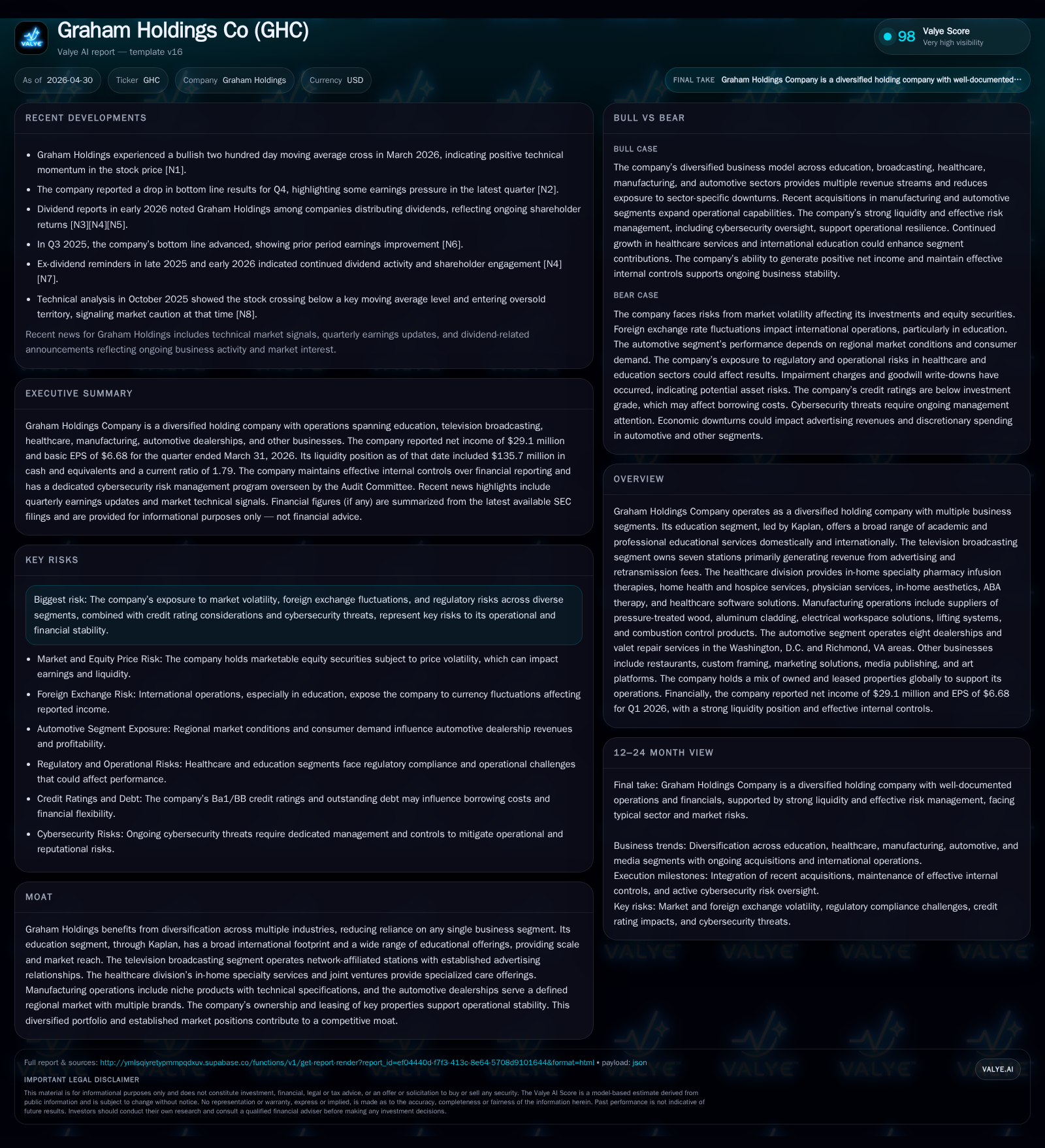
Graham Holdings operates as a distinctly multifaceted holding company structured around six principal business segments deployed across diverse industries [S1]:
Education: Led by Kaplan, Inc., this segment offers a broad spectrum of academic programs plus professional certification services both domestically and internationally. Kaplan’s footprint includes operational campuses in North America and Europe (e.g., London, Nice) alongside leased facilities spanning Asia-Pacific regions [S1]. Its multi-channel approach — traditional colleges to supplementary education — allows scale efficiency and exposure to shifting global education demand.
Television Broadcasting: Ownership of seven network-affiliated television stations primarily delivers revenue through advertiser spend and retransmission fees from cable/satellite distributors. With established market positions across Houston TX, Detroit MI, Orlando FL among others, broadcasting provides steady cash flows amid industry-wide challenges applying pressure on ad rates but supported by retransmission fee contracts [S1].
Healthcare Division: This segment represents a rapidly growing platform encompassing specialty pharmacy infusion therapies delivered directly to patients’ homes; home health & hospice care joint ventures; physician service partnerships; ABA therapy for developmental conditions; aesthetic medicine delivered outpatient; plus proprietary healthcare IT solutions that integrate operational efficiencies [S1]. The division benefits from aging population trends driving higher demand for cost-effective at-home treatments.
Manufacturing Operations: Across several technically complex product lines—including pressure-treated wood (Hoover), architectural aluminum cladding (Arconic subsidiary acquisition), electrical workspace solutions (Dekko), lifting systems (Clyde Machines)—GHC serves commercial construction and industrial markets with differentiated product mix emphasizing quality and compliance [S1], [S6].
Automotive Dealerships: Operating eight dealerships predominantly within key Mid-Atlantic metro regions supporting major brands including Honda. Dealership returns are sensitive to macroeconomic vehicle sales cycles but benefit from aftersales parts/services revenue diversification [S1], [S6].
Other Businesses: Miscellaneous holdings such as restaurant groups (Clyde’s) and new ventures reflect tactical investments contributing modest income but enhancing overall corporate nimbleness.
This multi-segment structure spreads risk while leveraging domain expertise tailored toward stable or structurally growing end-markets.
Competitive Moat Analysis Across Diverse Divisions
Graham Holdings' competitive advantage derives substantially from its diversified portfolio mitigating single-segment cyclicality risk intrinsic to industries like automotive or broadcasting. Kaplan’s international footprint provides scale economies uncommon among regional educational competitors, facilitating cross-border student recruitment flexibility hardened against local enrollment swings.
Broadcasting benefits from long-standing affiliate relationships forming barriers to entry alongside retransmission fee contracts that deliver recurring cash flows insulated from pure advertising volatility.
Healthcare offerings combine specialized at-home infusion therapy technologies with scalable joint venture models involving hospital systems—creating switching costs by embedding clinical pathways that competitors struggle to replicate quickly.
Manufacturing’s focus on niche product lines—pressure-treated wood engineered for longevity or aluminum cladding for highly specified architectural projects—creates customer loyalty based on technical product quality rather than commodity pricing alone.
The localized nature of automotive dealerships—anchored by brand exclusivity agreements coupled with geographic concentration—generates defensible pricing power in parts and service revenues even when new vehicle sales fluctuate.
Moreover, significant property ownership or long-term leases underpin operational stability across multiple segments reducing landlord tenant negotiation risks explored frequently in multi-site operations like Kaplan campuses or broadcast facilities [S1].
Together these factors coalesce into a durable moat characterized by balance between diversification benefits and industry-specific depth.
Growth Drivers: Expanding Specialty Healthcare and Targeted Acquisitions
Within healthcare, the continued expansion of home infusion therapies aligns with an aging demographic pattern emphasizing outpatient treatments that reduce hospital stays and overall costs—a structural trend benefiting specialized providers like GHC’s CSI Pharmacy platform [S7]. Recent acquisitions raising ownership stakes confirm management’s prioritization of scaling high-margin specialty segments where clinical specialization acts as a barrier to new entrants.
Automotive growth is being pursued through selective dealership acquisitions with recent injection of capital via term loans used specifically for real estate plus operations financing—increasing footprint without overextension given GHC’s measured borrowing approach [S2], [S16]. This plays into consumer behavior where branded dealerships centrally located maintain relevance despite shifts toward online car buying platforms because financing approval processes still depend heavily on physical locations.
Kaplan’s global reach allows participation in emerging-market education demand growth coupled with supplemental education offerings serving adult learners seeking career enhancement where public provision gaps exist particularly post-pandemic reshaping workforce retraining needs.
Manufacturing presents mixed headwinds; however strategic acquisitions such as Arconic Architectural Products diversify product lines into resilient non-residential materials sectors offering stable order books relative to residential construction fluctuations seen broadly across U.S markets [S6].
Overall growth prospects hinge on synergy capture post-acquisition integration along with incremental volume upticks particularly within healthcare service utilization rates measured quarterly by patient counts or service episodes provided.
Risks and Watchpoints: Regulatory Exposure, Market Sensitivities, and Cybersecurity
Given the scope across regulated industries—higher education accreditation requirements domestically abroad; healthcare compliance under CMS rules; manufacturing environmental standards—the complexity mandates vigilant regulatory monitoring lest compliance lapses incur fines or operational interruptions [S1],.
Foreign exchange exposure enfrenta risks chiefly through Kaplan’s international campuses where tuition payments collected in multiple currencies create translation volatility impacting reported results—though natural hedges exist via localized cost bases.
Cybersecurity emerges as a salient risk category given sensitive personal data managed within educational records databases plus patient information safeguarded across healthcare platforms. Governance structures emphasizing an experienced VP of Information Security reporting directly to CFO ensures focused oversight including regular penetration testing exercises plus continuous staff training on phishing defense protocols [S1]. Ensuring rapid detection / remediation capabilities mitigates potential reputational damages critical when trust drives customer retention.
Financial risk profiles remain sound though impacted by legacy mandatorily redeemable noncontrolling interests which introduce valuation fluctuations reflected in accounting interest expense variability affecting net income comparatives quarter-over-quarter [S2], [S8].
Traditional cyclical headwinds persist notably within automotive sales tied to macroeconomic consumer confidence and auto finance affordability constraints; advertising revenue streams face digital media disruptors despite underlying channel multiplier effect retention through retransmission fees delineated above.
Key Milestones and What to Watch Next
Investors should monitor:
- Execution timeline on the planned sale of KLG disposal group assets classified held-for-sale aiming for transaction closure within one year per IFRS criteria outlined by management in Q1 disclosures [S11]. Progress here will influence future capital redeployment versus ongoing operational expenses associated with transitional run rates.
- Integration progress on the small business acquisition within the healthcare segment initiated in Q1 alongside further minority interest redemptions indicating tightening ownership stakes controlling cash flow capture potential [S25].
- Automotive unit revenue trajectory following recent dealership acquisition balanced against market-wide new vehicle sales indicators reflective of broader economic conditions impacting consumer discretionary spending patterns.
- Stability or improvement in advertising revenue streams from TV broadcasting units amidst shifting media consumption measured quarterly through ratings trends combined with retransmission fee negotiations update if publicly disclosed.
- Refinancing plans or amendments regarding revolving credit facility usage levels together with term loan servicing costs spurred by interest rate dynamics affecting overall leverage metrics shown in subsequent quarters’ filings providing insight into financial flexibility sustainability.
Latest Financial Snapshot
Latest financial snapshot
| Metric | Value | Period |
|---|---|---|
| Cash & equivalents | $267mm | |
| 2025-12-31 | ||
| Current assets | $2.4bn | |
| 2025-12-31 | ||
| Current liabilities | $1389mm | |
| 2025-12-31 | ||
| Current ratio | 1.75x | |
| 2025-12-31 |
Source: SEC companyfacts cache [F1].
As of December 31, 2025, Graham Holdings maintained robust liquidity reserves totaling approximately $267 million in cash equivalents consistent with prior years reflecting strong cash generation capacity anchored by diversified operations [F1]. Total debt approximations reflect historical best efforts due to data vintage; however more granular disclosures confirm long-term notes issuance replacing prior maturities alongside revolving credit borrowings aggregating near $400 million capacity adjusted per recent amendments executed during late 2025 [S2], [S14], [S23].
Adjustments relating to mandatorily redeemable noncontrolling interests introduced volatile interest expense swings recorded recently which affect net income comparability but have limited direct cash impact as they primarily relate to fair value accounting considerations arising from subsidiary interests redemption arrangements concluding progressively over upcoming periods [S2], [S8].
This analysis is based solely on publicly available regulatory filings up to April 30, 2026 combined with internal expertise within relevant industries; it does not constitute investment advice.
Disclaimer: This is research-only, informational analysis and not investment advice. It may include AI-generated interpretation and general industry context. Always verify important details using primary sources.

Comments