
Molson Coors Executes Strategic Restructuring Amid U.S. Beer Market Pressure
The company’s Q1 2026 results highlight progress in its Americas restructuring plan as it navigates inflation, competitive market share losses, and margin pressures.
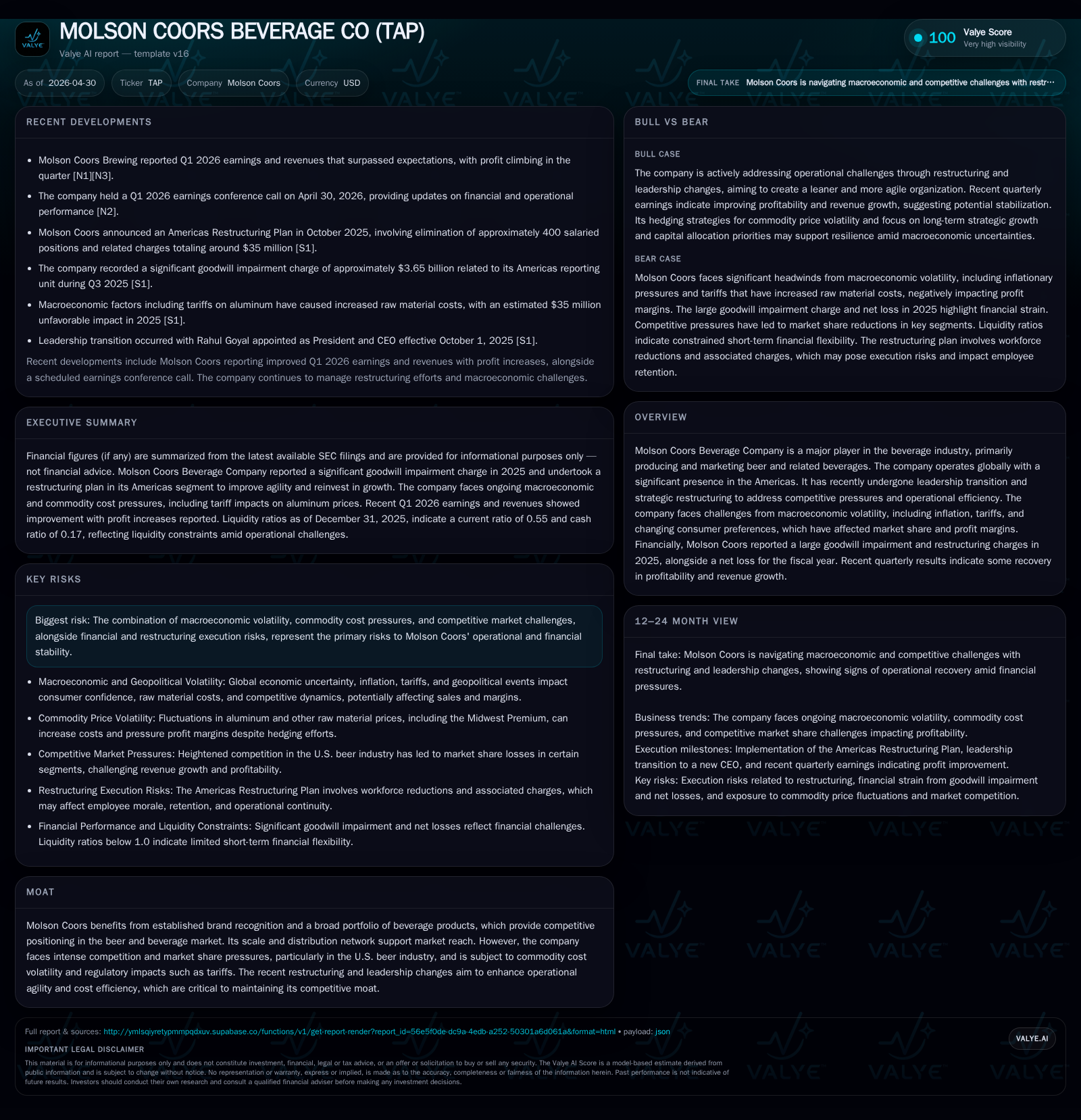
Molson Coors’ latest quarterly filing reveals initial signs of operating recovery driven by execution of its October 2025 Americas Restructuring Plan aimed at improving cost efficiency and agility. Despite lingering headwinds including elevated raw material costs linked to tariffs and intense U.S. beer market competition, management reports improved shipment volumes, pricing discipline, and margin restoration in Q1 2026. The company’s multi-brand portfolio and scale in beverage distribution underpin resilience but macroeconomic volatility and structural shifts in consumer preferences pose ongoing challenges. Key near-term focus areas include completing restructuring cost reductions, managing commodity inflation impacts, and sustaining premiumization trends to drive growth beyond volume pressures.
2026 First Quarter Operating Highlights: Signs of Recovery
Molson Coors’ first quarter filing for the period ending March 31, 2026 [S2] reveals a cautiously optimistic operating performance reflecting early benefits from its Americas Restructuring Plan initiated in late 2025. Management commentary emphasizes improving shipment volumes compared to recent quarters and successful price realization strategies helping to partially offset the impact of inflationary pressures and tariff-driven commodity cost spikes such as the Midwest Premium aluminum surcharge.
Despite industry-wide demand softness exacerbated by constrained consumer disposable incomes, especially in key U.S. markets, profitability improved significantly from the prior year which was burdened by a sizable goodwill impairment charge recognized in mid-2025 [S1]. The company reports executing strategic priorities to enhance operational efficiency via targeted workforce reductions, streamlining SG&A expenses, and shifting resources toward higher-margin product categories.
This early recovery phase underscores management’s view that while structural challenges persist, the combination of disciplined cost management alongside selective pricing initiatives is helping stem margin erosion during volatile macroeconomic conditions [S2]. Recent earnings beats reported by external sources [N1,N13] confirm that these operational adjustments have produced tangible quarterly gains.
Business Model Dynamics: Brand Portfolio and Product Quality
Molson Coors operates with a diversified brand portfolio encompassing mainstream lagers, craft beers, imports, hard seltzers, and other non-beer beverages—a deliberate strategy designed to capture multiple consumer segments amidst shifting preferences [S1]. This multi-tier framework supports premiumization efforts where more consumers opt for specialty or higher-quality brews commanding stronger unit economics.
The company leverages well-known heritage brands combined with innovation platforms targeting emerging trends such as low-calorie alcoholic beverages and flavored malt drinks. These offerings differentiate their unit economics from commoditized products sensitive to price competition.
Geographically anchored primarily in the Americas, Molson Coors capitalizes on extensive distribution networks that enable broad retail access while supporting customer loyalty through consistent product quality and brand marketing investments [S1]. However, the challenge remains in balancing volume declines in traditional beer segments with growth opportunities presented by these newer beverage categories.
Competitive Environment and Industry Pressures
The U.S. beer market continues to face intense competition from established rivals as well as craft brewers gaining regional traction. Additionally, imported beers expand their footprint competing on both premium appeal and taste differentiation [S1,S2]. This competitive environment has contributed to market share erosion for Molson Coors’ core products despite its scale advantages.
Tariff-induced raw material cost inflation—particularly the Midwest Premium on aluminum—has squeezed margins substantially. While some cost increases have been passed through to consumers via pricing actions, limited consumer willingness amid constrained disposable income caps pass-through potential without affecting unit sales volumes adversely [S1]. Hedging strategies for commodity prices are challenged by illiquid markets further complicating cost control.
These dynamics demand continued agility in pricing strategy and operational efficiencies to maintain competitiveness while protecting profitability.
Americas Restructuring Plan: Strategy and Execution
Announced in October 2025 [S4,S5], the Americas Restructuring Plan is a cornerstone initiative designed to create a leaner organizational structure by cutting approximately 400 salaried positions (about 9% of the Americas salaried workforce). The plan aims to reduce overhead costs substantially while redeploying capital toward strategic growth investments.
Total expected restructuring charges are refined toward the low end of initial estimates at around $35 million primarily reflecting severance payments incurred mostly during late 2025 [S1,S6]. Further employee-related charges related to this plan are anticipated through calendar 2026 as phased workforce reductions conclude.
Management expects meaningful SG&A expense savings over time stemming from this realignment which boosts overall productivity metrics. These cost savings provide critical runway for increased investment behind innovation pipelines and elevated marketing support necessary for premium product expansion [S2]. The execution progress reported in Q1 filings confirms steady advancement but highlights ongoing risks related to timely delivery of targeted savings.
Growth Catalysts: Innovation, Pricing Power, and Market Expansion
Molson Coors’ growth strategy hinges on penetrating higher-margin beverage segments that tap into evolving consumer preferences favoring premiumization and variety [S1]. Innovation across product lines—such as expansions into hard seltzers or craft-style brews—complements its established brand equity while potentially attracting new customer cohorts.
Price realization efforts accompany these initiatives by extracting greater value per unit sold where brand loyalty allows. This approach partially offsets volume softness observed in commodity lagers due to demographic shifts away from traditional beer consumption patterns.
Internationally, emerging markets within Americas present incremental opportunities supported by scaled distribution capabilities. Although growth here is gradual given global economic uncertainties, it offers diversification beyond mature North American beer segments.
Risks and Constraints: Cost Inflation, Market Share, and Macro Factors
Key risks remain centered on commodity cost volatility exacerbated by tariffs driving sustained Midwest Premium aluminum surcharges estimated at an adverse $35 million impact for fiscal 2025 [S1]. The opacity of this surcharge’s pricing dynamics complicates effective hedging measures increasing exposure to input cost spikes.
Competitive intensity threatens volume retention amid rising consumer preference fragmentation between large-scale brands versus niche craft imports. Limited discretionary spending power tightens acceptable price increase thresholds risking market share if passes appear excessive.
Execution risks attached to the Americas restructuring include potential employee attrition beyond planned reductions or delays that could inflate expense expectations beyond current guidance. Geopolitical uncertainties affecting trade policies add an additional layer of unpredictability influencing supply chain costs or currency fluctuations impacting international sales.
Key Near-Term Milestones and Execution Risks
Upcoming critical milestones revolve around fully realizing restructuring savings projected through calendar year 2026 as remaining severance payments complete [S2]. Monitoring sequential shipment performance trends will provide insights into whether volume improvements observed early in Q1 sustain through subsequent quarters amid competitive headwinds.
Management plans ongoing evaluation of capital allocation strategies factoring cash flow generation post-restructuring including dividend policy recalibrations or share repurchase activity authorized up to $4 billion [S9]. Commodity input costs trajectory remains under close scrutiny given past disruptions linked to tariff effects.
These inflection points collectively shape visibility into Molson Coors’ ability to translate operational changes into durable earnings recovery.
Latest Financial Snapshot: Liquidity, Leverage, and Profitability
Latest financial snapshot
| Metric | Value | Period |
|---|---|---|
| Cash & equivalents | $897mm | |
| 2025-12-31 | ||
| Current assets | $2.9bn | |
| 2025-12-31 | ||
| Current liabilities | $5.3bn | |
| 2025-12-31 | ||
| Current ratio | 0.55x | |
| 2025-12-31 |
Source: SEC companyfacts cache [F1].
Molson Coors entered fiscal year-end December 31, 2025 with cash & equivalents totaling approximately $896.5 million juxtaposed against total debt near $11.37 billion resulting in a current ratio of about 0.55 indicating tight but manageable liquidity levels [F1]. Net income for the full year recorded a loss of roughly $2.14 billion heavily influenced by the substantial goodwill impairment recognized during Q3 2025 related to the Americas segment [F1,S1].
The considerable leverage position underscores sensitivity to rising interest rates or any funded capital expenditures connected with restructuring efforts or innovation investments. However, management asserts sufficient capital resources exist supporting near-term working capital needs plus strategic reinvestments stemming from ongoing restructuring benefits [S2].
Molson Coors faces a pivotal juncture marked by deliberate structural reforms addressing inefficiencies alongside volatile market forces challenging traditional beverage consumption trends. Success hinges on robust execution of its leaner Americas operating model combined with capitalizing on premiumization dynamics across its diverse product portfolio while contending with ongoing inflationary pressures inherent within raw material markets.
This analysis is based solely on publicly available SEC filings dated through April 30, 2026 ([S1], [S2], [S3]), corroborated financial data ([F1]), and relevant news articles ([N1], [N13]). It does not constitute investment advice.
Disclaimer: This is research-only, informational analysis and not investment advice. It may include AI-generated interpretation and general industry context. Always verify important details using primary sources.

Comments