
BGC Group Simplifies Corporate Structure to Drive Sustainable Brokerage Growth
Transitioning to a full C-Corporation and emphasizing green economy brokerage positions BGC for streamlined operations and expansion.
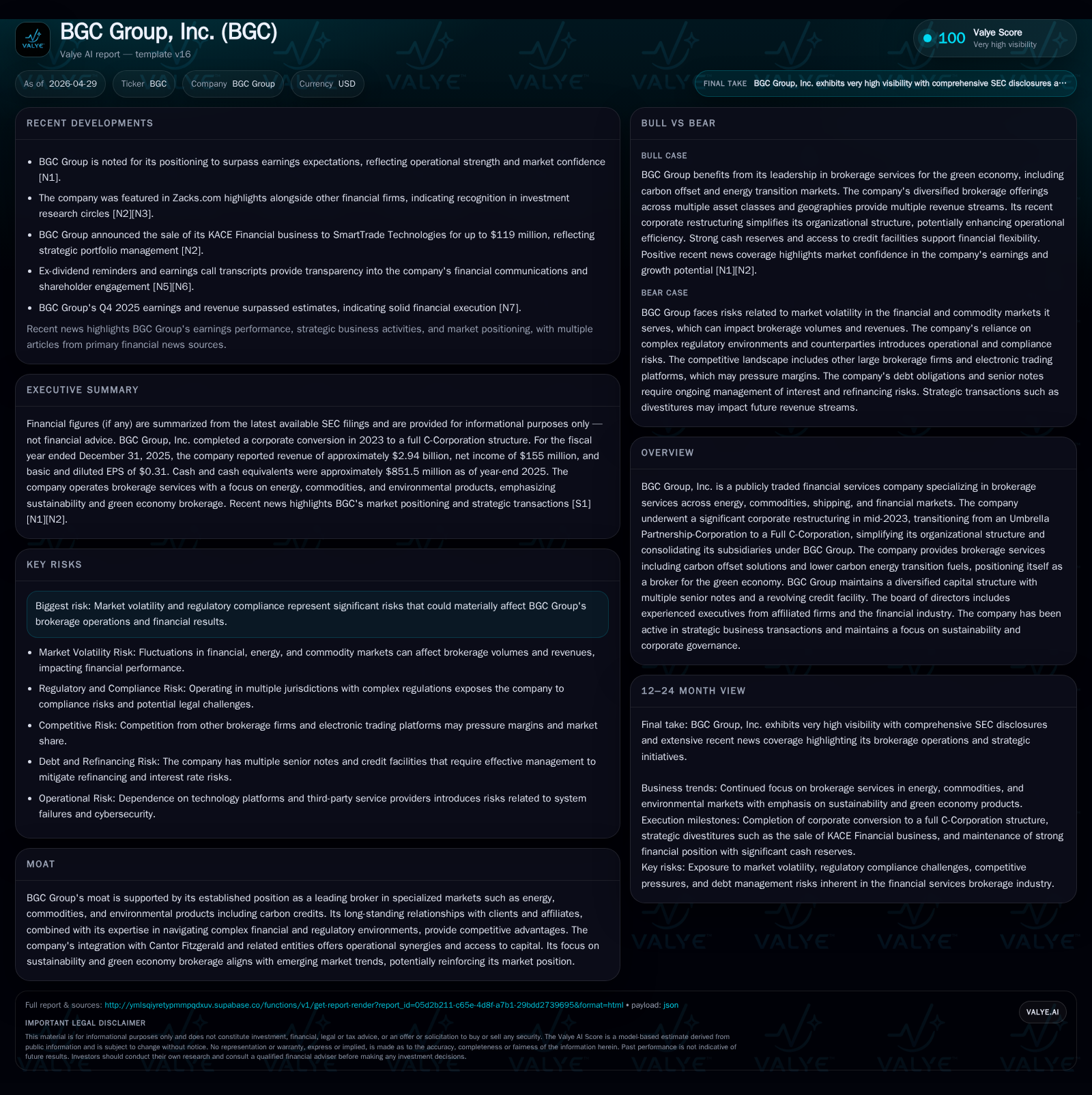
In its latest quarterly (2025-11-10 10-Q) and recent event filings, BGC Group detailed the completion of a corporate conversion from an Umbrella Partnership-Corporation to a full C-Corporation. This restructuring simplifies its organizational architecture, consolidating subsidiaries and enhancing operational efficiency. BGC continues to leverage its brokerage expertise across energy, commodities, and emerging sustainability-linked products such as carbon offsets. Electronic trading platforms under the Fenics brand complement its voice brokerage, supporting scalable growth. Key growth factors include rising regulatory demand for green economy products and digital innovation, while risks remain around market volatility and regulatory compliance. The company maintains a robust liquidity profile with over $850 million in cash against $1.54 billion debt as of year-end 2025, underpinning financial flexibility.
Latest Operating Developments Emphasizing Corporate Conversion
BGC Group's November 10, 2025 10-Q filing [S2] marks a pivotal update by detailing the operational aftermath of its mid-2023 corporate conversion. The company transitioned from a convoluted Umbrella Partnership-Corporation (Up-C) structure into a streamlined full C-Corporation effective July 1, 2023 [S2]. This conversion merged BGC Partners and BGC Holdings wholly under BGC Group’s umbrella [S2], simplifying governance and capital allocation frameworks.
Such structural consolidation reduces administrative friction inherent in layered partnerships, potentially accelerating decision-making processes crucial in fast-moving brokerage markets. It also facilitates clearer capital market access owing to uniform equity securities issuance directly under BGC Group [S1]. The March 26, 2026 8-K event filing [S3] highlights updated business outlooks post-conversion, indicating management confidence in the operational synergies realized.
Business Model Foundations: Brokerage Services across Diverse Markets
BGC monetizes through commissions and fees derived from brokering transactions across energy, commodities, shipping, financial rates, foreign exchange markets, alongside burgeoning segments like environmental products [S1]. Its product breadth includes traditional energy futures and forwards as well as carbon offset credits and lower carbon transition fuels reflecting sustainability trends [S1].
Revenue generation depends heavily on transaction volumes executed by brokers who operate via voice or hybrid systems complemented by Fenics electronic platforms providing fully electronic marketplace infrastructure [S2]. Clients pay brokerage commissions effected through negotiated contracts; sustained volume levels alongside expanding green product offerings promise to drive top-line growth.
Specialized expertise in navigating complex commodities regulations creates switching costs for clients reliant on BGC’s market intelligence and compliance support [S1]. Moreover, longstanding client relationships underpin retention amid competitive pressures.
Competitive Environment and Industry Position Within Financial Brokerage
BGC's moat centers on deep specialization in niche financial brokerage verticals including energy and environmental assets combined with strong affiliations with Cantor Fitzgerald group entities—yielding operational synergies and capital access advantages [S1]. Fenics’ suite of electronic trading venues enhances client execution quality via low-latency connectivity and advanced analytics services [S2].
Pricing power is modestly constrained by industry-standard commission frameworks but bolstered where exclusive product brokering exists—particularly for emergent sustainability-linked assets. Broader industry competitors like MarketAxess provide related venues but less entrenched in environmental commodity niches [S2].
BGC extends value beyond pure brokerage through post-trade services including compression techniques reducing counterparty risk exposures—a significant differentiator in derivatives-heavy trading environments [S2]. These ancillary services create modest margin expansion opportunities complementing core commission income.
Growth Drivers Anchored in Sustainability and Market Innovation
The shift toward decarbonization globally drives structural growth potential for BGC’s green economy brokerage channels such as carbon credits brokering and low-carbon fuel contracts [S1]. Heightened regulation via frameworks like the EU's MiFID II mandates transparent market intermediaries which underpin demand for compliant brokers experienced in environmental markets [S2].
Fenics’ technology-driven fully electronic platforms offer scalability benefits facilitating rapid onboarding of new products while reducing dependence on costly voice broker operations [S2]. Adoption of these platforms indicates evolving customer preferences toward digital executions enhancing operating leverage.
Further growth catalysts include strategic acquisitions like Open Energy Group enhancing renewable project origination capabilities [S1] plus continuous investments in proprietary analytics improving client decision-making.
Key Risks and Constraints: Volatility, Regulation, and Market Dynamics
Market volatility remains a double-edged sword—spurting episodic trading volume increases but also imposing inconsistent revenue patterns that challenge forecasting accuracy [S1][N1]. Regulatory compliance demands heighten costs particularly across jurisdictions adhering to stringent directives such as MiFID II affecting European operations [S2].
Technology platform reliance exposes operational risks around system uptime and cybersecurity breaches which could impair market reputation or trigger client losses if disruptions occur [S1]. Additionally, competition from other global brokers applies pressure on prices despite differentiated product offerings.
Management’s enterprise risk management program launched post-conversion addresses these multifaceted risks via integrated oversight frameworks encompassing cyber risks, regulatory compliance diligence, credit controls, and reputational safeguards [S1].
Forward-looking Indicators and Upcoming Milestones
Monitoring near-term guidance updates provided in the March 26, 2026 8-K event filing press release offers insight into Q1 2026 trajectory with special attention to sustainable product volume growth trends [S3]. Execution progress on technology platform rollouts impacting Fenics electronic marketplaces will serve as KPIs for efficiency improvements.
Client acquisition rates within green commodities sectors may yield forward visibility into revenue normalization post-volatility spikes witnessed historically. Additionally, attention to financing metrics tied to the unsecured revolving credit facility expiring April 26, 2027 provides cues on capital markets strategy given shelf registration expiration noted in recent filings [S4][S2].
Financial Snapshot: Liquidity Profile and Capital Structure
Latest financial snapshot
| Metric | Value | Period |
|---|---|---|
| Cash & equivalents | $852mm | |
| 2025-12-31 | ||
| Total debt | $1538mm | |
| 2025-12-31 | ||
| Net debt | $687mm | |
| 2025-12-31 |
Source: SEC companyfacts cache [F1].
| Metric | Amount (USD) | Period End |
|---|---|---|
| Cash & Equivalents | $851.5M | Dec 31, 2025 |
| Total Debt | $1.54B | Dec 31, 2025 |
| Net Debt | $687M | Dec 31, 2025 |
BGC ended fiscal year 2025 with a solid liquidity cushion totaling approximately $851.5 million in cash & equivalents against $1.54 billion total debt resulting in net debt near $687 million [F1]. This capital position provides ample flexibility to fund ongoing strategic initiatives including technology investments while maintaining manageable leverage ratios.
The unsecured senior revolving credit facility with maturity set for April 26, 2027 supports short-to-medium term financing needs offering adjustable borrowing capacity up to $700 million at SOFR-based interest rates plus spreads [S4]. Prudent balance sheet management post-corporate conversion reflects the company’s intention to sustain financial strength congruent with growth ambitions.
This report is based solely on publicly available SEC filings dated up to April 28, 2026 () and companyfacts data as of December 31, 2025 ([F1]). No investment advice or forward-looking guarantees are expressed herein.
Disclaimer: This is research-only, informational analysis and not investment advice. It may include AI-generated interpretation and general industry context. Always verify important details using primary sources.

Comments