
EMCOR Group Extends Growth Trajectory with Record Q1 Results and Strategic Acquisitions
EMCOR's Q1 2026 results demonstrate robust revenue expansion and margin gains driven by acquisition integration and operational efficiencies across diversified specialty contracting segments.
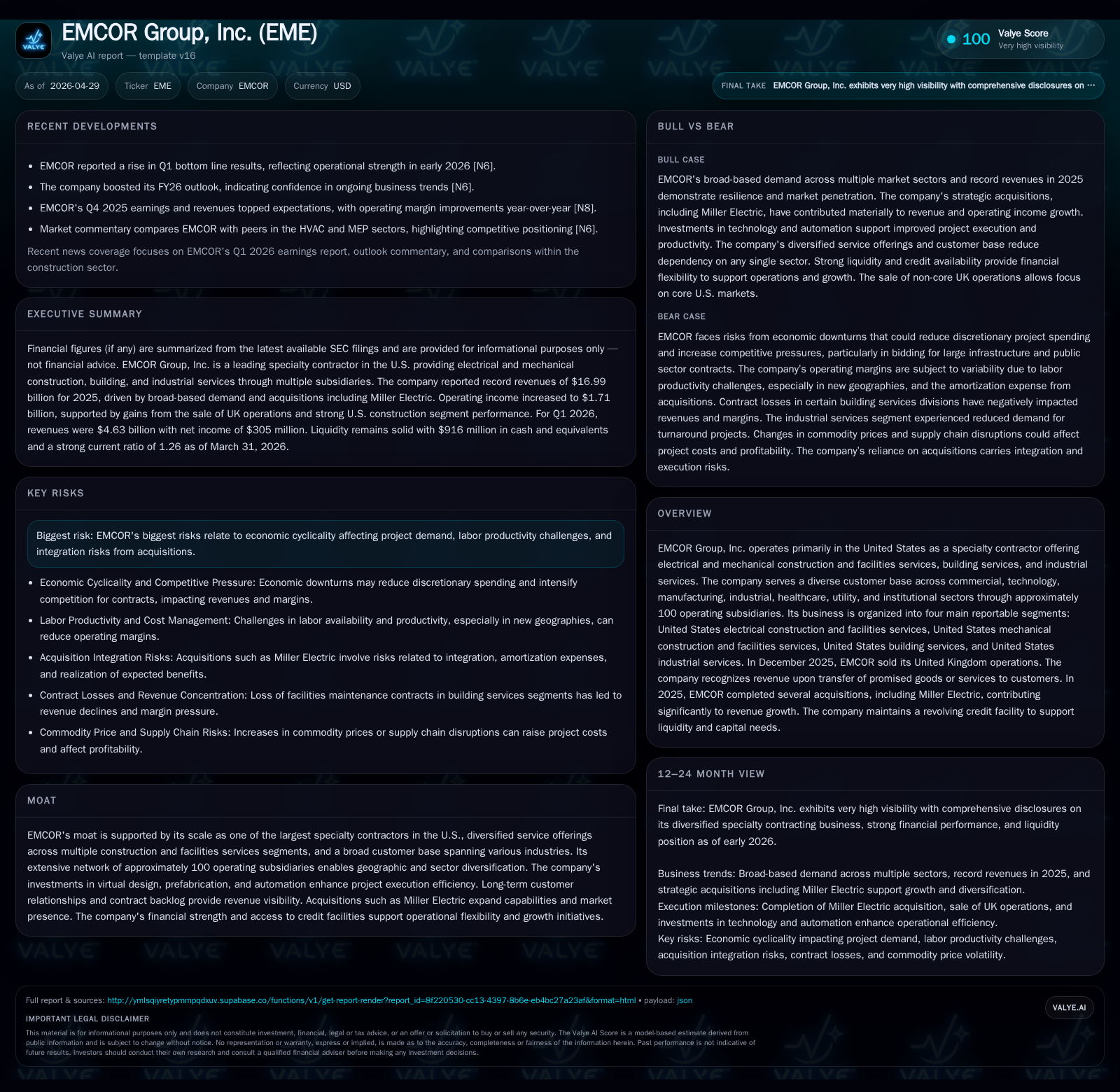
In Q1 2026, EMCOR reported a continuation of its growth momentum with record revenue scale reflecting an annualized pace exceeding $16.9 billion, supported notably by the Miller Electric acquisition completed in early 2025. Net income increased significantly to $305 million alongside operational margin expansion fueled by efficiencies in electrical and mechanical construction services. The company’s strong balance sheet, featuring $916 million in cash and negligible debt, underpins its financial flexibility for future acquisitions and organic growth investments. EMCOR’s diversified service platform and geographic reach position it well to capitalize on resilient demand across commercial, industrial, and institutional sectors even as macroeconomic cyclicality remains a watchpoint.
Latest Quarterly Operating Update: Scaling Revenue and Earnings
EMCOR Group’s first quarter of fiscal 2026 continued the company’s trajectory of robust growth that was set in the prior year. Per the April 29, 2026 Form 10-Q filing [S2], EMCOR delivered a net income of $305.5 million for the quarter ended March 31, 2026, outpacing the prior year quarter: this reflects operational leverage benefits alongside acquisition-related contributions. Cash and cash equivalents stood at a significant $916 million at quarter-end [F1], while the company maintained a remarkably low total debt position (around $2.8 million as of end-2023 but effectively zero term borrowings as documented in the latest filing), endorsing a very strong liquidity profile [S2][F1]. This liquidity cushion undergirds strategic freedom to capitalize on further acquisitions or invest organically.
Revenues are disclosed on an annualized basis at just under $17 billion per year pace given recent performance [F1], demonstrating continuing double-digit top-line momentum following a full-year 2025 increase of approximately 16.6% aided by acquisition integration notably including Miller Electric acquired early in 2025 with upfront cash consideration exceeding $875 million [S1]. This bolt-on has materially enhanced EMCOR's electrical construction capabilities and broadened geographic coverage.
The operating environment shows cross-segment strength with heightened demand especially in technology-driven data centers, educational institutions within the institutional segment, renewable energy facilities within industrial services (though that segment saw modest revenue decline last year), as well as complex commercial projects reflecting warehousing/distribution center construction activity [S1]. The company has simultaneous exposure to cyclical infrastructure spending patterns balanced by recurring maintenance contracts which provide steadier cash flow.
Business Model and Service Offering Quality: Driving Value Across Four Segments
EMCOR’s business model is anchored around specialty contracting and facilities services segmented into four principal units: United States electrical construction & facilities services; United States mechanical construction & facilities services; United States building services; and United States industrial services [S1]. This diversified scope offers revenue balance across project types and customer industries ranging from commercial real estate developers to medical institutions, manufacturing plants to utilities.
Revenue recognition follows transfer of promised goods or services with careful allowance for credit losses reflecting robust receivables management practices amidst broad customer diversity [S2]. The company's ~100 operating subsidiaries function semi-autonomously but benefit from centralized best practices including significant investment in virtual design technologies (enabling precise project visualization pre-construction), prefabrication facilities (which shorten onsite durations), and automation tools enhancing installation quality consistency while lowering labor intensity wherever feasible [S1]. These factors collectively contribute to improved gross margins sustained in recent periods (19.3% gross profit margin for full year 2025 vs. 19% prior year) despite inflationary cost pressures.
Long-term relationships with customers through recurring building maintenance contracts also create switching costs that support stable revenue streams despite competitive tendering environments. Contract backlog visibility further reinforces near-term revenue confidence.
Competitive Position and Industry Structure: Leveraging Scale in Specialty Contracting
EMCOR holds a formidable competitive moat stemming from its large scale—one of the largest specialty contractors nationally—broad industry exposure spanning approximately one hundred subsidiaries delivering localized service plus sector-tailored expertise [S1]. This decentralized yet coordinated footprint facilitates geographic risk diversification mitigating localized downturns.
The broader specialty contracting industry contends with cyclical swings driven primarily by corporate capital expenditure budgets and public infrastructure allocations. Margins can be pressured when input prices spike or when skilled labor shortages intensify wage inflation. EMCOR navigates these via operational discipline enabled by digital project controls promoting leaner site management.
Competitors range from multi-national general contractors offering integrated construction solutions to regional niche specialists focused on single trades or market segments. EMCOR’s ability to bundle multiple disciplines—electrical plus mechanical plus facilities maintenance—yields higher switching costs for clients valuing single-provider solutions reducing coordination complexity.
Moreover, the company faces ongoing challenges related to labor market constraints within skilled trades fields especially electricians and pipefitters where training pipelines have not fully rebounded post-pandemic. This context heightens bidding competition but EMI's scale helps sustain pricing power through value-based contract proposals emphasizing quality delivery metrics.
Growth Drivers: Acquisitions, Technology Adoption, and Market Diversification
Acquisition strategy remains central to EMCOR’s growth blueprint: With Miller Electric representing a material strategic milestone anchoring expanded electrical contracting capabilities while nine additional smaller acquisitions during 2025 added incremental revenues totaling over $180 million upfront consideration invested [S1]. Notably, incremental acquisition contribution outpaced associated amortization expenses on identifiable intangibles indicating overall accretive impact on profit margins for the year ending December 2025.
Technological integration such as virtual design enables early clash detection reducing costly rework while prefabrication accelerates project schedules—both factors improving throughput capacity without commensurate labor scaling requirements thus supporting margin resilience despite input cost volatility.
Market expansion is further propelled by selective exit from non-core geographies exemplified by December 2025 sale of United Kingdom operations allowing sharper US focus which attracts more sizeable infrastructure projects in energy transition areas such as renewable power facility construction within industrial services segment [S1].
Penetration into higher-margin service niches such as advanced energy-efficient HVAC systems within building services complements traditional mechanical contracting revenues enabling cross-selling synergies among segments.
Risks and Constraints: Economic Cyclicality, Labor Productivity, and Acquisition Integration
Despite structural growth tailwinds, EMCOR faces risks principally related to economic downturns which can suppress industrial capital spending thereby contracting project pipelines impacting all construction segments though partially offset via contractual fixed price maintenance agreements which have less volatility but limited upside pricing power).
Labor productivity challenges loom large as substitution effects are limited; wage inflation pressures operate counteracting automation gains requiring careful workforce planning while maintaining safety records critical to reputation [S1].
Integration risks remain given acquisition volumes; culture alignment disruptions or operational overlaps could impede realization of anticipated cost synergies or prolong amortization drag if asset impairment triggers arise absent projected growth acceleration.
Credit loss estimation remains a judgmental area especially amid macroeconomic uncertainty potentially affecting customers’ payment timeliness decreasing short-term liquidity if not prudently managed [S2].
Outlook and Key Milestones: Guidance Upgrades and Execution Watchpoints
Recent news reports indicate EMCOR raised its full-year fiscal 2026 guidance supported by early bookings confirming backlog expansions particularly in commercial real estate development segments along with data center-related network communications contracts vital to technology sector clientele [N8][S3]. Ongoing integration progress of Miller Electric will be key execution metrics monitored closely alongside new contract award announcements which act as leading indicators for sustained revenue run-rate enhancement.
The Board’s decision to raise quarterly dividends commencing January 2026 manifests confidence in sustained cash flow generation providing stable shareholder returns balance against capital reinvestment priorities [S12][N8].
Investors should track quarterly differential between acquisition-related amortization versus incremental revenues generated plus maintenance contract renewal rates to appraise operating leverage trajectory. Quarterly backlog disclosures remain pivotal demand markers.
Current Financial Profile: Liquidity, Leverage, and Cash Flow Snapshot
Latest financial snapshot
| Metric | Value | Period |
|---|---|---|
| Cash & equivalents | $916mm | |
| 2026-03-31 | ||
| Current assets | $6.1bn | |
| 2026-03-31 | ||
| Current liabilities | $4.8bn | |
| 2026-03-31 | ||
| Current ratio | 1.26x | |
| 2026-03-31 |
Source: SEC companyfacts cache [F1].
At quarter end March 31, 2026, EMCOR held cash & equivalents at an ample $916 million balanced against minimal direct debt obligations effectively rendering it a net cash entity ($916M cash minus approximately $2.8M legacy debt) yielding ample liquidity headroom for working capital funding or opportunistic acquisitions without reliance on external financing sources at present [F1][S2][S13].
The company operates under a revolving credit facility capped at $1.3 billion expiring in late 2028 providing contingent liquidity availability with no outstanding borrowings but letters of credit usage amounting close to $73 million slightly constraining but still leaving substantial unused capacity under this facility which carries flexible borrowing rates tied to base prime or adjusted SOFR plus leverage ratio-dependent margins ranging between low teens basis points up to sub-2% premiums consistent with prudent cost of capital management practices [S2][S14][S25].
A current ratio of approximately 1.26 evidences sufficient working capital coverage underscoring comfortable short-term liquidity buffer for payables maturity matching receivables collection cycles typical within the industry segment dynamics where upfront billing is common especially for long-duration fixed price contracts requiring progressive payments ahead of expenditures on large-scale projects.[F1]
Disclaimer
This analysis is presented solely for informational purposes based on publicly available SEC filings and related disclosures as of April 29, 2026. It does not constitute investment advice or recommendations regarding any securities discussed herein.
Disclaimer: This is research-only, informational analysis and not investment advice. It may include AI-generated interpretation and general industry context. Always verify important details using primary sources.

Comments