
Omega Healthcare Investors Advances Strategic Portfolio with New Acquisitions and RIDEA Expansion
OHI's recent quarter demonstrates proactive portfolio growth via reverse 1031 exchanges and an expanding RIDEA operating model amid Genesis Healthcare bankruptcy dynamics.
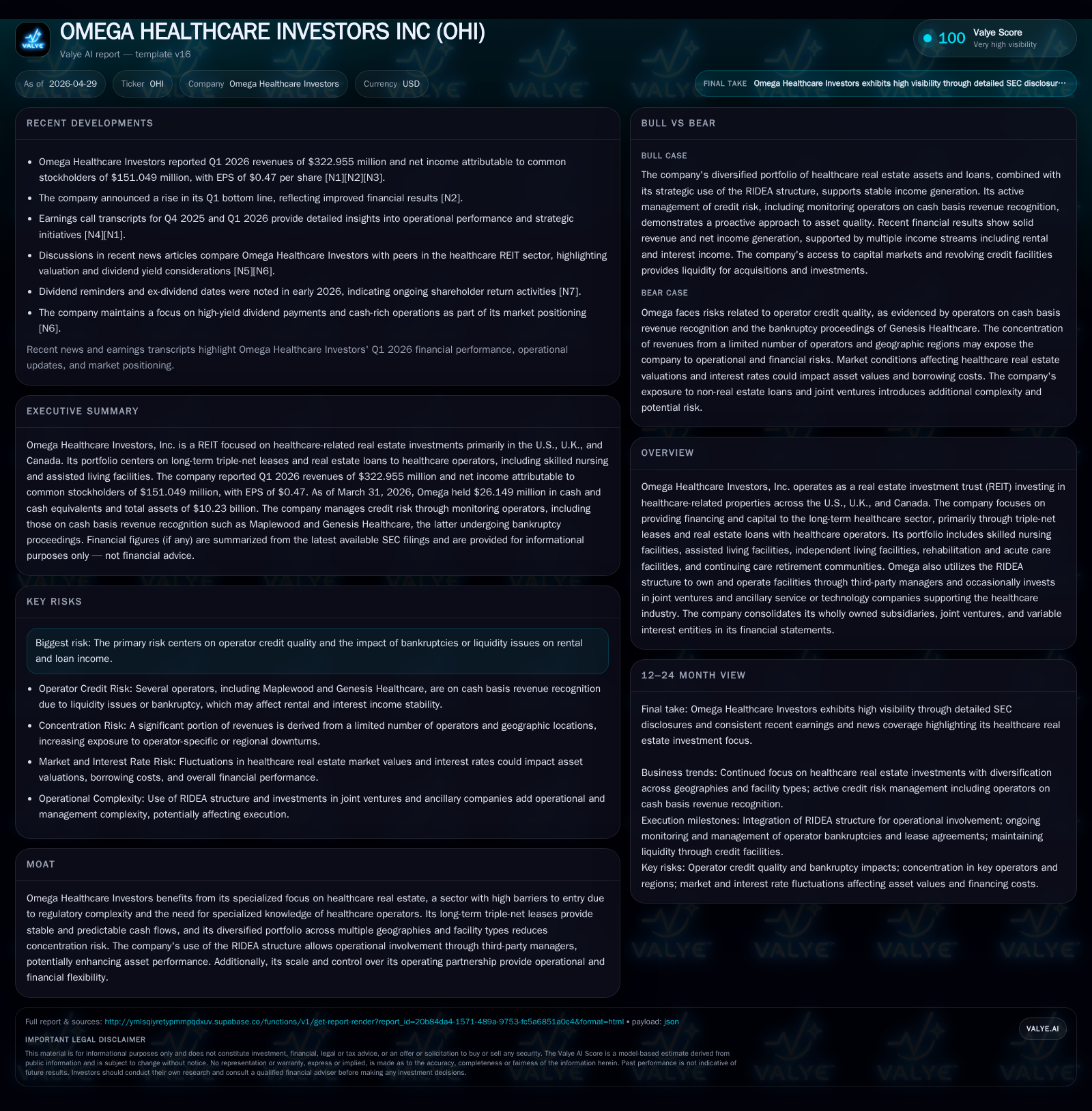
In Q1 2026, Omega Healthcare Investors acquired 13 facilities leveraging reverse like-kind exchanges, enhancing its healthcare real estate portfolio. Despite ongoing challenges related to Genesis Healthcare's debtor-in-possession status affecting lease income predictability, OHI maintains steady cash flow supported by triple-net leases and diversified asset types. The company’s strategic use of the RIDEA structure to own and operate facilities through third-party managers signals operational innovation aiming at portfolio performance enhancement. Key risks remain operator credit quality and contingent impacts on rental revenues, warranting close monitoring.
Recent Quarterly Operating Highlights
Omega Healthcare Investors' Q1 2026 filing reveals active portfolio enhancement through the acquisition of 13 healthcare facilities executed via a reverse like-kind exchange under Section 1031 of the Tax Code. This transaction methodology enables tax deferral benefits while expanding real estate holdings principally composed of skilled nursing and assisted living properties [S2]. Concurrently, Omega faces ongoing income stream uncertainties linked to Genesis Healthcare, an operator currently in Chapter 11 bankruptcy proceedings since July 2025. Genesis's debtor-in-possession (DIP) status permits continued occupancy of 31 leased facilities under a master lease agreement; however, rent payment irregularities necessitate diligent credit risk management from Omega's side. The first quarter reported increased contractual receivables—net at $12.67 million compared to $9.72 million a year earlier—alongside significant straight-line rent receivables totaling $279.47 million, reflecting scheduled rent revenues including lease escalations [S2].
Management has not flagged material revisions in collectibility assumptions this quarter but underscores ongoing scrutiny especially vis-à-vis distressed tenants. These dynamics collectively inform near-term cash flow stability considerations while corroborating the thematic importance of tenant credit quality in Omega’s business model.
Business Model and Portfolio Composition
Omega operates as a specialized healthcare-focused REIT that capitalizes on long-life healthcare real estate assets primarily leased under triple-net agreements to long-term care operators. These triple-net leases transfer most operating expenses such as property taxes, insurance, and maintenance back to tenants, stabilizing Omega’s net rental income streams [S1]. The property mix is notably diversified: over 550 skilled nursing facilities (SNFs), roughly 340 assisted living facilities (ALFs), about 19 independent living facilities (ILFs), alongside specialty hospitals and continuing care retirement communities (CCRCs) spread across key U.S., U.K., and Canadian markets [S2][S1].
Beyond passive landlord leasing roles, Omega deploys the RIDEA (Real Estate Investment Diversified Expansion Act) structure for certain assets where it owns facilities but contracts third-party operators for daily management. This hybrid ownership-operational engagement extends potential upside via enhanced asset-level control while retaining stable cash yield profiles. This dual model blends pure triple-net leasing with operational participation that can improve performance metrics.
Revenue generation hinges on contracted rents supplemented by interest income from loans extended to healthcare operators, plus variable reimbursements such as real estate tax pass-throughs. Customer retention rests heavily on maintaining strong operator relationships given specialized facility usage patterns and regulatory compliance demands.
Healthcare Real Estate Industry Dynamics and Competitive Positioning
Omega's niche within healthcare REITs benefits from high entry barriers created by regulatory complexity inherent in long-term care sectors and operator-credit assessment requirements. Skilled nursing facility demand exhibits structural drivers linked to aging populations but faces cyclical pressure points from reimbursement rate changes and policy shifts impacting operators’ financial health.
Competitive advantages accrue from scale—Omega’s broad geographic footprint reduces concentration risk—and operational sophistication enabled by integrated RIDEA strategies allowing more nuanced asset management than typical triple-net lease REITs. Pricing power remains moderate due to market competition coupled with tenant financial constraints; however, long-dated leases provide revenue visibility often absent in other real estate subsegments.
Operators’ creditworthiness is pivotal; bankruptcies like Genesis induce volatility in rent collections influencing liquidity profiles temporarily until leases are restructured or replaced. Regulatory oversight also affects supply-demand balances especially between SNF availability versus assisted living expansions responding to demographic trends.
Growth Drivers: Acquisition Strategy and RIDEA Model Opportunities
Key growth leverages center on acquiring assets through financially astute mechanisms such as reverse like-kind exchanges facilitating deferred tax obligations while augmenting core holdings [S2]. The recent purchase of 13 facilities exemplifies proactive capital deployment targeting accretive properties aligned with strategic diversification.
Simultaneously, scaling the RIDEA ownership-operate model offers avenues for margin enhancements by capitalizing on third-party manager expertise paired with deeper asset stewardship beyond traditional landlord roles [S1][S2]. This hybrid approach can generate incremental income streams through joint ventures or ancillary service investments backing primary healthcare operations.
Synergies arise from increased operational oversight enabling accelerated responses to tenant issues, improved property performance metrics, and tailored reinvestment strategies optimizing long-term value creation within the regulatory framework governing healthcare assets.
Risks: Operator Credit Quality and Market Headwinds
Foremost among risks is operator credit deterioration exemplified starkly by Genesis Healthcare’s Chapter 11 proceedings precipitating missed rent payments and elevated receivable write-offs risks [S2][S1]. Such events underscore sectoral vulnerability whereby concentrated leases expose Omega’s earnings if operators’ liquidity crises deepen or lease terms fail renegotiation.
Regulatory uncertainty concerning reimbursement schedules for Medicare/Medicaid programs influence tenant revenues directly impacting their ability to honor lease obligations. Volatility in these external factors compounds inherent cyclicality within demand for certain facility types, particularly skilled nursing beds amid shifting care preferences towards home health or assisted living options.
Receivables provisioning adjustments highlight ongoing sensitivity as management curtails downside impact via prudent loss allowances reflecting updated collection realities especially from high-risk tenants [S2]. Continued diligence here is essential given close linkage between tenant financial health and rental income sustainability.
Near-Term Monitoring: Key Milestones and Earnings Guidance
Stakeholders should closely monitor prospective updates on Genesis Healthcare’s restructuring outcomes which will materially affect lease income recovery trajectories. Additionally, integration progress for recently acquired properties through reverse exchange mechanisms serves as a marker for execution capability around accretive growth objectives.
Watching quarterly lease renewal rates, potential facility dispositions or further opportunistic acquisitions will provide insights into portfolio resilience amid evolving market conditions [N1][N4][S3]. Management commentary during upcoming earnings disclosures around dividend payout sustainability amidst tenant credit fluctuations should be noted carefully for signals regarding cash flow robustness.
Finally, disclosures regarding RIDEA expansion plans or new joint ventures will indicate strategic momentum toward diversifying revenue beyond conventional rent collection.
Financial Snapshot: Balance Sheet Strength and Receivables Quality
Latest financial snapshot
| Metric | Value | Period |
|---|---|---|
| Cash & equivalents | $26mm | |
| 2026-03-31 | ||
| Total debt | $4.26bn | |
| 2025-12-31 | ||
| Net debt | $4.23bn | |
| 2025-12-31 |
Source: SEC companyfacts cache [F1].
| Metric | Value (USD) | Period End |
|---|---|---|
| Cash & Equivalents | $26.15 million | March 31, 2026 |
| Total Debt | $4.26 billion | December 31, 2025 |
| Net Debt | $4.23 billion | December 31, 2025 |
| Contractual Receivables - Net | $12.67 million | March 31, 2026 |
| Straight-line Receivables | $279.47 million | March 31, 2026 |
Liquidity remains adequate with nearly $26 million cash equivalents at quarter-end supporting working capital needs amid a sizable debt load approximating $4.26 billion primarily fixed-rate unsecured notes maturing mostly beyond the medium term [F1][S2]. Contractual receivables have grown moderately reflecting increased leasing activity despite some operator payment delays associated with credit stresses. Straight-line receivables capture future scheduled rents including escalations providing visibility albeit subject to ultimate collectibility depending on tenant circumstances.
Disclaimer: This analysis is based solely on publicly available SEC filings and company disclosures as of April 29, 2026, without conjecture or forward-looking investment recommendations.
Disclaimer: This is research-only, informational analysis and not investment advice. It may include AI-generated interpretation and general industry context. Always verify important details using primary sources.

Comments