
Generation Essentials Group's Strategic Shift and Expansion in Global Hospitality
The company’s recent acquisition of the New York Tribeca Hotel marks a pivotal step in its strategic transition from franchising to direct ownership while leveraging its integrated media, entertainment, and hospitality platform.
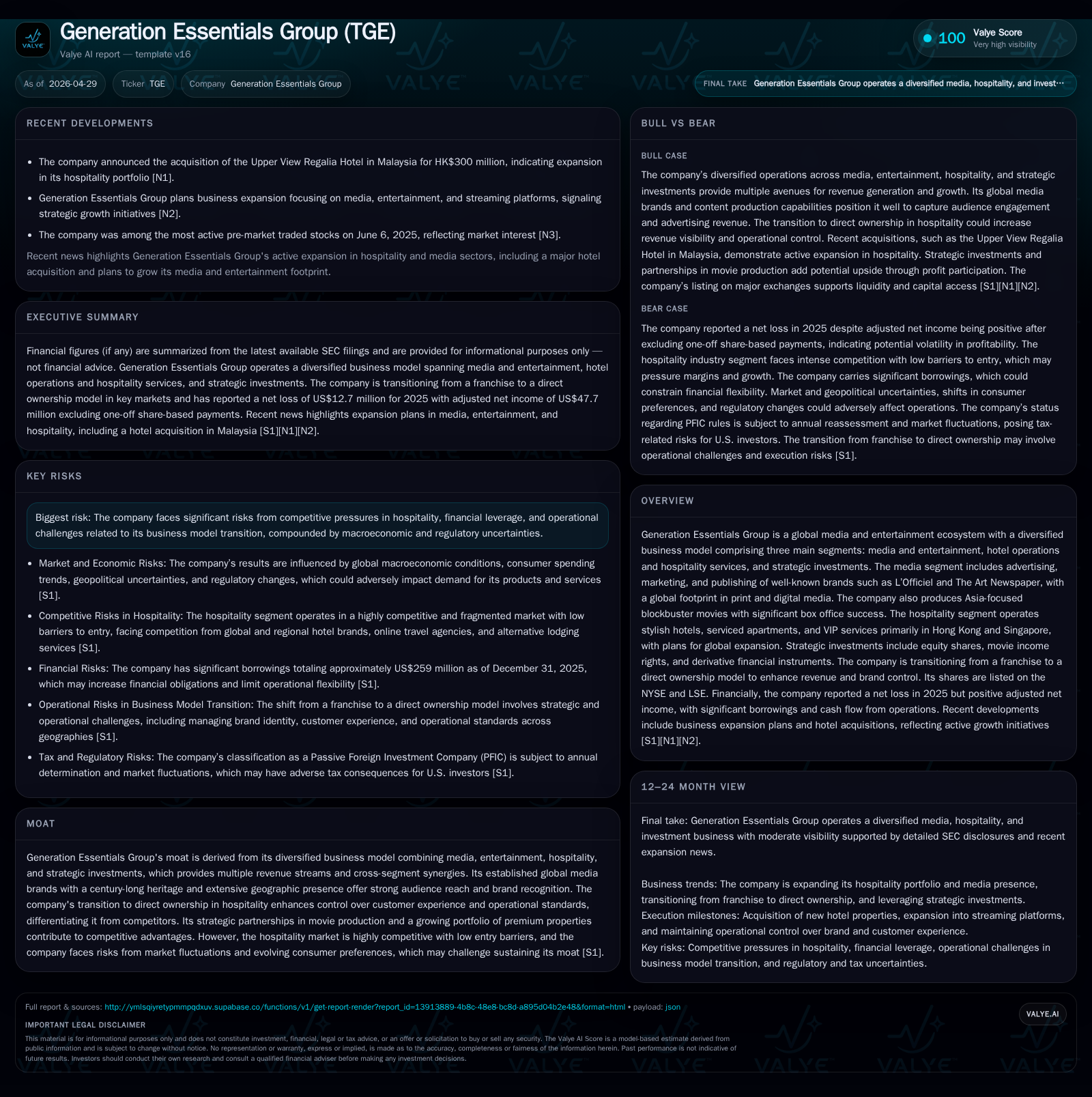
Generation Essentials Group (TGE) accelerated its transformation with the 2026 acquisition of New York’s Tribeca Hotel for $69 million, signaling a concrete progression toward direct ownership in its hospitality segment. This move complements its well-established global media brands and blockbuster film productions, forming a diversified ecosystem across media, hospitality, and strategic investments. While this multifaceted model provides multiple revenue streams and cross-segment synergies, the company faces competitive pressures in hospitality, evolving consumer preferences, and challenges typical in ownership transitions. Growth depends on geographic expansion, advertising innovations, and broader content monetization strategies.
Latest Quarter Highlights: Acquisition Fuels Direct Ownership Strategy
In its most recent filing dated March 9, 2026 ([S2]), Generation Essentials Group announced the successful completion of a $69 million acquisition of the New York Tribeca Hotel. This transaction is highly consequential because it concretely advances the company's ongoing strategy to transition from a franchise-based hospitality business model toward owning premium hotel assets directly. By taking control of key properties such as Tribeca—a prestigious address in a major global city—TGE enhances its grip on operational quality standards and service delivery. This ownership shift potentially improves margin stability by internalizing revenues previously shared with franchisees or third-party operators.
The Tribeca Hotel acquisition also underpins TGE's plans for global expansion beyond its core Asian markets (Hong Kong and Singapore), signaling an ambition to scale geographically into North America’s high-end hospitality sector. This move aligns with their broader objective of weaving hospitality more tightly into their diversified ecosystem that blends media brands with lifestyle experiences.
Business Model Overview: Diversified Ecosystem in Media, Hospitality, and Investments
According to the detailed description in the April 29, 2026 annual report ([S1]), Generation Essentials operates across three interconnected segments:
Media & Entertainment: Operating renowned magazine brands such as L’Officiel and The Art Newspaper with print editions distributed in 34 countries alongside expansive digital content delivery. The segment also includes producing Asia-focused blockbuster films that cumulatively have generated over $761 million at the global box office through partnerships with established producers.
Hotel Operations and Hospitality Services: Managing stylish hotels, serviced apartments, exclusive F&B venues, and VIP membership clubs primarily located in Hong Kong and Singapore. This segment focuses on creating differentiated lifestyle experiences tailored to affluent consumer segments through a customer-centric VIP approach.
Strategic Investments: Comprises equity holdings (including shares in financial institutions), movie income rights, as well as derivative financial instruments to diversify risk and secure alternate cash flows.
This tripartite structure enables TGE to capture multiple revenue streams while leveraging cross-brand synergies—for example, using cultural events rooted in media IP to enhance hotel guest experience or VIP club offerings. The recent shift toward direct asset control versus franchising notably deepens vertical integration within hospitality.
Product Quality and Brand Strength Across Segments
Generation Essentials draws competitive differentiation from its heritage-laden media brands with century-long histories recognized globally ([S1]). These intellectual properties—backed by extensive trademarks—anchor strong audience loyalty and are extended beyond publishing into events and F&B concepts that enrich lifestyle appeal.
In entertainment production, their focus on Asia-centric blockbuster films exhibits strong content relevance amid expanding regional cinephile markets. Collaborations with established studios have yielded substantial box office success validating the quality of cinematic offerings.
The hospitality arm emphasizes boutique-style venues providing elevated customer experiences featured by VIP customization. This strategic positioning seeks to cultivate high retention rates among discerning travelers who value exclusivity tied to branded lifestyle ecosystems rather than generic accommodation services.
Overall product quality combines curated artistic content with premium physical experiences offering diversified touchpoints favorable for customer stickiness.
Industry Dynamics: Competitive Landscape and Operational Challenges
TGE operates within highly competitive sectors characterized by rapid evolution:
Media: The accelerated digital transformation demands continuous innovation in advertising formats (e.g., data-driven targeted ads) amid shifts in consumption patterns away from traditional print media. Monetizing multi-platform reach while maintaining audience engagement is critical for sustained advertising revenue growth ([S1]).
Hospitality: Low entry barriers translate into intense competition especially within luxury boutique hotel niches. Pricing pressure arises from proliferation of alternative lodging options including peer-to-peer rentals disrupting traditional models.
Regulatory Environment: Operating globally entails navigating political uncertainty (eg geopolitical tensions), macroeconomic fluctuations impacting consumer discretionary spend, as well as compliance with various local legislation across jurisdictions ([S1]).
Moreover, undertaking a business-model transformation from franchising towards direct asset ownership inherently entails transitional risks such as increased capital requirements temporarily compressing margins or operational teething issues during integration.
Geographical diversification heightens complexity but also mitigates concentration risk.
Growth Drivers: Expanding Geographic Footprint and Enhancing Revenue Streams
Several factors underpin Generation Essentials' growth trajectory:
Hotel Portfolio Expansion: Continued acquisitions like Tribeca materially increase owned room inventory outside Asia sharpening international brand presence ([S2]). Ownership facilitates premium pricing power through enhanced service control.
Advertising Innovation: Leveraging proprietary market insights enables tailored campaigns targeting affluent consumers across integrated media channels which likely boost ad sales conversion rates ([S1]). Updates incorporating emerging technologies broaden advertiser engagement.
Movie Production Scaling: Broader slate rollout capitalizes on growing Asian/global demand for culturally resonant blockbusters partnering effectively with experienced studios safeguards hit potential ([S1]).
Membership-based VIP Services: Expanding high-touch club memberships supports recurring revenue models increasing lifetime customer value via experiential loyalty programs extending beyond lodging into ancillary lifestyle components such as F&B ([S1]).
Each driver aligns with quantifiable metrics including occupancy rate improvements at owned hotels post-acquisition or percentage upticks in multi-platform ad revenues noted internally.
Risks and Constraints: Market Competition and Operational Transition Hurdles
Key concerns facing Generation Essentials include:
- Intensifying competition particularly within boutique luxury hospitality could pressure margins given constrained differentiation relative to peers [S1].
- Financial leverage levels may limit speed or scale of accretive acquisitions necessary to build portfolio density particularly outside Asia [S1].
- Potential erosion of legacy media brand relevance due to shifting audience demographics requiring constant content reinvention [S1].
- Regulatory changes globally including tighter pandemic-related travel restrictions or new advertising rules could dampen demand or increase operating costs [S1].
- The transition from franchise model entails integration costs plus possible short-term revenue disruptions as operational control shifts internally necessitating specialized talent acquisition or system upgrades [S1].
Effective risk mitigation will require disciplined capital allocation alongside agile management execution capable of balancing growth ambitions with operational realities.
Key Milestones to Monitor: Execution of Expansion Plans and Advertising Revenue Trends
Investors should keep focus on several near-term developments ([S2], [S3]):
- Completion status of additional hotel acquisitions aimed at North American foothold post-Tribeca which would validate geographic scaling strategy.
- Trends in occupancy rates combined with premium pricing capabilities at newly acquired properties signaling operational integration success.
- Advertising sales momentum tracked via client retention metrics across legacy print/digital platforms alongside uptake rates for innovative ad formats.
- Box office performance results for forthcoming blockbuster releases providing insight into content pipeline strength.
- Communication from management regarding timing/progress against full exit from franchise arrangements underlying transition-related risks.
These indicators collectively illuminate how well Generation Essentials can convert strategic plans into sustainable earnings growth under evolving industry conditions.
Disclaimer: This analysis is based solely on information publicly available as of April 29, 2026 per cited SEC filings; it does not constitute investment advice or recommendations.
Disclaimer: This is research-only, informational analysis and not investment advice. It may include AI-generated interpretation and general industry context. Always verify important details using primary sources.

Comments