
Nam Tai Property Boosts Shenzhen Industrial Leasing as Legal and Market Pressures Persist
Q3 revenue grew modestly with key industrial asset sales and leasing, while legal disputes and residential market softness continue to weigh on profitability and redevelopment progress.
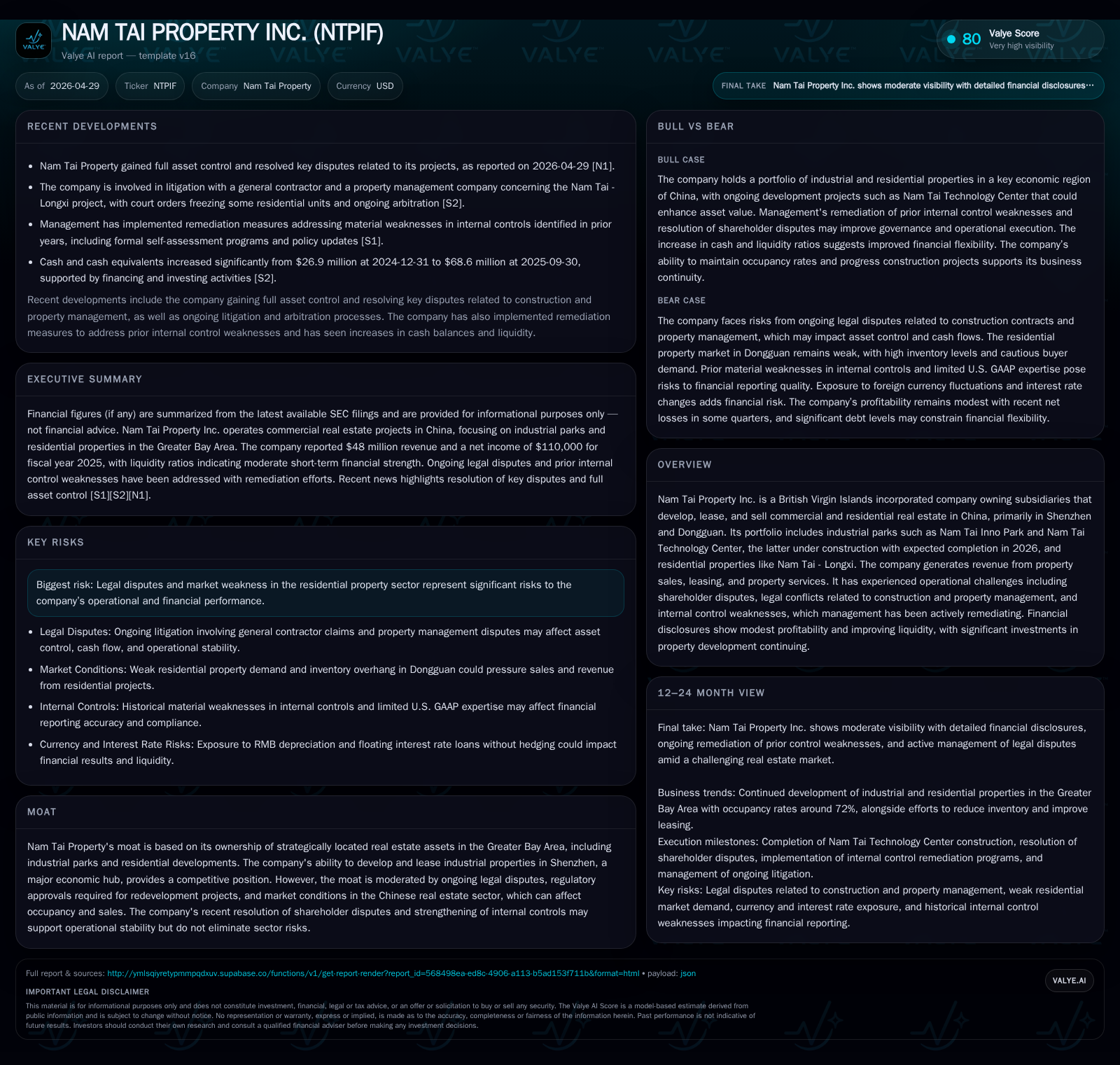
Nam Tai Property Inc. reported a modest revenue increase in Q3 2025 supported by property sales and industrial park leasing. The company’s focus remains on expanding its Greater Bay Area footprint through the near-term completion of Nam Tai Technology Center and the redevelopment plans for Nam Tai Inno Valley. Despite operational improvements and shareholder dispute resolutions, legal tensions and weak residential market conditions continue to constrain financial performance. Liquidity has strengthened following debt repayments and refinancing amendments, positioning Nam Tai to execute its lease-up strategy and asset monetization initiatives. Strategic growth drivers center on stabilizing occupancy at key industrial properties and unlocking redevelopment potential, while risks persist from regulatory uncertainties and interest rate volatility.
Recent Operating Update
Nam Tai Property's third quarter of 2025 saw total revenue tick up slightly to $9.7 million versus $9.5 million in Q3 2024, reflecting a mix of property sales from the Nam Tai - Longxi residential development and ongoing leasing operations from its industrial parks, primarily Nam Tai Inno Park and Nam Tai Inno Valley [S2][S24]. Property sales accounted for approximately $5.6 million of revenue with operating lease income contributing $2.6 million. Despite stable revenue levels, gross profit fell sharply by 47%, down to $2.95 million from $5.57 million the prior year quarter due to increased cost pressures [S2][S24].
Operating expenses remain elevated, with general and administrative costs decreasing from $7.1 million to $3.3 million but still significant relative to earnings given the smaller gross margin base. Selling and marketing expenses nearly doubled to $0.9 million, including higher staff costs and commission fees [S2][S24]. As a result, net loss from operations narrowed but remained negative at $1.25 million compared to a larger loss previously [S2]. Consolidated net loss improved substantially from $7.5 million in Q3 2024 to $1.87 million but reflected ongoing challenges including legal-related expenses [S2][S24].
On the balance sheet front, liquidity notably strengthened with cash and cash equivalents increasing by over $41 million since December 2024 to around $68.6 million at September-end, supported by financing activities and asset sales [S2][S24]. Correspondingly, current liabilities rose modestly with accounts payable increasing related to construction outlays for the Nam Tai Technology Center project now under active development [S2][S24]. The current portion of long-term bank loans declined substantially due to repayments totaling approximately $24.5 million during the first nine months of 2025 [S2].
A material financing highlight includes the December 2025 amendment of a promissory note with IAT Insurance Group extending its maturity via successive automatic 90-day rollovers, securing better near-term cash flow flexibility amid ongoing refinancing efforts [S2].
Business Model
Nam Tai Property operates primarily as a real estate developer and manager focusing on commercial and residential properties within China’s Pearl River Delta's Greater Bay Area—a region known for rapid urbanization and industrial growth, especially Shenzhen. The company generates revenue chiefly through three streams: property sales (notably residential units), operating leases from industrial parks (such as Nam Tai Inno Park), and property service fees related to facility management.
Its development portfolio features four main assets:
- Nam Tai Inno Park: Completed industrial park with roughly 75% occupancy in Shenzhen’s Guangming District.
- Nam Tai Technology Center: Under-construction industrial complex expected for completion mid-2026 in Bao’an District.
- Nam Tai Inno Valley: Former factory site earmarked for redevelopment pending government approval.
- Nam Tai - Longxi: Residential for-sale project in Dongguan with inventory-to-sales ratio nearing 89% indicating slow off-take [S1][S8].
Revenue mechanics depend on successful leasing agreements within its industrial assets—driving recurring rental income—and property sales velocity in residential projects which fluctuate considerably with market demand cycles. Operating lease contracts include both standard rental income plus periodic adjustments subject to tenant renewals or expansions.
Margins are influenced heavily by development costs, construction progress efficiency, leasing spread achieved (i.e., rental rates vs operating expenses), and ongoing legal contingencies impacting cost recognition or provisions.
Customer behavior gravitates towards industrial tenants seeking modern logistics or R&D facilities benefiting from proximity to tech clusters; however, the residential market segment faces cyclical softness that pressures sales velocity.
Industry Structure and Competitive Position
The Greater Bay Area represents one of China’s most dynamic real estate hubs combining commercial-industrial innovation zones with expanding urban residential demand. This region’s real estate landscape is typified by intense competition among local developers who differentiate themselves via location advantages, government relationships facilitating approvals, portfolio diversification into mixed-use developments, and coherence with China's broader high-tech manufacturing upgrading policies.
Nam Tai distinguishes itself through ownership of strategically placed large-scale industrial properties capable of attracting technology-driven tenants who value infrastructure quality and logistical advantages inherent in Shenzhen’s tech corridors. The imminent completion of Nam Tai Technology Center will provide modernized space enhancing competitive standing.
Nonetheless, competitive challenges remain notable due to regulatory hurdles delaying project approvals (as observed in Nam Tai Inno Valley) as well as persistent residential market volatility dampening profitability in segments like Longxi where inventory turnover is sluggish.
Growth Drivers
Completion and Lease-Up of Nam Tai Technology Center: Expected June-July 2026 completion opens ability to generate new recurring lease revenues from higher-end industrial tenants keen on advanced facilities within Bao’an District [S1][S8]. Lease-up success will be critical KPI affecting future cash flows.
Redevelopment Potential of Nam Tai Inno Valley: Regulatory approval enabling increase in gross floor area could unlock significant value creation through densification or rezoning opportunities enhancing asset utilization [S1].
Residential Sales Execution: Despite weak current inventory absorption at Longxi (approximate inventory-to-sales ratio ~88%), targeted marketing campaigns or price adjustments could moderate risk and improve sales proceeds inflow [S2].
Operational Stabilization Post Shareholder Disputes: Resolution of protracted governance conflicts allows management focus on execution efficiency improvements including tighter internal controls that should gradually reduce overhead costs related to litigation or mismanagement [S1][S20].
Liquidity Management & Debt Refinancing: Improved cash balances alongside strategic note amendments increase financial flexibility enabling project funding continuity without immediate capital raising dilutions or distress scenarios [S2].
Risks / Watchpoints / Growth Constraints
- Legal Disputes: Ongoing litigation concerning construction claims at Nam Tai - Longxi creates uncertain contingent liabilities impacting cash costs or reputation vis-a-vis contractors affecting project timelines [S7].
- Regulatory Approvals: Redevelopment plans such as for Inno Valley hinge on government consent which can be delayed or modified reducing scale economics anticipated by management.
- Residential Market Weakness: Persistent sluggishness in housing demand within Dongguan constrains sales velocity; prolonged inventory accumulation may pressure margins further.
- Interest Rate Sensitivity: Floating rate debts expose interest expense volatility against People's Bank of China benchmark changes; absence of hedging instruments may worsen future financing cost burdens if rates rise [S1][S19].
- Internal Control Limitations: Noted weaknesses in U.S. GAAP accounting expertise among staff necessitate continued investment in systems/training posing operational risks during transition period post-shareholder dispute settlement [S20].
- Exchange Rate Fluctuations: Significant RMB cash holdings subject company financials to FX risk impacting dollar-reported earnings depending on currency movements [S1].
What To Watch Next
Investors should monitor upcoming milestones including:
- Completion status updates for Nam Tai Technology Center toward mid-2026 deadline.
- Announcements regarding lease agreements signed securing anchor tenants at newly completed buildings.
- Regulatory news concerning potential approvals for expanded floor area at Nam Tai Inno Valley redevelopment plans.
- Quarterly disclosure updates showing trends in residential sales pace at Nam Tai - Longxi including pricing actions or promotional efforts.
- Management commentary on progress addressing internal control remediation related to financial reporting.
- Covenant compliance reports or amendments linked to recent debt refinancing arrangements.
- Macroeconomic indicators relevant for China’s commercial real estate demand dynamics particularly in southern tech hubs.
Financial Profile Summary (Latest Available Data)
Latest financial snapshot
| Metric | Value | Period |
|---|---|---|
| Total debt | $170mm | |
| 2025-12-31 | ||
| Net debt | $-42mm | |
| 2025-12-31 | ||
| Current assets | $108mm | |
| 2025-12-31 | ||
| Current liabilities | $88mm | |
| 2025-12-31 | ||
| Current ratio | 1.23x | |
| 2025-12-31 |
Source: SEC companyfacts cache [F1].
(*) Note: The latest available cash figure from companyfacts database predates recent filings; more updated cash data per quarterly disclosures indicate ~$68M as of Sept 30, 2025 [F1][S2].
Closing Remarks
Nam Tai Property Inc sits at the intersection of strategic regional development opportunities within China’s Greater Bay Area coupled with the imperative challenges typical of mid-sized developers navigating regulatory complexity, market cyclicality in residential real estate, and residual effects of corporate governance disruptions. The company’s emphasis on completing high-quality industrial assets aims to leverage sustained demand shifts towards modern logistics/R&D facilities in Shenzhen’s economic ecosystem while managing legacy residential inventory pressures. If lease-up momentum materializes post-completion of the Technology Center alongside regulatory progress unlocking land asset value at Inno Valley, operational stability could markedly improve beyond transient legal contingencies currently dragging margins downward. Close attention will be warranted over upcoming quarters regarding tangible lease gains and signs of sustained internal control enhancements crucial for transparent stewardship going forward.
This analysis is based solely on publicly available SEC filings dated through April 29, 2026 ([S1], [S2]) complemented by consolidated data snapshots ([F1]) without speculative forecasts or investment advice.
Disclaimer: This is research-only, informational analysis and not investment advice. It may include AI-generated interpretation and general industry context. Always verify important details using primary sources.

Comments