
Senti Biosciences Executes Structural Reorganization Amid Gene Circuit Advances
Senti Biosciences plans a holding company reorganization alongside pivotal clinical progress of its gene circuit therapies, shaping near-term strategic execution and growth prospects.
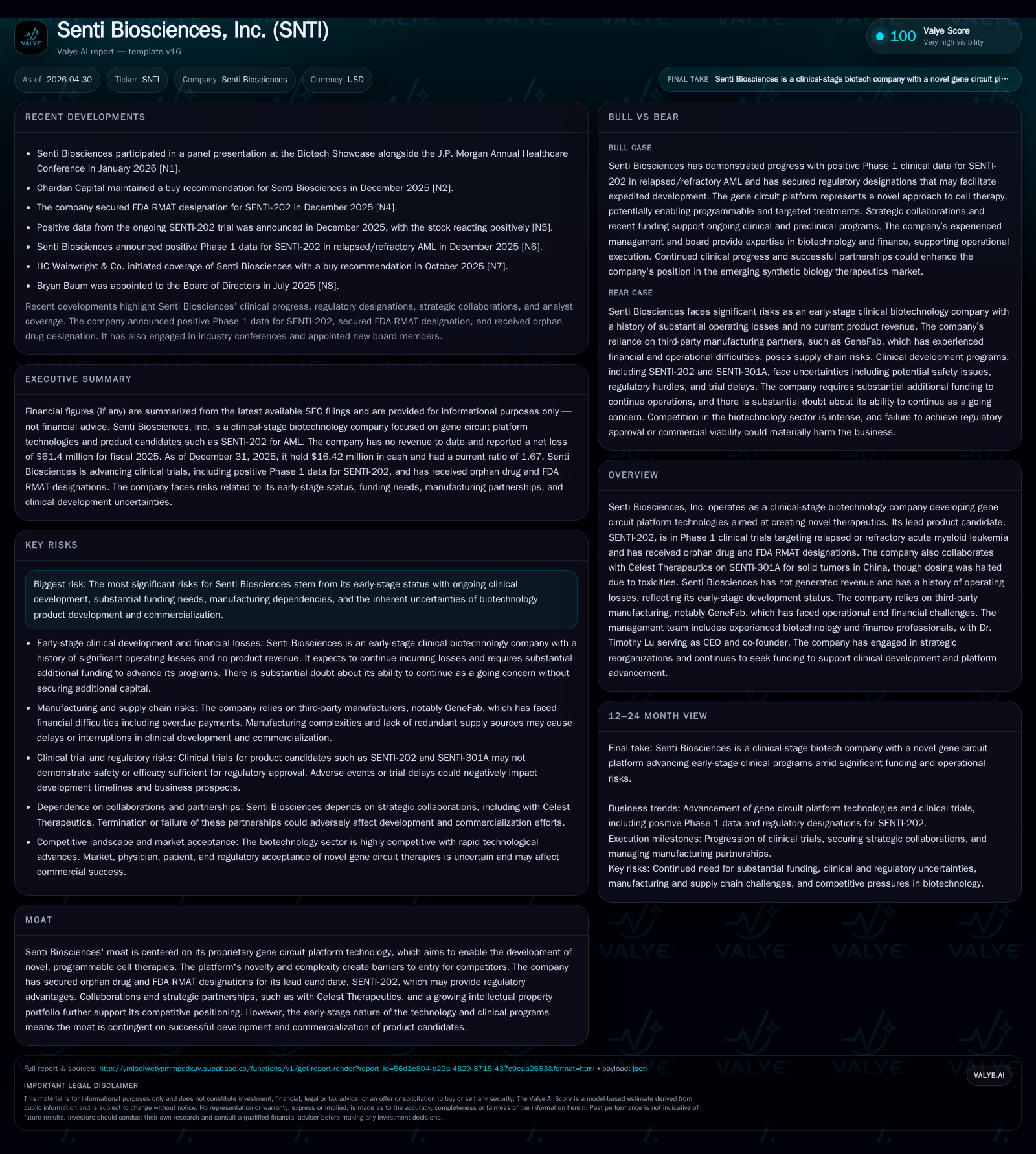
In April 2026, Senti Biosciences announced a tax-free holding company reorganization designed to enhance corporate governance flexibility and operational scalability. Concurrently, its lead candidate SENTI-202 advances in Phase 1 clinical trials targeting relapsed/refractory AML, while a partnered program SN301A dosing was halted due to safety concerns. These developments mark crucial inflection points for Senti’s early-stage programmable cell therapy platform, influencing capital deployment, regulatory positioning, and partnership evolution amid lingering developmental, manufacturing, and financial risks.
Recent Operating Developments: Structural Reorganization and Clinical Updates
On April 1, 2026, Senti Biosciences announced plans for a tax-free holding company reorganization designed to be effective by mid-April 2026. This restructuring entails merging the existing company into a newly formed Delaware subsidiary under Senti Holdings Inc., itself controlled by Senti Biosciences Holdings Inc. This layered corporate architecture is intended to enhance governance scalability and strategic flexibility to support long-term growth ambitions amidst an evolving early-stage biotech operational environment [S3].
Clinically, SENTI-202—the company's lead product candidate employing the gene circuit platform—continues in Phase 1 trials targeting relapsed or refractory acute myeloid leukemia (AML). Regulatory incentives such as orphan drug designation and FDA Regenerative Medicine Advanced Therapy (RMAT) status provide added procedural advantages potentially expediting development timelines and market entry [S1].
Conversely, the partnered SN301A program with Celest Therapeutics experienced a dosing halt in its Phase 1 solid tumor trial conducted in China due to toxicity concerns. This underscores the inherent safety complexities in first-in-class programmable cell therapies and signals careful risk management is necessary for collaborative projects [S2][S1].
These operational shifts not only influence near-term project cadence but also inject fresh impetus into capital deployment decisions and regulatory strategy alignment.
Business Model and Technology Platform Overview
Senti's business model revolves around its proprietary gene circuit technology platform—a modular system enabling cells engineered with programmable genetic circuits that can precisely respond within the human body. This approach aims to create novel cellular therapeutics that could address disease contexts beyond the reach of traditional biologics or small molecules [S1].
Revenue generation remains absent as all major candidates are pre-commercialization; value generation is contingent on clinical milestones, successful regulatory navigation, and establishing commercial partnerships.
The platform's novelty provides a competitive moat through barriers posed by scientific complexity and innate technical sophistication. Strategic alliances exemplified by Celest Therapeutics help leverage complementary capabilities and geographic access while sharing development risks.
Competitive Environment and Regulatory Positioning
Within the clinical-stage biotechnology sector focusing on advanced cell therapies, Senti operates amid increasing regulatory scrutiny but benefits notably from designations like orphan drug status for SENTI-202 that afford exclusivity periods and expedited FDA pathways [S1].
However, competition is intense from other immunotherapy developers including CAR-T firms pursuing similar hematologic malignancies. Senti's differentiation lies primarily in its programmable gene circuit approach enabling enhanced targeting specificity.
Manufacturing dependence on third-party Contract Manufacturing Organizations (CMOs), particularly GeneFab—reported as encountering operational strains—introduces supply chain vulnerability that could delay clinical progress or scale-up efforts,[S2]. Intellectual property protections underpin competitive positioning but remain subject to typical biotech litigation uncertainties.
Pricing power is presently theoretical given absence of approved products; eventual reimbursement will depend heavily on demonstrated clinical benefit versus existing standards under tightening healthcare cost frameworks.
Growth Catalysts: Clinical Progress & Strategic Alliances
The primary growth driver is successful advancement through clinical phases for SENTI-202. Completion of Phase 1 with favorable safety/efficacy data could validate the platform’s potential and unlock subsequent larger studies or partnership/licensing deals [S1][S2].
Re-engaging or restructuring the Celest Therapeutics collaboration following SN301A’s dosing pause will be critical to maintaining global extension of Senti's commercial reach.
Expansion of intellectual property (IP) holdings related to gene circuits can bolster negotiating leverage for partnerships or future business models emphasizing platform licensing.
Timely delivery of trial data readouts remains integral; delays or adverse outcomes would negatively affect enterprise valuation trajectories.
Risks and Constraints: Developmental, Manufacturing, and Financial Challenges
Operating within early-stage development inherently carries multi-year investment horizons before potential product commercialization. Clinical trial failures or unexpected toxicities—as seen with SN301A—can stall momentum substantially [S2].
External dependencies on CMOs like GeneFab with documented performance issues risk interrupting timely drug supply required for trials or commercial launches.
The company faces significant cash burn; as of late 2025 financials demonstrate sizable losses (~$68.8M operating loss) without revenue inflow necessitating continued capital access or fundraising which can be dilutive or costly [F1],[S2].
Additionally, a material weakness previously identified in internal controls over financial reporting introduces risks related to transparency that may undermine investor confidence if unresolved.[S2]
Manufacturing regulation compliance adds complexity—not fully controllable through third-party providers—and any deviations may result in regulatory sanctions or clinical hold scenarios.
Broad healthcare policy trends trending toward pricing scrutiny further complicate long-term revenue assumptions even if approval is secured.
Near-Term Milestones and Investor Watchpoints
Critical upcoming indicators include:
- The completion of the holding company reorganization expected by mid-April 2026 enabling improved corporate structure execution [S3].
- Data releases anticipated from ongoing SENTI-202 Phase 1 studies which will be decisive for pipeline validation timing [S2][S3].
- Operational updates describing manufacturing arrangement stability or alternative CMO partnerships addressing GeneFab-related challenges.
- Progress or changes in strategic alliances especially concerning SN301A developments impacting collaboration scope. Monitoring these KPIs will provide actionable insight into whether Senti stays on course toward technical validation or encounters further developmental setbacks.
Financial Position Snapshot
Latest financial snapshot
| Metric | Value | Period |
|---|---|---|
| Cash & equivalents | $16mm | |
| 2025-12-31 | ||
| Current assets | $23mm | |
| 2025-12-31 | ||
| Current liabilities | $14mm | |
| 2025-12-31 | ||
| Current ratio | 1.67x | |
| 2025-12-31 |
Source: SEC companyfacts cache [F1].
| Metric | Value (USD) | As of |
|---|---|---|
| Revenue | 0 | |
| 2024-12-31 | ||
| Operating Income | -68,779,000 | |
| 2025-12-31 | ||
| Net Income | -61,438,000 | |
| 2025-12-31 | ||
| Cash & Equivalents | 16,420,000 | |
| 2025-12-31 | ||
| Current Ratio | 1.67 | |
| 2025-12-31 |
At year-end December 31, 2025, Senti reported no revenues aligned with its early-stage development profile but incurred substantial operating losses totaling approximately $68.8 million accompanied by net losses of $61.4 million. Cash reserves stood at $16.4 million providing some short-term liquidity cushion supported by a current ratio of 1.67 indicating moderate ability to cover short-term liabilities [F1].
This financial footing places emphasis on efficient capital deployment post-reorganization while prioritizing milestone-driven expenditure control amid continuing research investments.
Disclaimer: This analysis is based solely on available SEC filings as of April 29, 2026, Companyfacts data as of December 31, 2025, and other documented sources cited herein. It does not constitute investment advice but aims to provide an informed overview grounded strictly in disclosed information.
Disclaimer: This is research-only, informational analysis and not investment advice. It may include AI-generated interpretation and general industry context. Always verify important details using primary sources.

Comments