
ENVIRI Corp’s Strategic Shift Focuses on Clean Earth Sale and Post-Divestiture Growth
ENVIRI Corp advances the sale of its Clean Earth segment, reshaping its business strategy amid debt covenant adjustments and leadership changes.
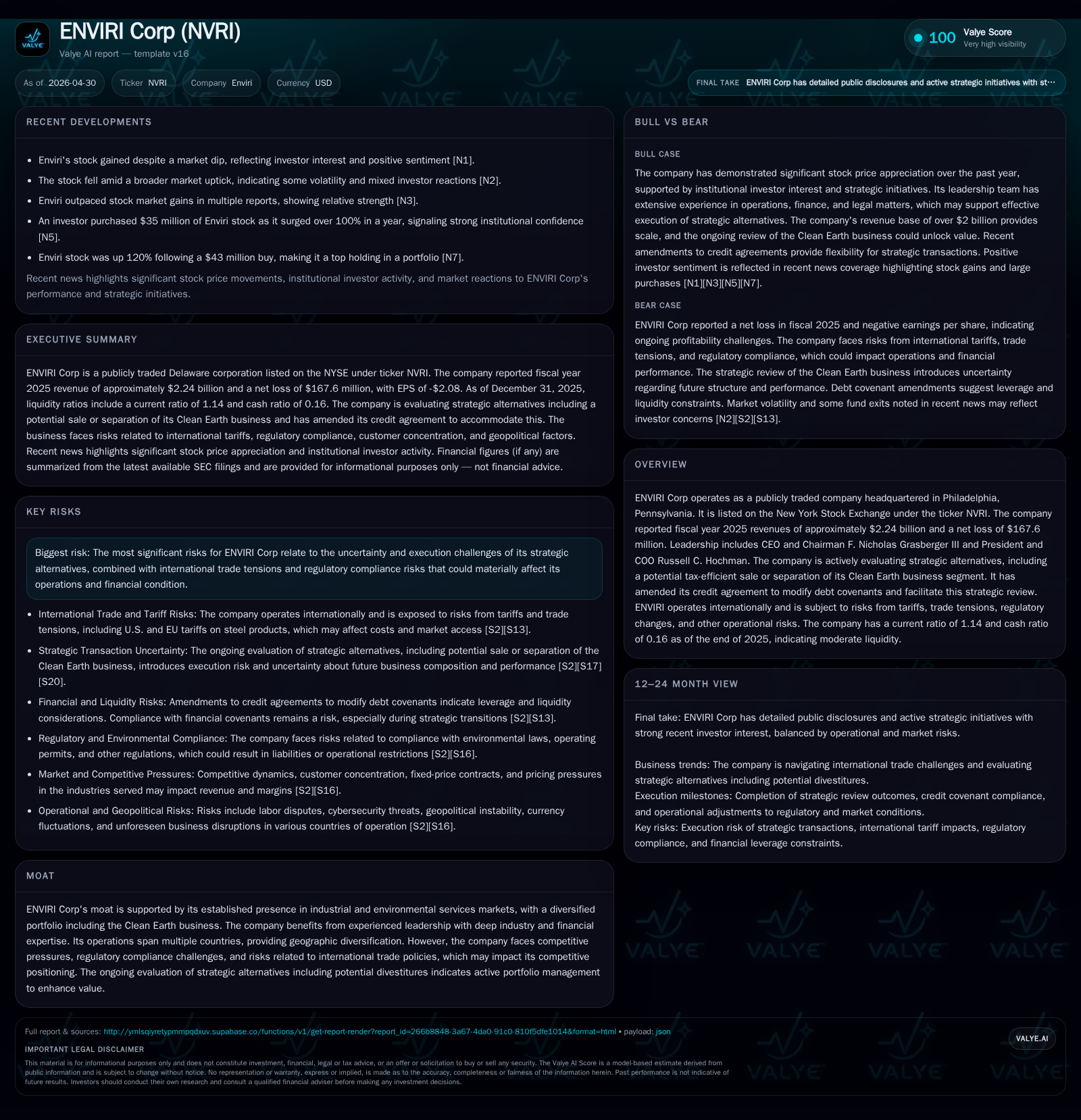
In its latest filings, ENVIRI Corp has confirmed definitive agreements to sell its Clean Earth business to Veolia Environnement S.A., accompanied by a corporate separation creating New Enviri. This transaction underscores a strategic refocus on core operations while managing significant debt and liquidity considerations. ENVIRI’s business model rests on environmental and industrial services, with differentiated offerings that now face structural transformation through divestiture. The industry remains sensitive to international trade tensions and regulatory shifts, which pose ongoing risks. Key upcoming catalysts include completion of the Clean Earth transaction and successful operational execution of New Enviri’s strategy.
Recent Operating Update
ENVIRI Corp’s most decisive recent development is the binding agreement reached on November 20, 2025, with Veolia Environnement S.A. for divesting its "Clean Earth" business segment ([S3], [S27]). This transaction involves a merger via a Delaware LLC structure alongside a planned spin-off that will create a stand-alone entity called New Enviri. Management has outlined a multi-step transaction process culminating in this separation, intended to optimize shareholder value by unlocking distinct market potential in both entities.
Concurrently, ENVIRI amended its credit facility in late 2025 to accommodate higher leverage during this divestiture process ([S2], [S11]). This reflects careful liquidity management aligned with strategic disposals.
Leadership evolves alongside these structural changes: Russell C. Hochman, formerly Senior VP and General Counsel, was appointed President and COO concurrently with these strategic moves; he is slated to become CEO of New Enviri upon separation ([S3], [S8]). This adjustment leverages his deep operational and governance expertise during this critical transformation phase.
Business Model
ENVIRI operates principally within the industrial and environmental services sector with diversified offerings targeting waste management, remediation services, and engineered solutions for environmental compliance ([S1]). Revenue generation stems from contracts with municipal clients, industrial manufacturers including steel producers, and specialized service agreements involving complex engineered equipment.
The company's revenue mechanics hinge on contract-based fee structures emphasizing recurring service delivery augmented by project-driven segments. Pricing incorporates fixed-price long-term contracts that confer some stability but invite margin pressure from competitive bidding processes and raw material cost volatility. Volume growth correlates with industrial activity levels and tightening environmental regulations driving demand for remediation and compliance services.
The Clean Earth unit historically represented a significant portion of revenues but divests as ENVIRI recalibrates toward core competencies. This spin-off entails shifting capital allocation focus toward operational excellence and margin improvement within environmental recovery services encompassing hazardous waste treatment and soil remediation.
Customer retention benefits from regulatory compliance imperatives creating high switching costs while evolving technology integration demands ongoing capital investment — factors that contribute to moderate pricing power albeit constrained by competitive intensity across global markets.
Industry Structure and Competitive Position
ENVIRI sits within an industrial services sector marked by fragmentation yet consolidation trends driven by environmental regulation tightening globally. Competitors range from large multi-service firms like Veolia (itself now acquiring ENVIRI’s Clean Earth business) to regional specialists focusing on niche waste streams or geographic markets.
Key industry drivers include regulatory enforcement rigor, tariff policies affecting cross-border materials flow (notably steel import tariffs impacting waste volumes), technological adoption around environmental sustainability standards, and economic cycles influencing industrial throughput ([S2], [S21]).
ENVIRI maintains an extensive operational footprint in multiple countries offering geographic diversification mitigating localized economic or regulatory downturns but heightening exposure to political risk uncertainties.
Competitive positioning benefits from legacy expertise in engineered solutions critical to complex remediation projects but faces pressures on pricing amid rising operational costs and entry of capitalized competitors expanding via acquisitions.
Growth Drivers
- Completion of Clean Earth Sale: Unlocking focused capital deployment for New Enviri enables sharper strategic execution optimizing returns in core environmental service lines.
- Strategic Re-investment Post-Separation: Enhanced operational focus on high-margin service areas – such as advanced soil remediation technologies – to drive incremental revenue growth and margin expansion.
- Regulatory Tailwinds: Ongoing strengthening of environmental laws globally maintains a structural need for compliance services supporting steady demand.
- Technological Integration: Adoption of digital monitoring and waste tracking systems can differentiate service offerings enhancing customer retention.
- Global Expansion: Leveraging existing infrastructure for potential selective inorganic growth or contract expansion in underpenetrated international markets.
Risks / Watchpoints / Growth Constraints
- Execution Risk on Separation: Any delays or complications completing the Clean Earth transaction or spin-off could disrupt financial flexibility or market confidence ([S22], [S28]).
- Regulatory Hurdles: Antitrust reviews or permit acquisition risks may prolong transaction timelines impacting strategic momentum.
- Debt Burden: Elevated net debt near $1.46 billion constrains capacity for opportunistic investments until post-divestiture deleveraging materializes ([F1]).
- Customer Concentration & Contract Terms: Dependency on large industrial clients exposes revenue volatility risks; fixed-price contract structures limit upside price adjustments amid inflationary pressures.
- International Trade Tensions: Tariffs and import quotas introduced by U.S., EU, and other regions affect input costs and demand patterns for treated waste materials ([S2]).
- Labor Market & Operational Costs: Managing workforce skill requirements amid union pressures introduces cost variability potentially compressing margins.
- Litigation Environment: Pending shareholder lawsuits contesting disclosure adequacy around proposed transactions underscore governance risks ([S22]).
What to Watch Next
- Timely closure of the Clean Earth sale transaction finalized under the established definitive agreements ([S6], [S27]).
- Regulatory approval progress including antitrust clearances critical for smooth transition.
- Transition updates on organizational structure execution post-spin-off including Mr. Hochman assuming CEO role for New Enviri ([S3], [S8]).
- Financial results reporting reflecting impact of divestiture and operational performance trajectory emphasizing EBITDA improvement.
- Disclosure updates concerning litigation resolution associated with shareholder actions over proxy statements ([S22], [S28]).
- Market response indications from contract renewals or new bookings within core operating segments signaling sustainable revenue trends.
Financial Profile
Latest financial snapshot
| Metric | Value | Period |
|---|---|---|
| Cash & equivalents | $104mm | |
| 2025-12-31 | ||
| Total debt | $1567mm | |
| 2025-12-31 | ||
| Net debt | $1463mm | |
| 2025-12-31 | ||
| Current assets | $721mm | |
| 2025-12-31 | ||
| Current liabilities | $634mm | |
| 2025-12-31 | ||
| Current ratio | 1.14x | |
| 2025-12-31 |
Source: SEC companyfacts cache [F1].
As of December 31, 2025, ENVIRI reported $2.24 billion in revenue but recorded a net loss of approximately $167.6 million influenced by restructuring charges related to the ongoing strategic realignment ([F1]). Operating income was minimal at around $4.25 million indicating margin pressures during transition phases.
Balance sheet metrics reflect $103.7 million cash & equivalents balanced against $1.57 billion in total debt resulting in approximately $1.46 billion net debt position ([F1]). Current assets versus liabilities deliver a current ratio of about 1.14 suggesting moderate short-term liquidity sufficiency but limited cushion given high leverage ratios ([F1]).
The amended credit facility accommodates these dynamics with covenant thresholds relaxed temporarily acknowledging elevated leverage before anticipated deleveraging post-Clean Earth distribution ([S2], [S11]). Free cash flow generation will be vital going forward not only to reduce leverage but also finance organic growth actions across New Enviri’s portfolio.
Disclaimer: This report is an analytical overview based solely on publicly available SEC filings and recent company disclosures as cited. It does not constitute investment advice or recommendations regarding any securities of ENVIRI Corp or associated entities.
Disclaimer: This is research-only, informational analysis and not investment advice. It may include AI-generated interpretation and general industry context. Always verify important details using primary sources.

Comments