
Cloudflare's Expanding Cloud Connectivity Platform Demonstrates Strong Growth but Sustains Operating Losses
Cloudflare reported a robust 30% revenue increase in 2025, driven by enterprise demand for its scalable, security-centric cloud platform, while continuing to invest heavily in infrastructure and innovation amid competitive pressures.
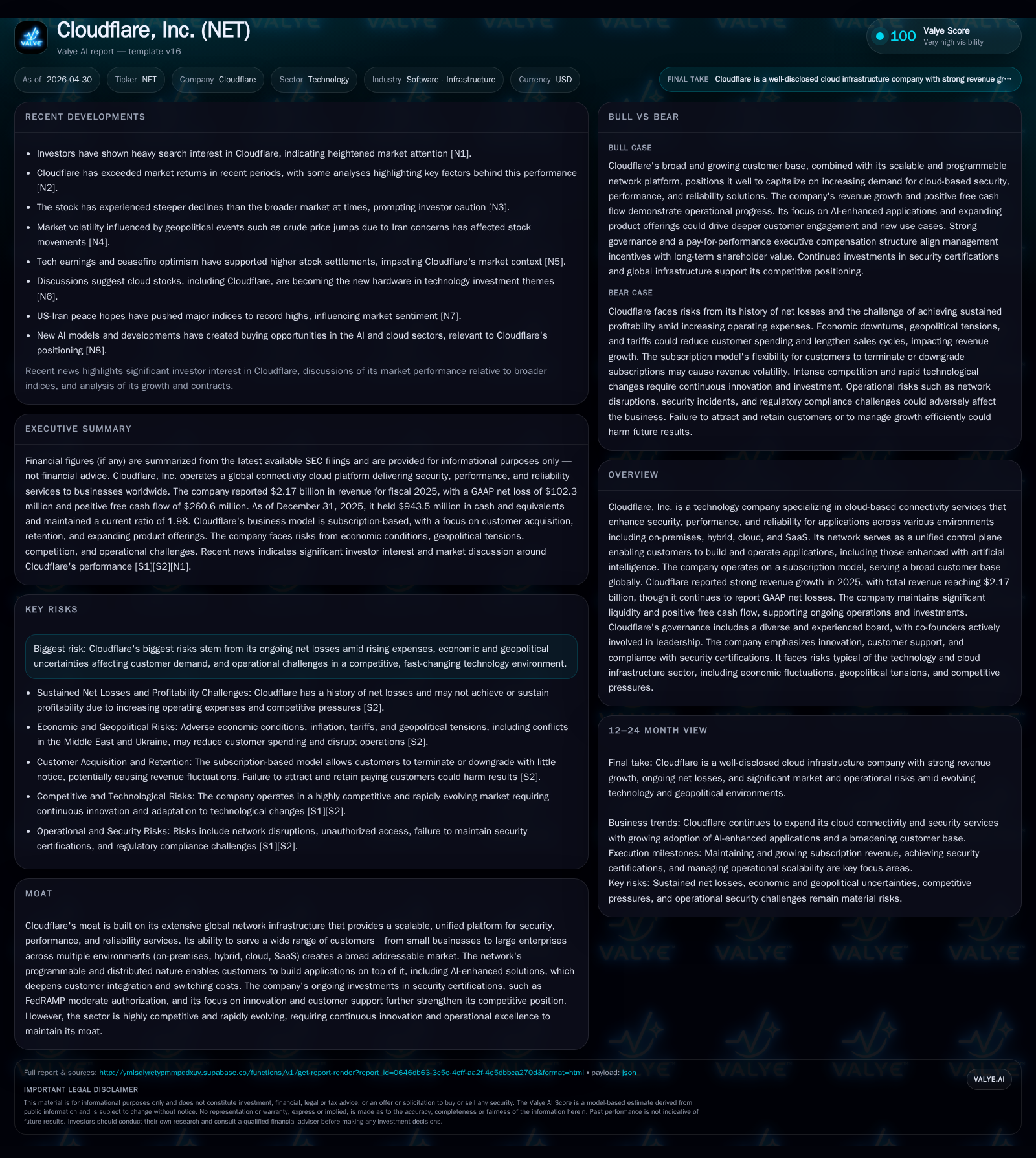
In its latest annual filing, Cloudflare Inc. showcased $2.17 billion in revenue for fiscal 2025, up nearly 30% year-over-year, propelled by growing adoption of its unified connectivity, security, and performance services across cloud, hybrid, and on-premises environments. Despite this top-line growth and positive free cash flow of approximately $287 million, the company recorded a GAAP operating loss of $207 million and a net loss of $102 million due to ongoing investments in infrastructure expansion and R&D. Cloudflare’s differentiated global network and programmable platform foster ecosystem lock-in and enable AI-enhanced application deployments, positioning it well against peers in the fast-evolving software infrastructure sector. Key risks include continued net losses, competitive market dynamics, macroeconomic uncertainties, and execution against innovation priorities.
Recent Operating Update
Cloudflare's latest quarterly filing dated October 30, 2025 [S2] highlights continued robust revenue growth yet persistent GAAP operating losses. Revenue for the nine months ended September 30 rose from $1.21 billion in 2024 to $1.55 billion in 2025, an increase exceeding 28%, although management cautions that growth rates have modestly decelerated relative to earlier periods owing to market maturation effects. The company reported GAAP net losses of approximately $90 million year-to-date through Q3 2025, comparable with prior year losses but indicative of sustained investment spending.
The full-year annual report amended on April 29, 2026 [S1] confirms these trends with total fiscal year revenue reaching $2.17 billion—a near-30% gain from fiscal 2024—with GAAP gross margins declining slightly to around 74.5% due to scale effects and product mix shifts that favor newer capabilities requiring higher cost inputs. Despite this margin compression, free cash flow improved significantly to around $287 million after capital expenditures surged by over 70% year-over-year to $315 million as Cloudflare expanded its global network footprint.
These results reflect the company’s operational emphasis on building out its edge network infrastructure while evolving software offerings that power application security and performance across multi-cloud and SaaS environments.
Business Model
Cloudflare operates primarily on a subscription model where customers—from small businesses to global enterprises—pay recurring fees for access to a broad suite of cloud connectivity services that enhances security (e.g., DDoS mitigation), performance acceleration (e.g., CDN), and reliability (e.g., failover). The offering spans multiple deployment modalities including on-premises integrations, hybrid setups, public cloud environments, and SaaS platforms.
Revenue mechanics are driven by volume (number of subscribers/users), pricing tiers aligned with feature sets or usage levels (e.g., bandwidth consumed), and contractual renewals. The company benefits from a rising shift toward distributed computing architectures which propel demand for unified control planes that handle policy enforcement across fragmented environments seamlessly.
Margins benefit from substantial operational leverage inherent in Cloudflare's global infrastructure investments; however, the need to continuously innovate—especially in AI-enhanced solutions—and support high-touch enterprise customers tempers near-term margin expansion potential.
Industry Structure and Competitive Position
Cloudflare sits at the nexus of several rapidly converging technology trends: edge computing, cloud-native application delivery, cybersecurity services, and artificial intelligence augmentation. It competes with both major public cloud providers offering their own security/performance toolkits (AWS CloudFront & Shield, Azure Front Door) as well as focused pure-play vendors specializing in CDN or security layers (Akamai, Fastly).
The competitive advantage lies in Cloudflare's unified platform which integrates performance enhancement with advanced security protections under one scalable network fabric covering more than 270 cities worldwide—this scale reduces latency and removes integration complexity that customers face when managing siloed point solutions.
Customer retention is strengthened through programmability enabling clients to embed business logic or AI functionality directly onto Cloudflare’s edge nodes—an example being AI-powered bot detection or personalized content caching—which increases switching costs.
Growth Drivers
Key drivers supporting future Cloudflare growth include:
- Expansion of Enterprise Customer Base: Large corporations increasingly view integrated cloud connectivity platforms as critical infrastructure for digital transformation initiatives.
- AI-Augmented Services: Embedding AI capabilities within network functions creates differentiated value propositions distinct from commodity networking or security offerings.
- Global Network Expansion: New points of presence further reduce latency for mobile users worldwide enhancing user experience critical for latency-sensitive applications.
- Hybrid & Multi-Cloud Adoption: Growing complexity drives demand for consistent policy enforcement across diverse environments where standalone vendor solutions fall short.
- Cross-Sell Opportunities: Broader product portfolio including zero trust security bundles fosters higher wallet share per customer.
Risks and Watchpoints
Despite favorable secular tailwinds Cloudflare faces several risks:
- Sustained Net Losses: GAAP profitability remains elusive due to elevated R&D and sales/marketing investment intensity necessary in a highly competitive market.
- Slowing Growth Rates: While still strong, recent deceleration suggests Cloudflare must focus on retention improvements and driving deeper product adoption within existing accounts.
- Macroeconomic Volatility: Geopolitical tensions and economic uncertainty could pressure discretionary IT spend among mid-sized customers impacting churn rates.
- Competitive Pressures: Large hyperscalers aggressively bundling similar capabilities may exert pricing or contract pressure especially on price-sensitive segments.
- Operational Execution: Maintaining network service reliability at scale alongside rapid feature development poses ongoing engineering challenges.
What To Watch Next
Important upcoming indicators include:
- Quarterly updates highlighting trends in customer count growth versus contract renewals.
- Introduction or expansion of AI-enhanced application features leveraging the programmable edge network.
- Gross margin trajectory revealing leverage gains as newer service offerings mature.
- Capital expenditure cadence reflecting strategic investments into underpenetrated geographies or emerging markets.
- Leadership commentary on macroeconomic impact assessments amid shifting IT budget priorities.
Financial Profile Summary
Historical performance (annual)
Capital returns and efficiency (annual)
The financials reveal a significant ramp in both investment spend and free cash flow generation—indicative of capital-intensive growth strategy being executed prudently amid strong recurring revenue inflows [F1].
This analysis is provided solely for informational purposes respecting disclosed data from Cloudflare Inc.'s public filings and does not constitute investment advice.
Disclaimer: This is research-only, informational analysis and not investment advice. It may include AI-generated interpretation and general industry context. Always verify important details using primary sources.

Comments