
Security Midwest Bancorp's Transition to Stock Form Elevates Growth Prospects
Conversion from mutual to stock form and an IPO have redefined Security Midwest Bancorp’s capital access and strategic position in its local banking market.
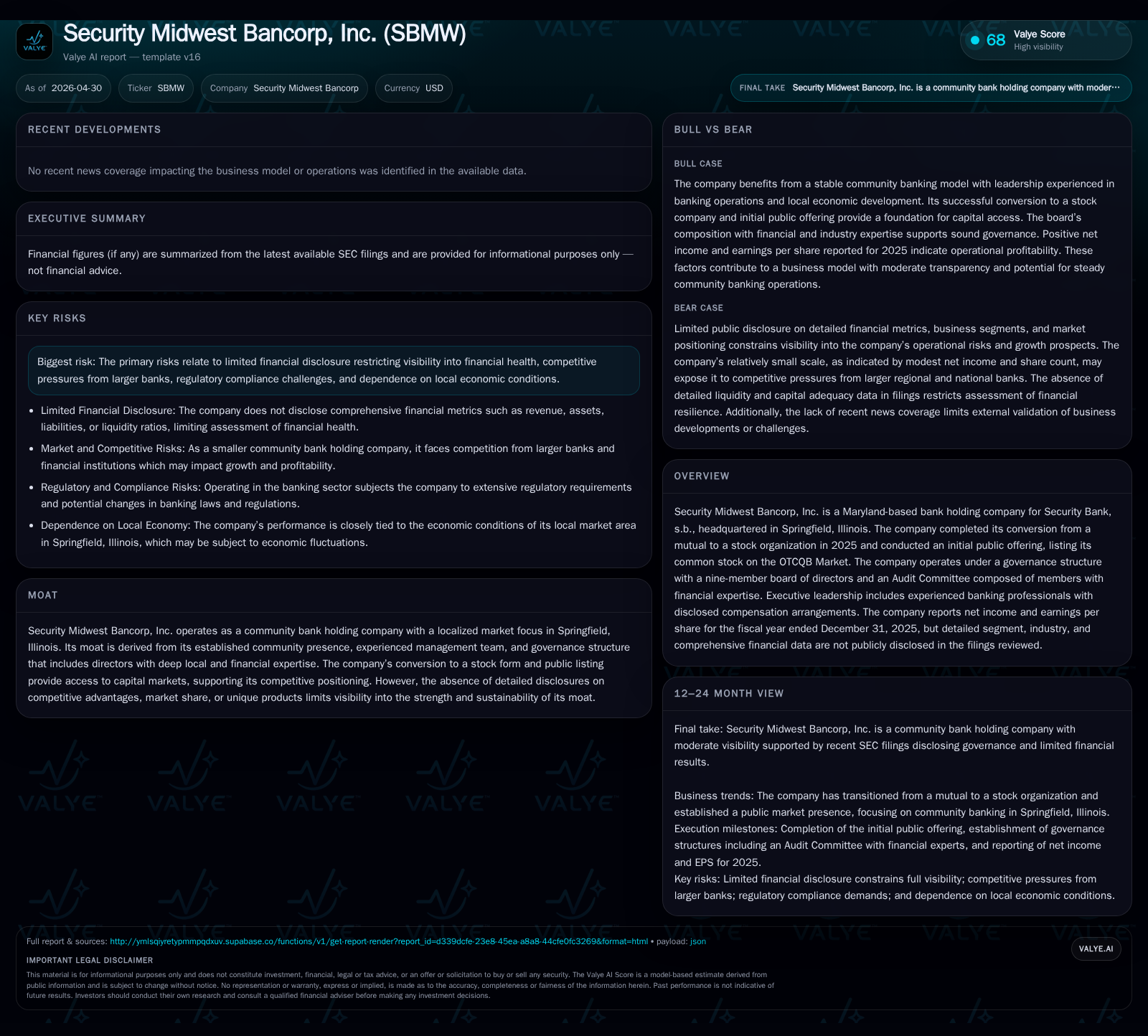
Security Midwest Bancorp completed its mutual-to-stock conversion and an IPO in mid-2025, listing on the OTCQB Market and raising approximately $8.9 million in equity capital. This transition enhances its ability to fund growth initiatives, improve governance with a financially experienced board, and increase market visibility. However, as a small community bank centered in Springfield, Illinois, it faces competitive pressures from larger regional banks and inherent risks tied to local economic conditions and regulatory compliance. Near-term growth hinges on effective deployment of raised capital into loan portfolio expansion and cross-selling within its established customer base.
Recent Operating Developments and Their Strategic Implications
In mid-2025, Security Midwest Bancorp marked a pivotal operational milestone by completing its conversion from a mutual organization to a stock corporation. This transition culminated in an initial public offering (IPO) finalized on July 31, 2025, which raised gross proceeds approximating $8.9 million through the sale of roughly 889,781 shares priced at $10 each. Notably, about 62,000 of these shares were allocated to an Employee Stock Ownership Plan (ESOP), creating direct employee equity stakes designed to enhance retention and alignment.[S11][S25]
Following the offering, the company's common stock began trading on the OTCQB Market around August 1, 2025, effectively increasing market liquidity and public visibility beyond its prior mutual structure.[S11] This shift allows Security Midwest Bancorp improved access to equity capital markets as a tool for strategic funding initiatives that were previously constrained by mutual ownership.
Governance enhancements accompanied this structural change. The company operates under a nine-member board with directors serving on critical committees including an Audit Committee composed of members deemed "financial experts" under SEC rules—fortifying financial oversight practices.[S1] Such governance improvements are imperative for public listing compliance and investor confidence.
However, this evolution also introduces new challenges: heightened regulatory scrutiny typical for publicly traded entities demands expanded reporting capabilities and compliance expenditures. Additionally, managing investor relations becomes essential to sustain market support amid increased transparency.
Business Model and Core Market Offering
Security Midwest Bancorp functions as a community bank holding company specializing in conventional banking services tailored predominantly to the Springfield, Illinois market. Its revenue streams derive mainly from interest income generated via loan originations to local consumers and businesses alongside fee income from deposit accounts and ancillary banking services.[S1]
The bank's product suite remains straightforward—standard deposit accounts (checking/savings), consumer loans (residential mortgages, vehicle loans), commercial loans primarily targeting small-to-medium-sized enterprises within the region—and does not extend into complex financial products or diverse geographic markets. This focus enables intimate customer relationships but inherently limits scale economies.
The mutual-to-stock conversion and IPO do not indicate any immediate strategic pivot toward broadening product complexity or venturing beyond core markets; rather, they appear designed to consolidate the institution’s foothold by injecting incremental capital for operational scalability concentrated within existing markets.
Community Bank Dynamics and Competitive Positioning
Within the crowded but localized regional banking sector of Springfield and surrounding areas in Illinois, Security Midwest Bancorp occupies a niche defined by longstanding community presence and personalized service. Unlike larger regional or national competitors who leverage scale advantages to offer diversified product sets—including wealth management services, extensive ATM networks, digital platforms—and aggressive pricing models, Security Midwest’s competitive edge is rooted in customer familiarity and management’s embeddedness within the local economy.[S1]
Regulatory environments post-conversion impose standard public-company compliance burdens — annual audits by independent accounting firms adhering strictly to GAAP principles overseen by audit committee financial experts — which elevate operational costs compared with non-public peers.[S1] This intensifies pressure on cost efficiency while striving to maintain relevant service quality.
Moreover, pricing power appears limited given competitive availability of products from larger institutions that can subsidize margins with non-interest income streams or operate at higher volumes impacting fee structures.
Key Growth Drivers and Strategic Initiatives
The infusion of approximately $8.9 million from the stock offering materially expands Security Midwest Bancorp’s capacity for growth investments.[S11] These funds are pivotal for expanding its loan portfolio—historically the primary source of net interest income—which can boost top-line revenue if deployed prudently within credit risk parameters.
Additionally, capital availability opens opportunities for selective technology enhancements supporting digital customer engagement improvements—a necessary evolution amid industry digitization trends—though no explicit roadmap for technological investment is disclosed.
Employee engagement incentives via the ESOP structure promote aligned interests between staff productivity and corporate performance fostering retention—a particularly attractive feature amid tight labor markets in financial services talent pools.[S25]
The company’s ability to grow its customer base organically by leveraging enhanced brand recognition as a publicly listed entity also constitutes an intangible growth lever. Localized marketing campaigns combined with trusted community banking relationships could support incremental deposit inflows enabling asset-liability management flexibility.
Risks, Constraints, and Regulatory Considerations
Despite structural positives following conversion and IPO completion, Security Midwest Bancorp confronts several headwinds. The company’s scale confines its ability to generate diversified revenue streams beyond conventional lending/deposit activities rendering it vulnerable during economic downturns impacting its concentrated geography—Springfield’s economy.
Competitive pressures loom large; larger banks’ product breadth allows attraction of more clients possibly eroding Security Midwest’s share even within its niche geographic footprint.[S5]
Compliance burden increases substantially for publicly traded entities due to SEC-mandated disclosures including periodic filings (10-Qs/10-Ks) made available per SEC regulations imposing further expenditures on internal controls over financial reporting (ICFR) enhancements.
Transparency limitations arise from relatively minimal financial disclosures restricting stakeholders’ visibility into deeper facets such as detailed segment performance or comprehensive risk metrics, potentially dampening investor appetite amid uncertain macroeconomic conditions.
Pricing power constraints persist given stiff competition limiting margin expansion prospects that often drive reinvestment capacity.
Forward-Looking Indicators and Execution Watchpoints
Key operational milestones warrant close attention going forward:
- Monitoring loan book expansion rates relative to incremental capital injection will illustrate effective capital deployment capabilities post-conversion[S2].
- Stability or growth in core deposit balances signals continuing customer loyalty essential for funding asset growth[S2].
- Quality metrics such as non-performing assets (NPAs), charge-offs reflecting credit risk management efficacy remain critical.
- Governance execution particularly from audit committee oversight ensures ongoing compliance integrity vital for sustaining public-company credibility[S1].
- Evolution of shareholder composition over time may influence strategic shifts or board dynamics.
- Progress in enhancing non-interest income avenues beyond traditional fees could diversify revenue sources if disclosed subsequently.
- Responsiveness in adapting operational technology suite supporting digital banking trends complements broader industry shifts though unquantified currently.
Disclaimer
This analysis is based solely on information publicly disclosed by Security Midwest Bancorp up through April 30, 2026. It does not constitute investment advice or recommendations but serves as an informed examination of recent corporate developments combined with industry context relevant to this regional community bank's evolving business landscape.
Disclaimer: This is research-only, informational analysis and not investment advice. It may include AI-generated interpretation and general industry context. Always verify important details using primary sources.

Comments