
Lincoln Electric Increases Q1 Sales with Strategic Rationalization and Automation Focus
Strong consumable sales and ongoing cost rationalization underpin Lincoln Electric's latest quarterly growth.
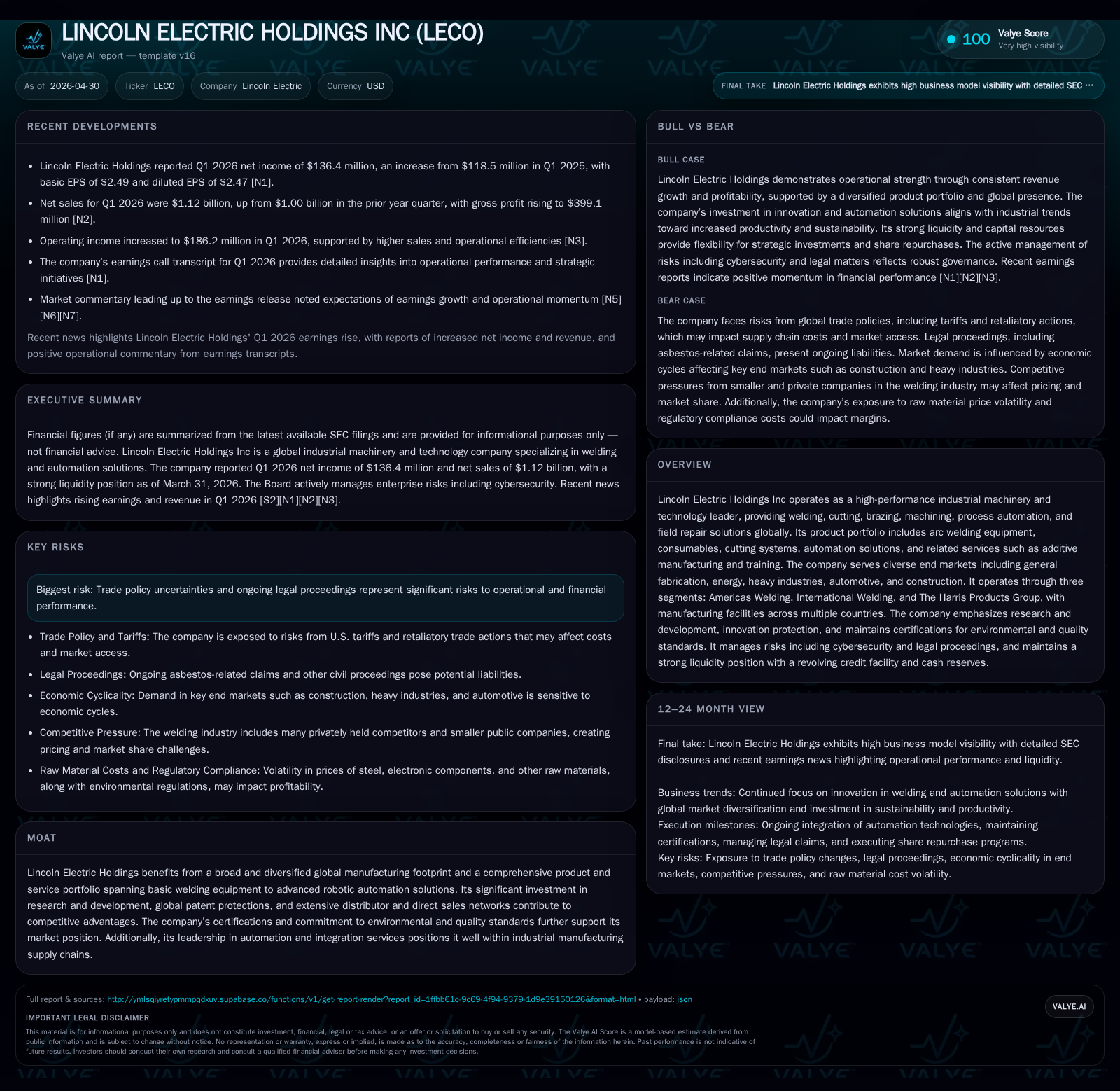
Lincoln Electric Holdings reported a solid first quarter in 2026 with net sales rising to $1.12 billion, driven primarily by higher consumables revenue. The company continues to implement cost rationalization measures expected to positively influence future operations without impairing liquidity. Lincoln Electric’s diversified product range, global footprint, and investments in automation position it well against competitors in the welding equipment and industrial machinery sectors. Key growth drivers include expanding automation solutions and strategic acquisitions enhancing digital welding capabilities. However, trade policy uncertainties and legal proceedings remain notable risks. Monitoring backlog trends, automation segment performance, and cost control execution will be essential in upcoming periods.
Recent Operating Update
In the first quarter ended March 31, 2026, Lincoln Electric Holdings Inc reported net sales of $1.12 billion, representing an 11.7% increase compared to the prior year quarter ($1.00 billion) [S2]. This top-line growth was largely propelled by consumables — specifically welding, brazing, and soldering filler metals — which rose robustly from $520.6 million to $636.0 million. Equipment revenues showed measured improvement to $275.2 million from $268.5 million while automation segment sales experienced a slight decline to $210.3 million from $215.3 million [S2].
Management emphasized ongoing rationalization actions aimed at optimizing the cost structure; these initiatives are anticipated to have a positive impact on future operational results without materially affecting liquidity or capital resources [S2]. Notably, additional rationalization charges may emerge in forthcoming periods as the company continues its evaluation.
The latest event filing corroborates these updates through the April 30, 2026 press release detailing first-quarter financials [S3]. Industry transcripts also echo strong demand for consumables and anticipation of further growth driven by automation enhancements [N1], [N3].
Business Model
Lincoln Electric operates a comprehensive industrial technology business focusing primarily on welding equipment and consumables alongside process automation solutions including robotic welding systems and cutting equipment [S1]. Its revenue streams derive principally from three segments: Americas Welding (covering North and South America), International Welding (Europe, Africa, Asia-Pacific), and The Harris Products Group (specialty gases, cutting products, soldering/brazing) [S24].
Consumers of Lincoln’s products span multiple industrial verticals such as general fabrication shops, automotive manufacturing plants, heavy industries including shipbuilding and energy infrastructure projects [S1]. The company generates revenue through direct sales to large industrial customers as well as via an extensive independent distributor network that supports broad market penetration.
Key drivers within revenue involve:
- Volume: usage rates of consumables linked directly to operational intensity at customer sites.
- Price/Mix: ability to price premium consumables or equipment augmented by innovation adds margin upside.
- Contracts: longer-term automated systems projects entail multi-year deployment commitments providing backlog clarity.
Rationalization of production facilities alongside targeted capital investments supports margin expansion via operational efficiency improvements [S2]. Moreover, Lincoln's dedication to R&D enables continuous innovation—especially in adaptive robotics and intelligent welding software—helping sustain competitive differentiation [S1].
Industry Structure and Competitive Position
Lincoln Electric holds a prominent position within the global arc welding machinery and consumables market characterized by moderate fragmentation but high technological barriers related to quality certification standards (ISO/ANSI), intellectual property protections, and proprietary process know-how.
Its competitive advantages include:
- A geographically diversified manufacturing base allowing proximity to key markets which helps mitigate tariff risks and supply disruptions.
- Broad IP portfolio safeguarding proprietary technologies such as Inrotech’s vision-based adaptive welding algorithms acquired recently [S5].
- Integrated service offerings spanning field repair services and training that enhance switching costs for customers.
- Extensive distribution channels reaching both large-scale industrials and smaller end users.
Peers often consist of large diversified industrial conglomerates or specialized weld equipment firms; however, Lincoln’s scale combined with advanced automation products positions it favorably especially as factories increasingly adopt Industry 4.0 practices.
Growth Drivers
Several structural factors underpin expected mid-to-long term growth:
Automation Demand: Rising incorporation of robotic welding cells in automotive assembly lines and heavy manufacturing is accelerating investment in automated welding solutions where Lincoln leads with adaptive intelligence features [S5].
Consumables Stability: Consumable materials represent recurring revenue with relatively stable demand linked closely to global manufacturing activity levels.
Strategic Acquisitions: Integration of companies like Alloy Steel Australia expands exposure to mining sector maintenance solutions enhanced by digital monitoring capabilities—a niche with significant growth potential given mining industry capex cycles [S10].
Energy Sector Expansion: Growth in energy infrastructure development worldwide fuels demand for precision welding solutions critical for pipelines and heavy equipment fabrication.
Global Construction Activity: The construction industry's rebound post-pandemic drives demand for reliable welding tools that support infrastructure projects across geographies.
Moreover, continuous R&D investment ensures next-generation technologies maintain product relevance amid financial tightening phases affecting capex budgets broadly.
Risks / Watchpoints / Growth Constraints
Despite strengths, certain challenges could constrain growth:
Trade Policy Volatility: Fluctuating tariffs or import restrictions could raise input costs or disrupt supply chains globally impacting price competitiveness [S21].
Legal Proceedings: Ongoing product liability claims bring potential episodic litigation costs; although historically defense outcomes have been favorable these liabilities warrant prudent monitoring [S21].
Raw Material Price Inflation: Costs of steel wire feedstock or specialty alloys can compress margins if not effectively passed through consumers.
Automation Segment Headwinds: Slight Q1 decline hints at potential softness or deployment timing challenges within high-value automation orders requiring careful tracking.
Integration Risks: Successful assimilation of recent acquisitions remains pivotal for realizing expected synergy gains without undue disruption.
What To Watch Next
Investors should follow several key execution indicators:
- Quarterly backlog levels in automation solutions which serve as forward-looking revenue levers.
- Consumable volume trends reflecting underlying industrial utilization rates across markets.
- Progress on cost rationalization efforts including charges recorded in upcoming quarters.
- Metrics relating to integration success such as cross-selling wins with recently acquired businesses.
- Management’s commentary on raw material pricing dynamics and pass-through capabilities.
- Renewal rates or expansions within major accounts especially in energy-related sectors.
Explicit guidance remains unprovided but management’s emphasis implies cautious optimism pending macroeconomic developments [N1], [N3].
Financial Profile Contextualization
Latest financial snapshot
| Metric | Value | Period |
|---|---|---|
| Cash & equivalents | $299mm | |
| 2026-03-31 | ||
| Total debt | $1150mm | |
| 2026-03-31 | ||
| Net debt | $851mm | |
| 2026-03-31 | ||
| Current assets | $1863mm | |
| 2026-03-31 | ||
| Current liabilities | $1020mm | |
| 2026-03-31 | ||
| Current ratio | 1.83x | |
| 2026-03-31 |
Source: SEC companyfacts cache [F1].
As of March 31, 2026 Lincoln Electric’s balance sheet shows cash & equivalents at approximately $299 million against total debt near $1.15 billion (net debt close to $851 million), reflecting moderate leverage consistent with historical levels [F1], [S2], [S18]. The weighted average interest rate on senior notes stands at about 4.16% with roughly 8.4 years remaining tenure offering manageable refinancing risk profiles [S2].
Current assets cover current liabilities nearly twice over (current ratio ~1.83), underlining sound short-term liquidity positioning [F1]. The company maintains compliance with all debt covenants per recent disclosures [S2], signaling credit profile stability supportive of strategic investments without immediate funding pressures.
Disclaimer
This report is for informational purposes only and does not constitute investment advice or a recommendation regarding the purchase or sale of any securities.
Disclaimer: This is research-only, informational analysis and not investment advice. It may include AI-generated interpretation and general industry context. Always verify important details using primary sources.

Comments