
SHOP Unveils New Growth Trajectory Through AI-Driven Commerce Platform Enhancements
Shopify's latest disclosures highlight operational momentum fueled by AI integrations and strategic executive alignment, reinforcing its expansive merchant ecosystem and innovation-led growth.
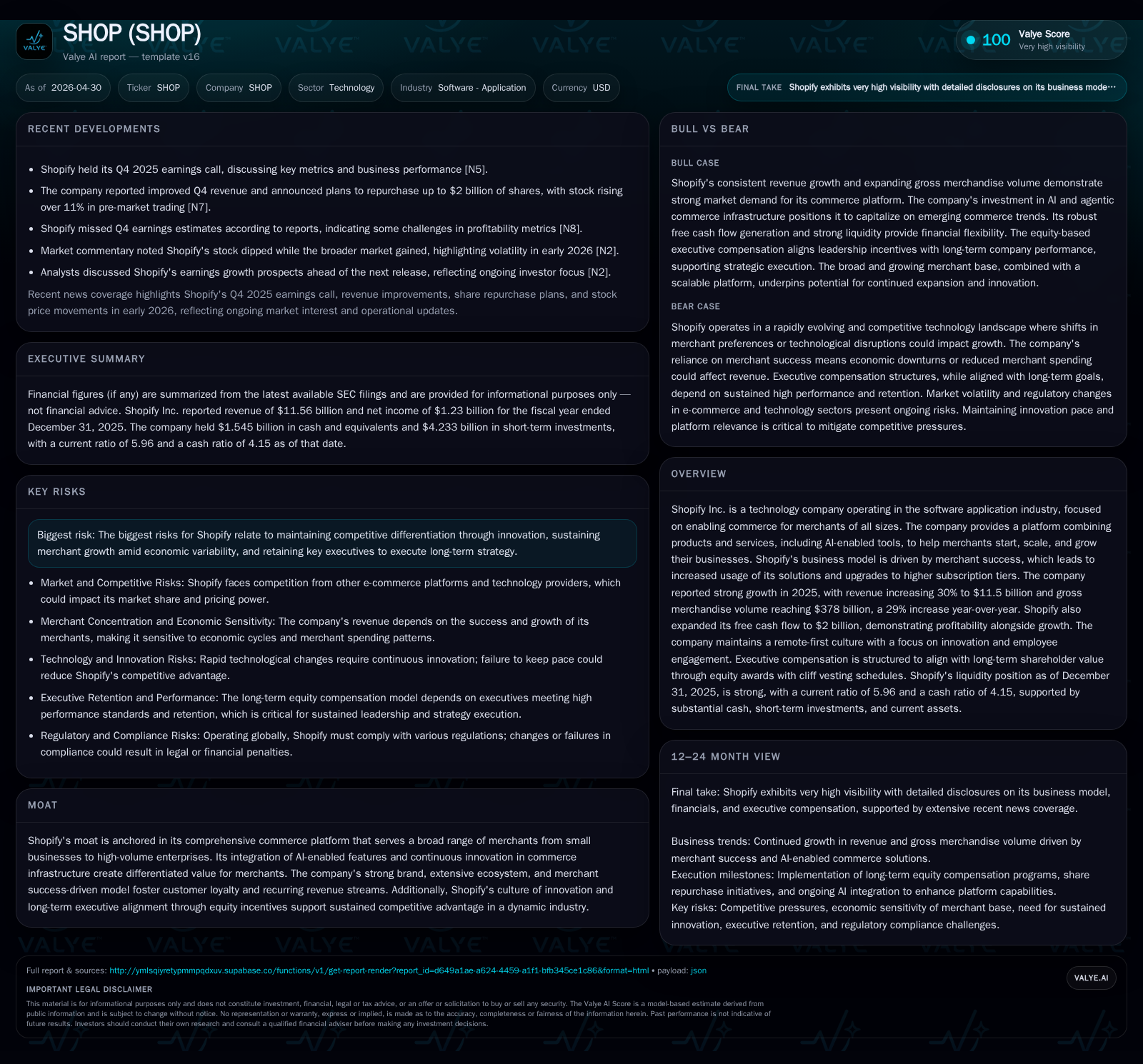
In its November 2025 quarterly filing and amended 2025 annual report, Shopify detailed sustained growth supported by AI-enabled commerce tools and an executive compensation structure that incentivizes long-term shareholder value. The company’s integrated platform serves merchants across scales, leveraging subscription upgrades and app ecosystems to drive recurring revenue. With a broad market coverage from small businesses to enterprises, Shopify solidifies its moat through continuous innovation and cultural investment. Growth is propelled by rising gross merchandise volume and merchant expansion, while risks center on maintaining differentiation amid dynamic market conditions and ensuring leadership retention. Key upcoming milestones include tracking AI adoption rates within the merchant base and managing long-term incentive vesting to sustain executive focus on strategic execution.
Latest Operational Developments and Strategic Updates
Shopify’s most recent quarterly disclosure dated November 4, 2025 (10-Q) reveals a continuation of robust operational momentum leveraged by deepening integration of artificial intelligence within its commerce platform [S2]. Notably, Shopify emphasizes the rollout of Sidekick—an AI-powered commerce assistant—to empower merchants in optimizing operations and scaling sales. This reflects a dual-front strategy: enhancing merchant business intelligence while concurrently building foundational infrastructure for what they term "agentic commerce," encompassing advanced protocols like Universal Commerce Protocol and Agentic Storefronts [S6]. These technology investments signal Shopify’s intent to remain at the vanguard of commerce evolution well beyond traditional e-commerce boundaries.
Complementing these operational enhancements, the company’s April 29, 2026 amended annual filing (10-K/A) underscores executive compensation reforms to further align leadership incentives with long-term shareholder value creation [S1]. The Compensation and Talent Management Committee has shifted towards an equity-heavy pay structure featuring "boxcar" equity grants characterized by cliff vesting schedules extending over multiple years [S16]. This design departs from conventional metric-tied incentive plans in favor of promoting sustained execution agility within a rapidly evolving commercial landscape.
SHOP’s Integrated Commerce Platform: Business Model Insights
Shopify operates what can best be described as an integrated commerce ecosystem serving a diverse range of merchants—from nascent entrepreneurs to large-scale enterprises [S1]. Its revenue mechanics are primarily subscription-driven, with multiple tiers reflecting escalating levels of platform functionality, augmented by transactional services including payment processing, fulfillment solutions, and app marketplace offerings. Merchant success forms a self-reinforcing feedback loop: as sellers grow their gross merchandise volume (GMV), they typically upgrade to higher subscription tiers and add on complementary apps that optimize business operations [S10].
This model yields strong recurring revenue profiles because switching costs stem not only from platform data lock-in but also from the extensible nature of Shopify’s software ecosystem supporting custom integrations—a significant competitive advantage in the SaaS application sector. While churn exists, it is mitigated by continuous innovation cycles introducing new AI functionalities and diversified product services that respond dynamically to merchant needs.
Quality of Products and Service Differentiators
Product-wise, Shopify fuses SaaS simplicity with enterprise-grade extensibility. The user experience remains streamlined for smaller sellers while simultaneously supporting complex customization requirements demanded by larger clients [S6]. AI integration stands out as a differentiator; tools like Sidekick augment merchants’ decision-making with data-driven insights rather than mere automation.
Beyond direct SaaS offerings, Shopify nurtures an active developer community that fuels network effects vital for marketplace vibrancy, creating an ecosystem effect whereby both merchants and third-party developers benefit from shared engagement. Its infrastructure investments in emerging commerce protocols aim to future-proof the platform against both technological disruption and shifting consumer behavior patterns.
Industry Dynamics and Competitive Positioning
Within the broader software application industry focused on commerce enablement, Shopify occupies a formidable position thanks to its broad market addressability ranging from SMBs to global enterprises [S1], [S2]. Competitors include other commerce platforms like BigCommerce or Wix eCommerce as well as marketplaces such as Amazon offering competing seller services. However, Shopify’s moat derives from its holistic approach—offering not just storefront technology but also payment processing, fulfillment options, marketing tools, analytics, app ecosystems, and now AI-augmented workflows.
Pricing power faces some pressure given commoditization trends in basic e-commerce solutions; yet Shopify mitigates this through tiered offerings that progressively embed higher-value features incentivizing upgrades rather than outright price increases. Regulatory risks appear manageable currently but could intensify should global digital sales tax policies or data privacy regulations evolve unpredictably.
Key Growth Engines and Expansion Opportunities
Growth at Shopify is structurally driven by several measurable engines:
- Incremental expansion in unique paying merchants as digital commerce penetration widens globally.
- Migration of existing merchants into higher-priced subscription plans reflecting increased platform usage enabled by added functionalities.
- Adoption rates for newly introduced AI-enabled solutions acting as usage multipliers.
- Extension of referral partner programs amplifying channel reach beyond organic direct sign-ups.
Recent disclosures note revenue growth nearing 30% year-over-year with GMV scaling close to $378 billion in 2025—a concrete testament to these underlying drivers [S1]. Internal KPIs like subscription upgrade velocity alongside third-party developer activity serve as critical barometers for sustaining this momentum.
Potential Risks and Structural Constraints
Despite strengths, Shopify acknowledges multifaceted risks relevant today. The foremost is the imperative to maintain rapid innovation velocity required to differentiate amid intensifying competitive pressures [S1]. Falling behind peers technologically could erode pricing power and customer loyalty over time.
Economic cyclicality poses a second-order risk; downturns or reduced consumer spending power impact merchant ordering frequency directly influencing platform volumes. Additionally, executive retention risk garners notable focus given strategic complexity requiring seasoned leadership stability.
Potential user churn elevated by shifting platform preferences or commoditization pressures also warrants vigilance though mitigated presently through the ecosystem lock-in effect. Operationally, scalability constraints are less evident due to cloud-native architectures but should be monitored alongside geographic expansion efforts considering regulatory compliance complexity.
Forward-Looking Indicators and Execution Milestones
Looking ahead, key indicators to monitor include:
- Merchant subscription tier migration rates evidencing willingness to pay for premium capabilities.
- Utilization statistics for emergent AI tooling such as Sidekick reflecting incremental value capture from technological enhancements.
- Merchant count growth trends separating structural adoption gains from macroeconomic noise.
- New partner program enrollments signaling channel diversification success.
- Executive equity vesting milestones aligned with retention ensuring continuity in strategy execution.
Stakeholders will also keenly observe management commentary around innovation pipelines anchoring agentic commerce paradigms as well as any shifts in governance practices reinforcing shareholder alignment through compensation framework adaptations [S7], [S16].
This analysis synthesizes details strictly derived from SEC filings dated November 2025 through April 2026 without extrapolation beyond provided disclosures. It aims solely to present an informed perspective on SHOP’s operational context within the software application industry focusing on commerce enablement platforms.
Disclaimer: This publication does not constitute investment advice or recommendations. Readers should conduct their own due diligence before making financial decisions.
Disclaimer: This is research-only, informational analysis and not investment advice. It may include AI-generated interpretation and general industry context. Always verify important details using primary sources.

Comments