
Enzon Pharmaceuticals Transforms into Viskase Holdings Post-Merger with Operational and Capital Structure Shifts
Following a strategic merger in early 2026, Enzon Pharmaceuticals has repositioned its business model, governance, and financial structure under the Viskase Holdings identity.
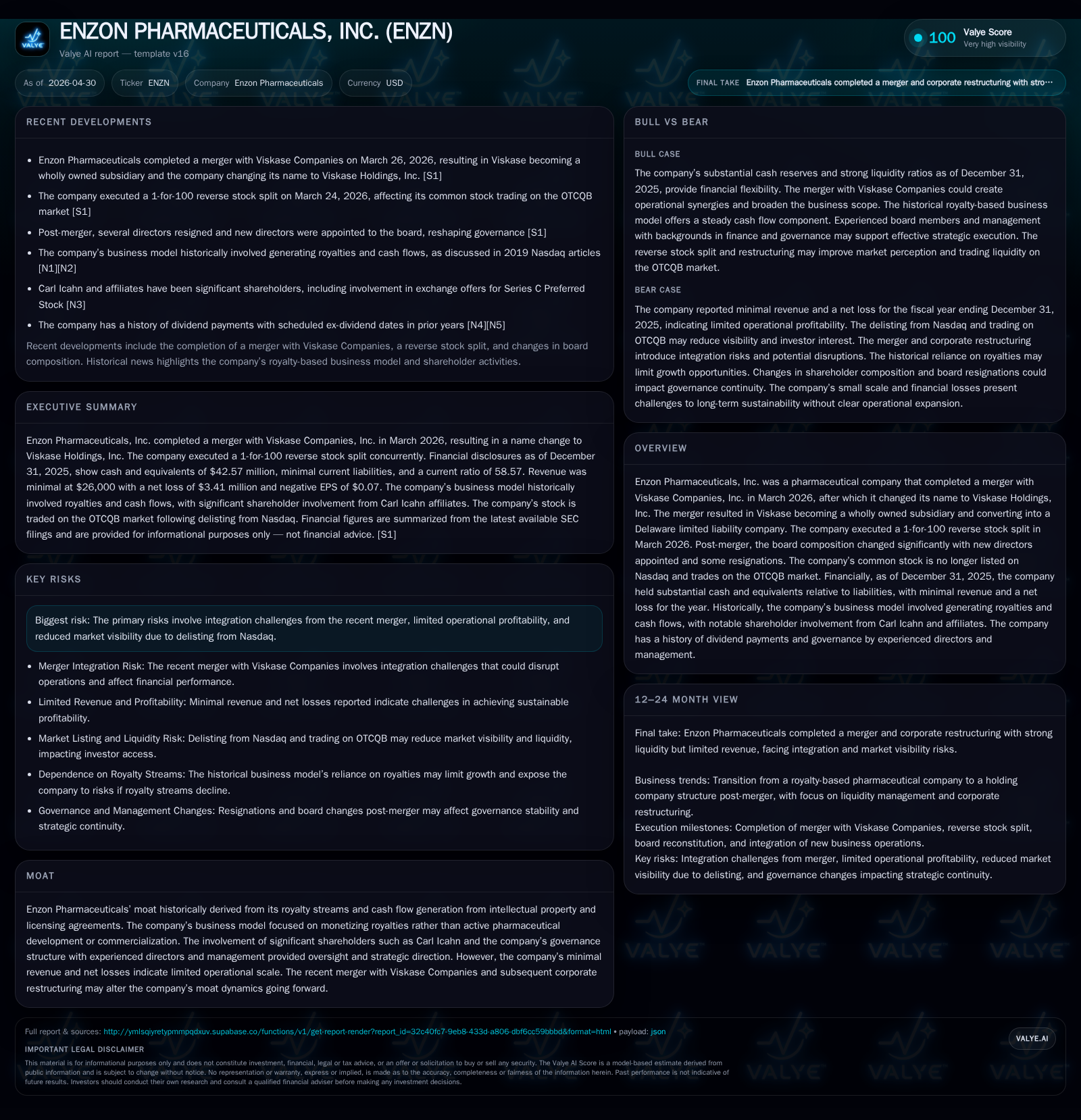
Enzon Pharmaceuticals completed a transformative merger with Viskase Companies in March 2026, resulting in a rebranding to Viskase Holdings and a shift from pharmaceutical royalties to manufacturing operations focused on packaging solutions. The company executed a 1-for-100 reverse stock split preceding this transition and is now traded on the OTCQB market after delisting from Nasdaq. Its historical business model centered on royalty income from intellectual property, but the merger places it within the food-grade packaging sector, facing new operational dynamics and growth drivers. Financially, Enzon maintained a solid cash position going into transition but operated at a net loss with minimal revenue prior to the merger. Risks center on integration challenges and market visibility amid the strategic pivot.
Recent Operating Update
Enzon Pharmaceuticals' latest critical development is its completed merger with Viskase Companies, Inc. as of March 26, 2026 [S20]. This transaction fundamentally reshaped Enzon—from a former pharmaceutical royalty monetization company into a holding entity for Viskase, now operating primarily in the manufacturing and packaging domain under the name Viskase Holdings, Inc. Preceding this merger was a significant corporate housekeeping event: a 1-for-100 reverse stock split executed on March 24, 2026 [S27], which consolidated the company's outstanding shares to meet strategic goals associated with the merger.
Post-merger governance saw substantial board composition changes aligning leadership with the new business focus [S1].
Operationally, Enzon's latest quarterly filings through November 2025 revealed minimal revenue generation (approximately $26,000 annually per latest year data) derived primarily from royalty income linked to legacy intellectual property rather than active pharmaceutical product sales or development [F1]. This underscores that prior to merging, Enzon's core business generated low operational scale and losses (net income of -$3.4 million in FY2025) while maintaining substantial cash reserves ($42.6 million at year-end 2025) [F1].
Parallel with these transitions were amendments to credit agreements extending maturity dates and adjusting interest rates, evidencing ongoing corporate finance management amid restructuring phases [S3]. These steps highlight efforts to maintain leverage discipline as business focus transitions.
Business Model Evolution
Historically, Enzon functioned largely as an IP licensing entity within biopharmaceuticals—monetizing royalties rather than engaging directly in drug development or manufacturing. This model concentrated revenue mechanics on residual streams primarily from external licensees paying royalties based on product sales or milestones related to proprietary formulations or delivery technologies.
With near-zero revenue generation historically supported by royalty inflows accompanied by net operating losses after administrative expenses [F1], Enzon lacked significant internal product pipelines or manufacturing capabilities.
The recent merger effectively dissolves this legacy model by folding Enzon into Viskase Holdings—a company whose operational thrust centers on manufacturing specialty food casings used extensively in sausage production and related packaged foods. This pivot moves the combined entity downstream into tangible product manufacture and supply chain management rather than intangible IP rights monetization.
Revenue mechanics now shift towards direct customer billing for manufactured goods with volume driven by food industry demand cycles and pricing influenced by raw material costs (notably collagen-based or cellulose casings), competitive positioning among global casing producers, and relationships with major food processors.
Margins will depend intensively on manufacturing efficiency, scale optimization at production sites (now organized as wholly owned LLC subsidiaries), raw material input price volatility management, and distribution reach—factors sharply distinct from previous IP-driven cash flow profiles.
Industry Structure and Competitive Position
Food packaging casings constitute a niche yet global industry segment dominated by specialized manufacturers often serving large downstream clients such as meat processors and food service companies. The market features moderate fragmentation but high regulatory scrutiny given food safety standards alongside ongoing innovation pressures around sustainable materials.
Viskase traditionally holds strong competitive stature within this space due to established customer relationships, ingredient expertise (collagen-based casings), and technical capabilities aligned with compliance demands across multiple jurisdictions. The merger places former Enzon stakeholders into an operating company exposed to cyclicality linked to consumer food trends, raw material input costs (e.g., collagen availability), and innovation adoption rates.
Competitive differentiation hinges upon product quality consistency, ability to innovate with alternate biodegradable or synthetic casing materials amidst sustainability trends, customer service adaptability within just-in-time supply models, and geographic footprint expansion to meet global demand centers.
Growth Drivers
Post-merger growth will be driven largely by:
- Market Demand: Increased processed meat consumption globally fosters steady expansion opportunities for natural casing manufacturers despite some substitution risks.
- Product Innovation: Development of novel casing materials addressing health-conscious or environmental concerns could unlock premium pricing or new segments.
- Operational Scale: Leveraging merged capital resources facilitates capacity investments enhancing cost leadership or enabling entry into adjacent packaging categories.
- Customer Retention & Expansion: Deepened penetration among existing large-scale food processors combined with acquisition of smaller customers drives volume growth.
- Geographic Diversification: Expansion into emerging markets where processed meat consumption is rising represents structural opportunity beyond saturated developed markets.
These drivers interlock around effective deployment of capital—notably enabled by stable cash reserves inherited pre-merger—and managerial expertise tailored toward facility optimization rather than prior R&D-focused resource allocation.
Risks / Watchpoints / Growth Constraints
Key risks relate primarily to transition execution:
- Integration Complexity: Merging disparate corporate cultures—from IP licensing heritage to manufacturing operations—poses governance and operational continuity risks.
- Market Visibility Reduction: Delisting from Nasdaq reduces institutional analyst coverage potential and liquidity—possibly affecting capital access or investor relations effectiveness.
- Financial Leverage Adjustments: Amendments increasing applicable interest rates under revolving loans may raise cost of capital during integration expenditure periods [S3].
- Operational Cyclicality: Raw material input price fluctuations coupled with consumer demand variations can pressure margins absent dynamic pricing agility within inherently commoditized environment.
- Regulatory Compliance: Food safety regulations remain stringent; any lapses could result in costly recalls or reputational damage impairing customer relationships.
- Shareholder Dilution: Exchange offers concerning preferred stock conversions introduce complexity in shareholder base stability ahead of full integration completion [S21].
What To Watch Next
Upcoming checkpoints include:
- Filing of pro forma financial statements post-merger detailing combined entity metrics [S20]; these will illuminate synergy capture progress and baseline profitability trajectory shifts.
- Execution milestones for integrating manufacturing operations under Viskase Holdings’ organizational framework impacting cost structures.
- Updates on innovation pipeline around new casing materials responding to sustainability trends potentially flagged through press releases or proxy communications.
- Market adoption signals visible through customer contracts or backlog announcements indicating sales momentum in key regions.
- Refinancing developments signaling financial flexibility enhancement post-amendment transitioning period [S3].
- Monitoring share trading patterns on OTCQB platform for liquidity changes reflecting investor confidence following delisting effects.
Financial Profile Contextualization
Latest financial snapshot
| Metric | Value | Period |
|---|---|---|
| Cash & equivalents | $43mm | |
| 2025-12-31 | ||
| Current assets | $43mm | |
| 2025-12-31 | ||
| Current liabilities | $731000 | |
| 2025-12-31 | ||
| Current ratio | 58.57x | |
| 2025-12-31 |
Source: SEC companyfacts cache [F1].
At December 31, 2025—the last reported fiscal year end before merger completion—Enzon Pharmaceuticals sustained extremely limited revenue ($26k) reflecting its dwindling pharmaceutical royalty base [F1]. The operating loss was material at approximately $5.3 million leading to a net loss of $3.4 million for that period despite conserving substantial cash resources amounting to $42.57 million against minimal current liabilities ($731k), yielding an exceptionally strong current ratio exceeding 58x [F1]. This suggests robust near-term liquidity underpinning transaction activities but underscores poor operational cash flow generation formerly.
The absence of debt reported at least since end-2013 frames Enzon’s prior balance sheet as conservatively leveraged before absorbing Viskase’s operating assets [F1]. Recent amendments raised borrowing costs slightly but extended maturities help manage refinancing risk during transformation phases [S3].
Overall financial characterization indicates healthy solvency cushioning against integration expenses but demands careful margin improvement via operational scale once focused on manufacturing revenue streams commences fully post-merger.
This analysis synthesizes SEC disclosures up to April 30, 2026, including filings directly associated with Enzon Pharmaceuticals' corporate restructuring events transitioning it into Viskase Holdings. It avoids speculative forecasts not grounded in filing evidence while highlighting analytical insights into business strategy shifts prompted by recently concluded transactions. Readers should consider potential rapid evolution as integration proceeds along with broader market developments in related industry segments.
Disclaimer: This is research-only, informational analysis and not investment advice. It may include AI-generated interpretation and general industry context. Always verify important details using primary sources.

Comments