
United Homes Group Prepares for Stanley Martin Merger Amid Governance and Market Challenges
UHG faces operational headwinds and governance setbacks while securing credit flexibility as it approaches a pivotal merger.
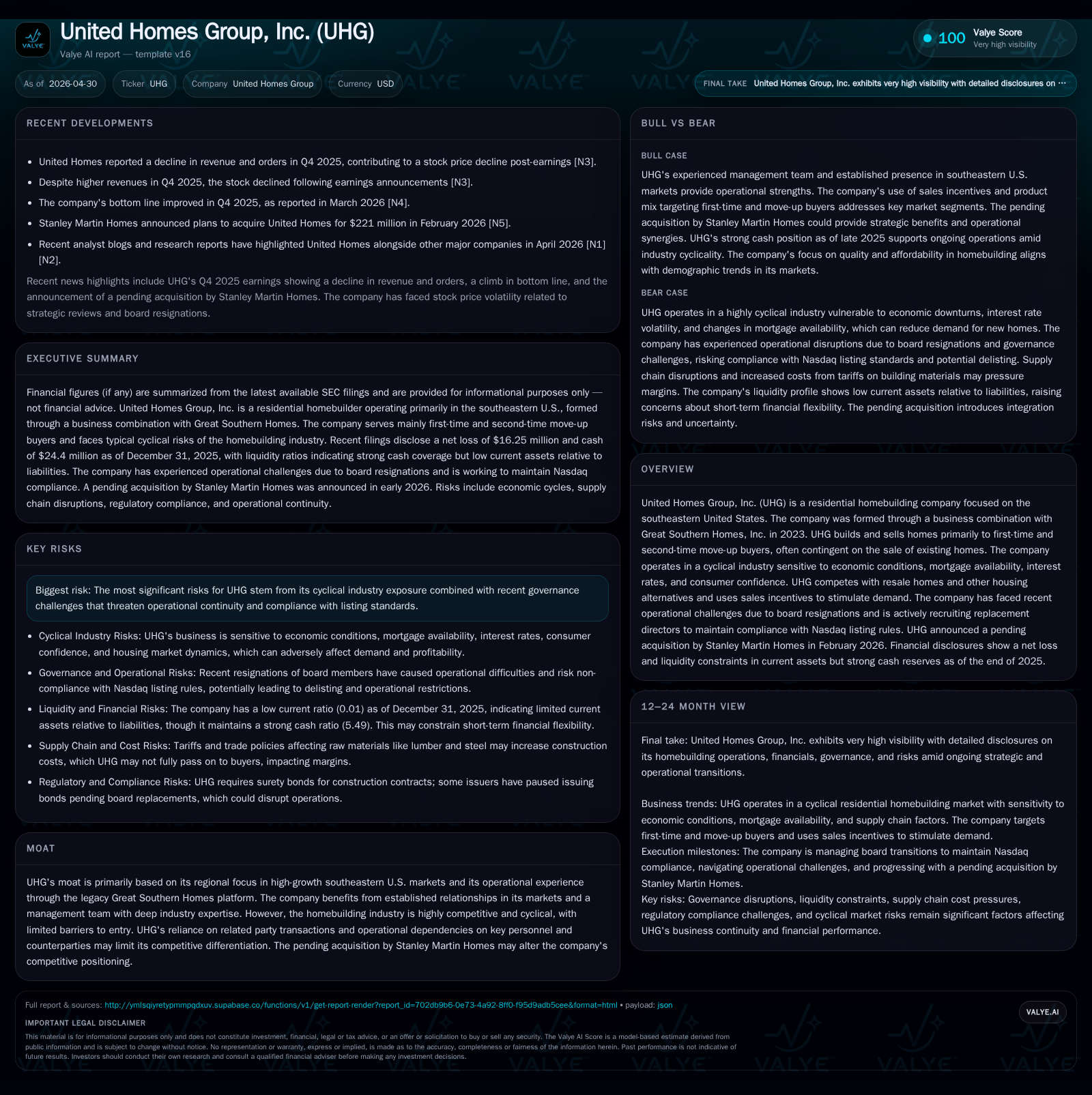
United Homes Group, Inc. (UHG) reported worsening liquidity metrics and ongoing governance challenges in its latest 10-Q, underscoring the risks inherent in its homebuilding business amid economic cyclicality. The company has negotiated a critical amendment to its credit facility to waive key covenants pending the anticipated merger with Stanley Martin Homes, planned for Q2 2026. This merger represents a strategic inflection that could significantly reshape UHG’s competitive positioning in the Southeastern U.S. homebuilding market. However, execution risks persist given board turnover, tight liquidity, and market headwinds affecting its core buyer base.
Recent Operating Update: Q3 2025 Filing and Early 2026 Developments
United Homes Group’s latest significant disclosure is its Q3 2025 Form 10-Q filed on November 7, 2025 [S2]. The filing reaffirms persistent risks related to liquidity and governance. UHG’s reported current ratio is alarmingly low—around 0.01 based on available current assets versus liabilities [F1], signaling strained near-term liquidity. The company continues to operate under heightened risk due to multiple board member resignations announced in late 2025 [S12], threatening Nasdaq listing compliance.
On April 3, 2026 [S3], UHG entered into the Fifth Amendment of its credit facility with Wells Fargo that waived the debt service coverage ratio and leverage ratio covenant requirements through May 31, 2026—conditional upon completing the pending merger with Stanley Martin Homes or facing refinancing obligations thereafter [S26]. This amendment buying time evidences financial stress against a backdrop of merger-driven uncertainty.
February 2026 marks a material turning point when UHG publicly announced a definitive merger agreement with Stanley Martin Homes valued at $1.18 per share in cash consideration [S22]. The merger remains subject to customary closing conditions with an expected Q2 2026 consummation timeline [S19]. This transaction encapsulates market uncertainties impacting valuation given downward pressure on orders and revenue noted in prior earnings releases [N1].
Business Model Overview
UHG operates principally as a residential homebuilder focused in Southeastern U.S., formed from the business combination with Great Southern Homes in 2023 [S1]. The company targets first-time buyers and second-time move-up buyers who often need contingent sales of existing homes to finance purchases. Revenue derives primarily from home sales generated by volume bookings influenced by new construction starts in subdivisions developed or controlled by UHG.
The revenue mechanics hinge on:
- Customer Base: Mostly early-stage homeowners requiring mortgage availability.
- Pricing: Home prices set based on local market conditions but reliant on passing through costs of building materials subject to supply-chain volatility [S17].
- Volume: Driven by consumer confidence, economic conditions, demographic tailwinds including population growth & immigration.
- Contracts: Sales often include contingencies tied to buyers disposing existing properties.
Margins are pressured by material cost inflation (steel, lumber tariffs etc.), labor shortages common in residential construction markets, and the necessity of sales incentives/software financing options to maintain deal flow amid competition from resale homes or other housing forms [S12]. Cash conversion cycles are elongated relative to many industries because homebuilding spans multiple quarters from land acquisition through construction completion.
Industry Structure and Competitive Position
The Southeastern U.S. residential homebuilding sector is fragmented but intensely competitive. UHG leverages GSH’s established operational footprint concentrated in fast-growth metro areas with favorable demographic trends such as migration from higher-cost states [S1]. This regional focus provides some moat via localized market knowledge, supplier relationships, and brand awareness.
However, barriers to entry remain low given abundant land availability outside dense urban cores while national builders compete aggressively on scale advantages. Customer switching costs are minimal; buyers favor convenience, pricing competitiveness, product customization options & brand trust at local levels.
Notably, industry cyclicality deeply exposes operators like UHG to macroeconomic shocks—interest rates hikes impair buyer purchasing power; mortgage credit tightening delays closings; inflationary pressures erode margins; regulatory changes alter financing incentives [S12]. Furthermore,
- Supply-chain disruptions raise incremental cost unpredictability.
- Surety bond availability—a critical prerequisite for public developments—is currently challenged due to governance instability at UHG leading some sureties to suspend issuance affecting project pipelines [S25].
Governance remains a salient theme: mass resignations of directors late last year have introduced compliance risks that ripple over investor confidence and operational stability [S12]. Replacing qualified independent directors is urgent to avoid listing penalties.
Growth Drivers
Despite cyclical headwinds, several structural growth drivers support demand for UHG’s offerings:
- Demographic Trends: Population growth across southeastern metros driven by domestic migration inflows, immigration patterns, and expanding employment opportunities underpin housing demand.
- Urban/Suburban Migration: Post-pandemic shifts favor suburban living spaces where starter homes prevail.
- First/Second-Time Buyers: These buyers form a large share of market volume; stable mortgage markets could unlock pent-up demand among these cohorts.
- Land Development Pipeline: Control over attractive infill tracts at competitive acquisition costs can fuel volume growth if capitalized efficiently.
Scaling new communities with enhanced amenities tailored for move-up buyers could increase average selling prices (ASP) mildly improving revenue mix composition over time. However, demand elasticity relative to pricing remains high; aggressive discounting or incentive programs may be necessary during downturns.
Risks / Watchpoints / Growth Constraints
UHG’s risk profile is materially elevated:
- Liquidity Risks: Low current ratios combined with material debt levels ($67.45 million total debt vs $24.42 million cash) suggest leverage constraints that could amplify if adverse market developments delay merger closure or refinancing options post-May 31 covenant waiver expiration [F1] [S26].
- Governance Uncertainty: Board attrition threatens Nasdaq continued listing eligibility creating potential operational disruptions particularly regarding audit committee oversight necessitating timely appointments of qualified directors [S12].
- Merger Execution Risk: While the Stanley Martin deal provides a clear strategic path forward, integration complexity plus risk of termination fees or regulatory hurdles remain possible derailments [S21].
- Market Cyclicality: Sensitivity to macroeconomic fluctuations (mortgage rates especially) can cause volatile booking patterns undermining predictability.
- Supply Chain & Cost Inflation: Continued tariff exposure around critical inputs such as lumber may pressure margins without commensurate price adjustments [S17].
- Surety Bond Access: Restricted surety bonding capacity imposes direct project delivery restrictions adversely impacting revenue timing [S25].
What to Watch Next
Key near-term indicators will inform outlook clarity:
- Closing status of the Stanley Martin Homes merger expected by Q2 2026 including receipt of all requisite approvals [S19].
- Appointment of replacement independent directors fulfilling Nasdaq Governance Rule requirements mitigating delisting risk [S12].
- Refinancing progress or liquidity enhancements if merger conditions lapse beyond May 31st covenant waiver expiry date per credit agreement amendments [S26].
- Evidence of order stabilization or improvement reflecting seasonal buying patterns interacting with prevailing interest rate environment [N1].
- Cost trajectory for building inputs following any shifts in trade policy or supply dynamics impacting gross margin sustainability [S17].
Financial Profile (Summary)
Latest financial snapshot
At year-end December 31, 2025, United Homes Group reported: FY 2022* | *Latest reported current assets/liabilities data as of end CY22 indicates extreme current liquidity stress; note more recent data not explicitly disclosed in filings for later periods [F1].
This profile underscores negative profitability typical for firms undergoing restructuring or cyclical downturn pressures coupled with substantial indebtedness stressing refinancing imperatives ahead of merger closing deadlines.
This analysis is prepared solely for informational purposes based on publicly available SEC filings and news reports without offering investment advice or recommendations.
Disclaimer: This is research-only, informational analysis and not investment advice. It may include AI-generated interpretation and general industry context. Always verify important details using primary sources.

Comments