
Old National Bancorp Advances with Subordinated Notes and Dividend Stability
The latest quarterly filing reveals ONB’s capital enhancements, dividend consistency, and governance shifts underpinning operational resilience in a competitive regional banking landscape.
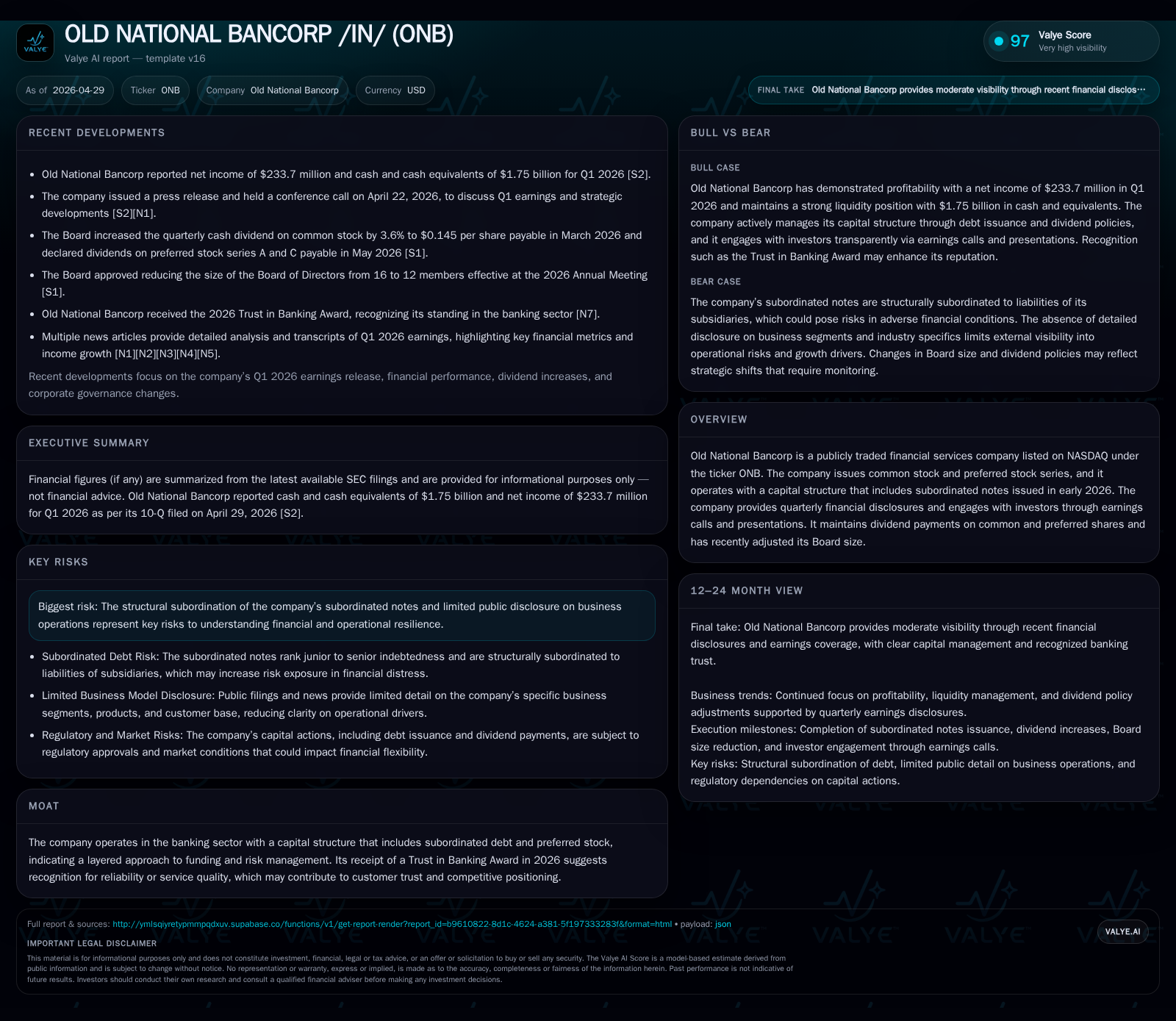
Old National Bancorp’s April 2026 quarter filings disclose the issuance of subordinated notes alongside steady dividend payments on both common and preferred stock classes, and a reduction in Board size signaling refined governance focus. The company’s layered capital structure not only supports growth capacity but also reflects prudent risk management. Industry recognition through the 2026 Trust in Banking Award bolsters customer trust, an essential moat amid competitive regional banking pressures. Going forward, ONB’s growth hinges on leveraging its enhanced funding framework, sustaining dividend appeal, and expanding market penetration while navigating regulatory dynamics and visibility constraints due to limited public disclosures.
Latest Quarterly Operating Highlights: Capital Structure and Dividend Updates
In its April 29, 2026 10-Q filing [S2], Old National Bancorp (ONB) revealed key developments that shape its near-term operational landscape. Foremost is the issuance of subordinated notes early in 2026 which strategically enhance the firm’s capital structure by layering a form of subordinated debt beneath senior obligations. This move expands ONB's capacity to deploy additional funds into revenue-generating assets while maintaining required regulatory capital buffers.
Additionally, ONB reaffirmed its commitment to consistent shareholder returns by maintaining dividends on both common stock and its Series A and Series C preferred stock shares [S3]. This signals confidence in cash flow stability despite ongoing economic headwinds often faced by regional banks.
The company also disclosed a reduction in Board size during Q1, a governance decision presumably aimed at improving oversight efficiency and decision-making agility amid an evolving regulatory and competitive banking environment [S2]. These operational elements collectively present a picture of a disciplined financial steward balancing growth ambitions with shareholder value preservation.
Business Model Overview: Banking Services, Customer Value, and Funding Layers
Old National Bancorp functions primarily as a regional bank headquartered in Indiana with diversified banking services encompassing commercial lending, retail deposits, mortgage financing, and fee-based wealth management products [S1]. Revenue generation hinges principally on net interest income — the spread between interest earned on loans and securities versus interest paid on deposits — complemented by non-interest fees derived from transactional accounts and advisory services.
A defining characteristic of ONB's business model is its layered capital structure consisting of common equity, preferred stock series (Series A & C), and recently issued subordinated notes. Such structuring represents an effort to optimize balance sheet funding cost while preserving regulatory capital adequacy. The subordinated notes provide gracefully subordinated claims which help absorb losses ahead of equity but behind senior creditors — a classic mix to support growth without diluting shareholders excessively.
Critical to ONB’s strategic moat is its receipt of the Trust in Banking Award for 2026 [S1], an accolade reflecting perceived reliability and service quality among its clientele. This recognition reinforces customer retention dynamics by reducing attrition risks inherent in highly competitive regional markets. Stable dividend payments further boost investor appeal by signaling earnings quality and distributable cash flow sustainability.
Competitive Positioning Within Regional Banking
Operating within the midwestern U.S., Old National faces a competitive set comprising other regional banks with overlapping footprints as well as large national banks exerting pressure through scale economies. Regulatory demands impose rigorous capital standards restricting aggressive leverage-based expansion; consequently, ONB’s ability to grow loan portfolios is inherently calibrated.
Pricing power over loans is moderate — constrained by alternative credit providers but bolstered incrementally through strong client relationships fostered by trusted brand identity highlighted in its award recognition. Deposit gathering benefits from established local presence but faces competition from digital-first fintech entrants accelerating innovation adoption rates.
Switching costs for customers appear elevated due to ONB’s comprehensive service mix including relationship banking for businesses that integrates credit availability with treasury management services — areas where reliability matters greatly. These factors combine to delineate ONB’s niche as a dependable provider rather than lowest-cost disruptor.
Growth Drivers: Capital Leverage, Customer Trust, and Market Penetration
The infusion provided by recently issued subordinated notes amplifies ONB's capital base enabling incremental loan origination without immediately raising common equity levels — a favorable lever given current shareholder return priorities [S2]. This additional capital layer supports measured expansion beyond organic growth constrained by internal accruals alone.
Investor confidence is nurtured via consistent dividends on multiple stock classes underscoring management’s commitment to returning excess capital while balancing internal reinvestment needs [N1]. This track record can sustain valuation premiums relative to peers reliant on erratic payout policies.
Customer loyalty driven by recognized service excellence sustains wallet share expansion opportunities particularly within established geographic markets. Such reputation acts as a buffer against competitor incursions while aiding new client acquisition at cost-effective levels.
On the product front, diversified offerings encompassing commercial loans aligned with local economic activity alongside retail deposit innovation provide platforms for cross-selling that can fuel sustainable volume increases within manageable risk thresholds.
Risks and Constraints: Disclosure Gaps and Structural Subordination
While ONB’s filings reveal structural subordination explicitly via issuance terms for its new notes—subordinated debt holders are junior to other creditors—this configuration introduces credit risk considerations impacting both borrowing costs over time and rating assessments [S2]. In distress scenarios, recovery prospects for subordinated note holders diminish more rapidly than seniors necessitating vigilant risk management.
Moreover, the company's relatively limited public disclosure beyond standard SEC filings restricts granular external analysis regarding specific operational efficiencies or emerging challenges such as credit quality trends or segment profitability dynamics [S2,S1]. This opacity constitutes a monitoring challenge for stakeholders seeking forward visibility.
Regulatory regimes governing capital requirements remain stringent especially post-2008 reforms imposing risk-weighted asset minima that could constrain rapid scaling compared to larger national peers benefiting from normalized cost-of-capital advantages.
Outlook and Near-Term Catalysts: Guidance, Milestones, and Investor Watchpoints
Investors should closely monitor execution related to incremental loan deployments funded via the new subordinated notes — any signs of pace acceleration or margin improvement would validate strategic rationale shared during earnings commentary [N1]. Additionally, clarity around dividend sustainability amid fluctuating net interest margins warrants attention considering sector-wide rate volatility impacts.
Upcoming quarterly results will serve as milestones assessing progress against disclosed guidance emphasizing balance sheet growth targets coupled with ongoing expense discipline promised alongside governance reforms including streamlined Board operations [S2,N4]. Progress in digital service capabilities or market share gains within targeted Indiana or nearby regions may emerge as further catalysts enhancing competitive stance.
Remaining alert to macroeconomic conditions affecting regional credit demand dynamics or deposit flows also remains prudent given their outsized influence over core banking economics relative to isolated fee income streams.
Current Financial Profile: Liquidity and Capital Positioning
As of March 31, 2026 balance sheet data confirms Old National Bancorp holding $1.75 billion in cash & equivalents evidencing robust liquidity reserves supporting daily operating needs plus strategic opportunism [F1]. While latest total debt figures reported date back several years without refreshing in current filings for senior borrowings [F1], net debt proxy computed suggests modestly negative positioning (-$34 million), indicating excess cash above outstanding debts enhancing safety margins.
This liquidity adequacy underpins servicing costs associated with subordinated notes issued early 2026 while sustaining dividends across equity rounds without apparent strain. The financial posture complements operational narratives reflecting measured but confident navigation of growth amidst sectoral pressures.
Disclaimer: This analysis is based solely on publicly available SEC filings dated through April 29, 2026; it incorporates no material nonpublic information nor offers investment advice. Readers should consider further diligence given intrinsic banking industry complexities.
Disclaimer: This is research-only, informational analysis and not investment advice. It may include AI-generated interpretation and general industry context. Always verify important details using primary sources.

Comments