
CTS Corp Advances Sensor and Connectivity Innovation While Securing Flexible Capital Structure
CTS strengthens its financial foundation with a new revolving credit facility while bolstering growth in key sensing, connectivity, and motion product segments.
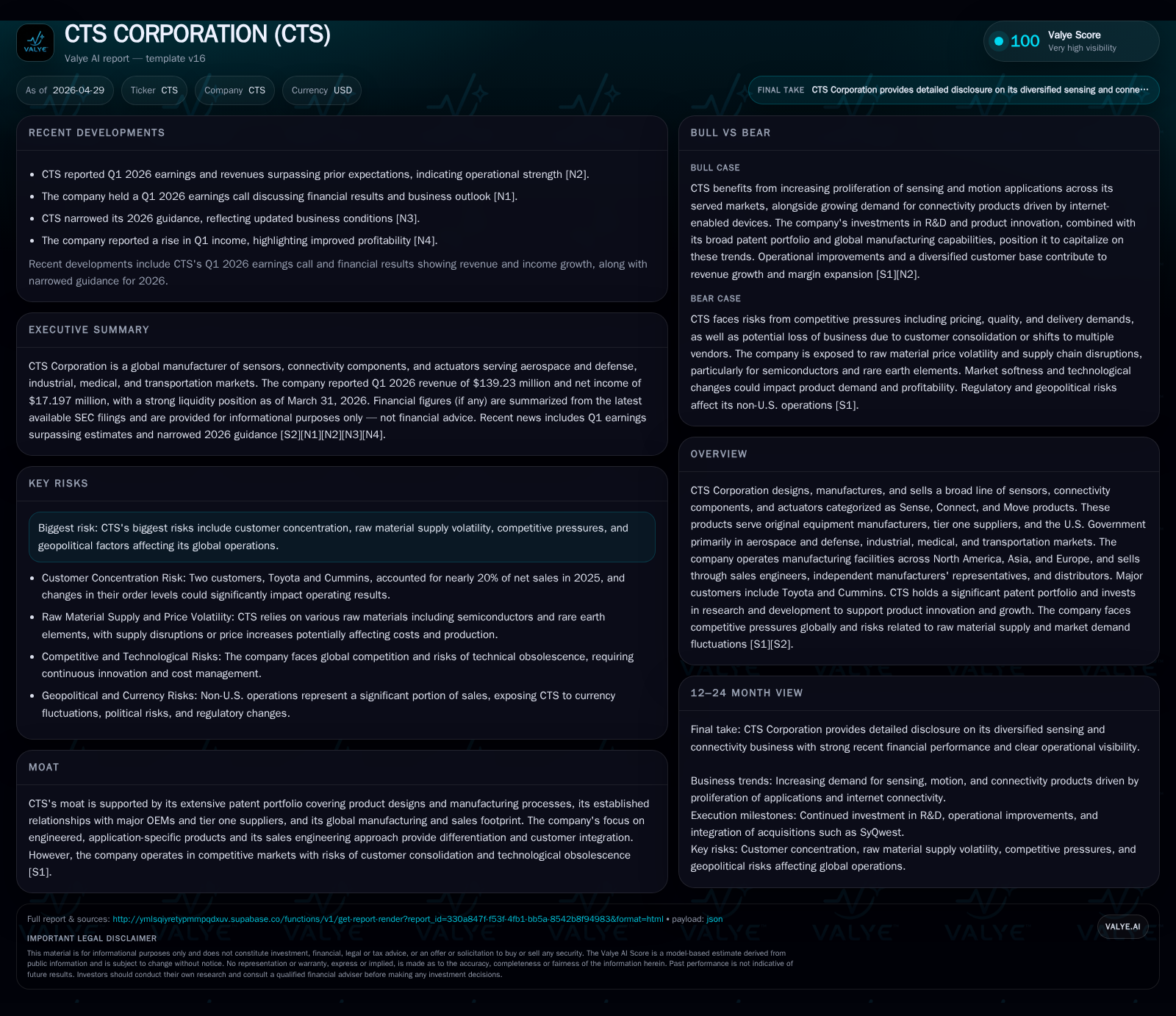
In Q1 2026, CTS Corporation refinanced its revolving credit facility into a five-year $300 million unsecured agreement providing enhanced covenant flexibility and interest rate hedging. Operationally, the company saw revenue gains driven by aerospace, defense, and medical end markets despite transportation headwinds. CTS’s diversified portfolio across Sense, Connect, and Move products serves OEMs and tier one suppliers globally, leveraging patented technology and a global manufacturing footprint. Growth is fueled by increased IoT adoption and aerospace expansions, though risks include raw material volatility and customer concentration. Near term, monitoring sales trends post-acquisition SyQwest integration and R&D pipeline progress will be critical.
Quarterly Operating Update and Capital Structure Refinement
CTS Corporation's latest quarterly filing dated April 29, 2026 reports a pivotal refinancing move executed on November 24, 2025: the company replaced its prior $400 million revolving credit facility due December 2026 with a new unsecured five-year $300 million facility maturing in November 2030 [S2][S15]. This refinancing brings several crucial enhancements — notably modified financial and non-financial covenants that afford CTS greater operational flexibility amid volatile market conditions. The Revolving Credit Facility also incorporates sublimits for swing line ($20M), letters of credit ($20M), and alternative currency borrowing ($150M), reflecting sophisticated currency management capabilities for global operations [S2].
To manage interest expense risks tied to variable rates under this new credit framework, CTS has employed interest rate swaps fixing rates on $50 million of outstanding debt through December 2030 at contractual rates between approximately 1.49% to 2.45%, recognized as cash flow hedges in other comprehensive income [S2]. Moreover, the company's net leverage ratio determines the commitment fee range (0.175%-0.25%) applied quarterly on undrawn facility amounts.
Operationally, Q1 2026 revenue rose year-over-year supported by strength across aerospace & defense and medical segments, partially offset by transportation sector softness associated with commercial vehicle volume declines in China [S2][N1][N2]. Earnings before taxes reached $21.7 million for the quarter amid controlling SG&A and R&D expenses proportional to sales growth [S2]. The company confirmed compliance with all revolving credit facility covenants as of March 31, 2026 indicating robust liquidity management practices [S2].
Business Model Overview: Sense, Connect, Move Product Ecosystem
CTS’s business model centers on designing, manufacturing, and selling high-precision sensors (Sense), connectivity components (Connect), and actuators (Move) [S1]. These product categories drive electronic system functionality in targeted end markets: aerospace & defense; industrial; medical; transportation; plus contracts with the U.S. Government.
Sense products include controls like pedals and switches delivering critical input signals; Connect devices (EMI/RFI filters, capacitors) enable synchronization among electronic systems; while Move products (piezo microactuators) execute precise physical movements critical in automation or safety applications. This triad addresses specific layers of system integration fostering stickiness with OEMs and tier one suppliers like Toyota and Cummins who rely on CTS for application-specific product solutions tailored via sales engineering support teams [S1].
Manufacturing footprints span North America, Europe, Asia — facilitating localized customer responsiveness while mitigating supply chain risks. Sales channels mix direct sales engineers complemented by independent reps and distributors expanding market reach. The extensive patent portfolio covering product designs and manufacturing processes underscores the company’s strategic intellectual property moat supporting premium pricing power on differentiated offerings [S1].
Competitive Positioning within Aerospace, Industrial, Medical, and Transportation Markets
CTS competes amid global suppliers serving industries increasingly reliant on sensor intelligence coupled with connectivity robustness for next-generation automation. Its moat derives from integrated strengths: patented technologies guarding against commoditization; established long-term OEM relationships fostering switching costs; broad geographic manufacturing reducing exposure to regional disruptions; plus focused engineering capabilities enabling custom solutions rather than standard parts alone [S1].
The aerospace & defense vertical is a notable source of margin stability given high certification requirements that limit low-cost competition. Meanwhile industrial markets benefit from automation growth trends albeit exposed to cyclical capital spending fluctuations. Medical segment gains reflect aging demographics driving adoption of advanced sensing for diagnostics or therapeutic devices.
However, intense competition persists from large electronics component firms alongside specialized newer entrants advancing rapid product innovations raising obsolescence risk cycles. Regulatory complexities pertaining to multi-region compliance also add overheads restricting swift scale-ups globally [S1]. Customer consolidation among OEMs can amplify negotiation power pressures especially in transportation where some clients have lost market share in key regions like China [S1].
Drivers Fueling Growth: Innovation, Customer Base Expansion, and Market Trends
Demand for CTS’s products structurally benefits from secular tailwinds underpinning IoT expansion proliferating sensing needs across industrial automation platforms and smart vehicles requiring advanced connectivity components facilitating data transfer integrity [S1]. Aerospace & defense budgets recovering post-pandemic plus military modernization efforts boost actuator segments where precision motion control is paramount.
The acquisition of SyQwest added over $22 million in net sales in 2025 further diversifying revenue streams into niche sensing technologies enhancing organic product pipeline breadth [S1][N1]. Continuous investments into research & development supporting new product introductions—accounting for nearly 5% of revenues—anchor future growth potential especially via engineered application-specific designs enticing tier one customers aiming at end-product differentiation [S1].
Emerging data trends increase demand for secure EMI/RFI filtering components embedded within wireless networked devices while movement toward electrification in transportation may stimulate longer-term actuator usage growth. The sales engineering-driven model encourages strong customer retention through technical consultative selling not easily replicated by generic suppliers.
Risks and Constraints: Raw Material Volatility, Customer Concentration, and Competitive Pressures
Notwithstanding positive growth trajectories CTS faces headwinds including raw material cost inflation notably precious metals such as platinum used extensively in manufacturing certain sensor components; supply constraints could pressure gross margins absent price pass-through mechanisms [S24][S28].
Customer concentration risk remains prominent—Toyota dominates transport segment orders making any volume reductions or share losses potentially impactful on cash flow predictability. Technological obsolescence risk arises from rapidly evolving electronics landscapes necessitating sustained R&D expenditure to remain competitive.
Geopolitical uncertainties affect multi-continent operations requiring complex currency risk management alongside operational contingencies maintaining production continuity amid rising trade tensions or export restrictions especially relevant to aerospace clients with sensitive technology requirements [S1][S15].
Near-Term Milestones and What to Watch Next
Key indicators will emerge from quarterly revenue contributions tracking synergy realization from SyQwest incorporation particularly within specialized sensor lines touching aerospace applications—management commentary around integration cost efficiencies or cross-selling effectiveness will be telling.
Monitoring R&D pipeline advancement announcements—initiation of qualifying production runs or regulatory clearances granting access to new end markets—will spotlight innovation cadence sustaining differentiation.
Further expansion or augmentation of sales engineering teams or distributor network breadth could serve as leading signs of channel penetration strategies aimed at bolstering aftermarket resilience beyond OEM contract waves.
The evolution of raw material procurement contracts such as platinum purchases documented recently may signal improved cost controls supporting margin stability amidst external price pressures [S24]. Continued strict covenant compliance under the new revolving credit arrangement with transparent disclosure around net leverage ratios should reassure lender confidence sustaining capital structure integrity.
Financial Snapshot: Liquidity, Leverage, and Profitability
Latest financial snapshot
| Metric | Value | Period |
|---|---|---|
| Cash & equivalents | $91mm | |
| 2026-03-31 | ||
| Current assets | $266mm | |
| 2026-03-31 | ||
| Current liabilities | $105mm | |
| 2026-03-31 | ||
| Current ratio | 2.52x | |
| 2026-03-31 |
Source: SEC companyfacts cache [F1].
Supporting these operational narratives is CTS's robust financial position at Q1-end March 31, 2026. The company reported cash & equivalents totaling approximately $90.9 million alongside current assets of $266 million versus current liabilities near $105 million yielding a healthy current ratio of about 2.52 indicative of solid short-term liquidity coverage [F1].
Total debt outstanding is conservatively low relative to cash balances implying net debt neutrality or slight net cash status improving financial flexibility despite best-effort total debt figure estimates (~$25 million) being dated from several years ago; however latest filings confirm manageable debt service costs benefiting from fixed-rate swap arrangements reducing interest expense volatility [F1][S15][S2].
- Note: Total Debt figure lacks explicit current quarter update but historically around this level per filings.
This analysis synthesizes publicly available SEC filings alongside company disclosures as of April 29, 2026 to paint an operationally grounded but non-investment advisory view on CTS Corporation's strategic positioning amidst an evolving sensor/connectivity marketplace.
Disclaimer: This report is for informational purposes only without expressing any investment recommendation or opinion regarding the purchase or sale of securities related to CTS Corporation.
Disclaimer: This is research-only, informational analysis and not investment advice. It may include AI-generated interpretation and general industry context. Always verify important details using primary sources.

Comments