
Waste Management Inc Advances Automation and Renewable Energy Amid Commodity Price Headwinds
WM's Q1 2026 results highlight operational resilience driven by technology investments and segment diversification despite recycling market challenges.
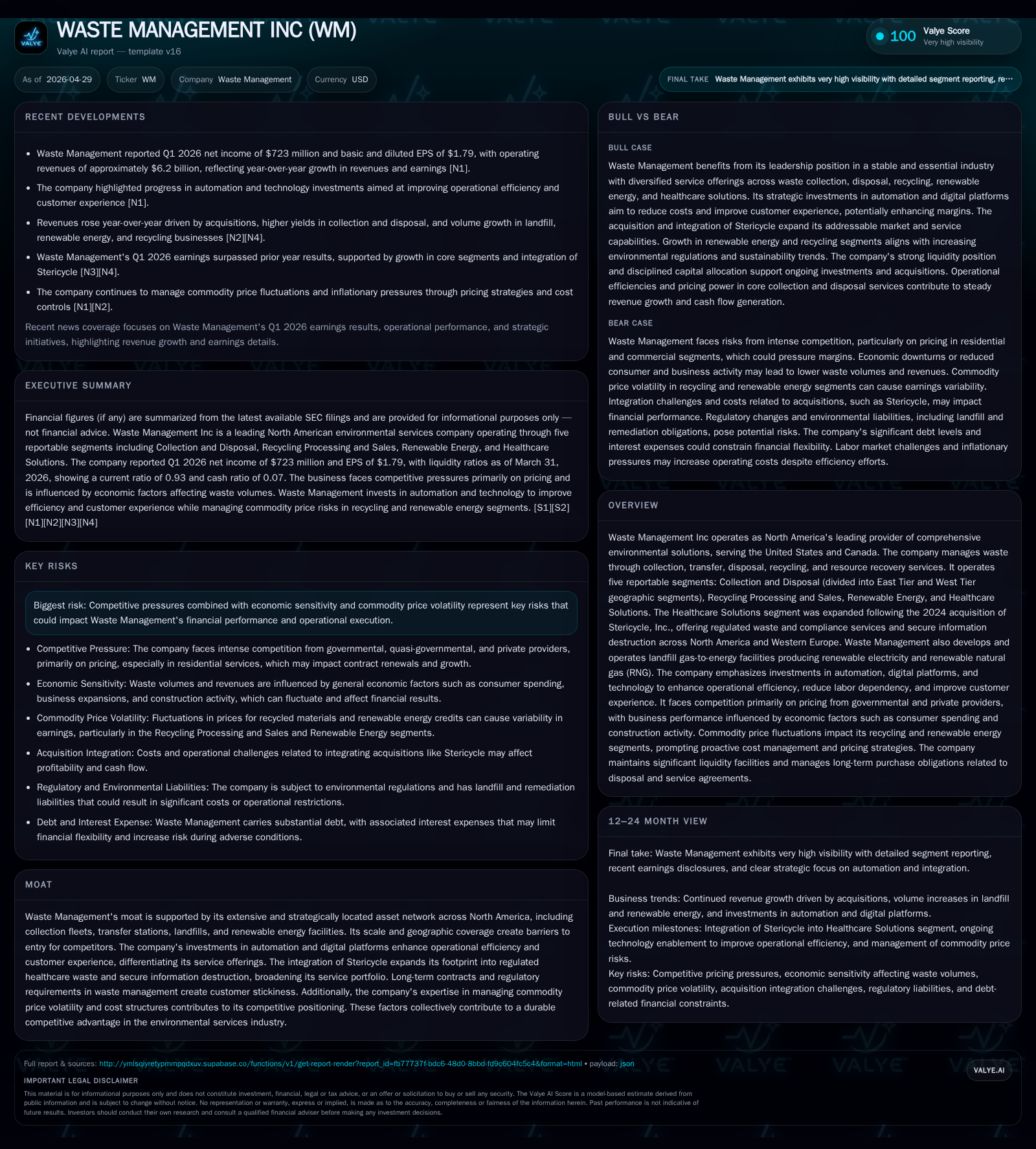
Waste Management Inc reported a solid first quarter in 2026, reflecting increased revenues and margins across most segments fueled by automation, digitalization, and expanded renewable energy projects. Challenges persist in commodity price volatility impacting recycling revenue but are partly offset by volume growth and operational efficiencies. The company leverages a broad North American asset network and long-term contracts to sustain competitive advantage while expanding healthcare solutions post-Stericycle acquisition. Its strong liquidity position supports continued investments in technology and sustainability initiatives.
Recent Operating Update: Q1 2026 Financial Results
Waste Management Inc’s latest quarterly filing (Form 10-Q filed April 29, 2026) reveals continued operational progress despite persistent market challenges in recycling commodities [S2]. Total operating revenues reached $6.23 billion for Q1 2026 versus $6.02 billion in the prior year quarter. Operating income rose to $1.11 billion from $1.01 billion year-over-year [S16], underscoring margin expansion driven largely by improved throughput across service segments and disciplined cost management.
Notably, the company maintains active liquidity management with $1.07 billion outstanding under its commercial paper program as of March 31, fully backed by a $3.5 billion revolving credit facility maturing in 2029 [S2][S5][S9]. This robust credit support facilitates WM’s capacity to navigate short-term debt maturities—approximately $3.7 billion falling due within the next year—while retaining intent to refinance the bulk as supported by ample facility capacity [S5].
Business Model Overview
WM operates as North America’s foremost environmental services provider with an integrated portfolio covering waste collection, transfer, disposal, recycling processing/sales, renewable energy production via landfill gas recovery, and healthcare waste compliance solutions [S1][S12]. The business is segmented into five reportable units:
- Collection and Disposal (East & West Tier): Core revenue driver involving municipal solid waste pickup leveraging proprietary fleet networks.
- Recycling Processing and Sales: Handling diverse recyclable commodities (paper, plastic, glass), which exposes the company to commodity price swings.
- Renewable Energy: Development/operation of landfill gas-to-electricity/RNG projects producing sellable renewable energy credits.
- Healthcare Solutions: Expanded post-2024 Stericycle acquisition; delivers regulated medical waste disposal plus secure data destruction services across US/Canada/Western Europe.
- Corporate & Other: Supporting functions not allocated directly to major segments.
Revenue is primarily derived from contracted waste service fees based on volume collected or disposed plus pass-through fees related to commodity sales or regulatory credits (e.g., Renewable Identification Numbers - RINs). Margins benefit from scale economies inherent in WM’s extensive asset base of collection vehicles, landfills strategically located across North America, transfer stations, and advanced processing facilities [S1].
Industry Structure & Competitive Position
Waste management is characterized by high barriers to entry including capital-intensive infrastructure requirements (landfills subject to rigorous environmental permitting), complex regulatory compliance demands at federal/state/local levels, and long-term customer contract durations that ensure steady service demand.
WM’s dominant geographic footprint—spanning both US coasts inward through central regions—and expansive fleet capacity create substantial moat advantages against private competitors or municipalities seeking privatization alternatives [S1]. Integration of Stericycle strengthens penetration into healthcare waste markets less sensitive to economic cycles but subject to stricter regulations.
Innovative uses of automation technologies (robotics for sorting; telematics optimizing route planning) coupled with digital platforms for customer self-service enhance operational efficiency while elevating client engagement—a differentiator amid commoditized industry pricing pressures [S1]. These investments also mitigate labor shortages prevalent in collection roles prone to high turnover.
Growth Drivers
Automation & Digital Integration
WM continues accelerating automation deployments within recycling facilities improving throughput and reducing dependency on manual labor—a key cost component exposed to wage inflation risk [S1]. Additionally, digital customer interfaces streamline billing/contact processes promoting stronger retention rates.
Renewable Energy Expansion
Landfill methane projects underpin growing Renewable Energy segment contribution through RNG production and electricity sales bolstered by favorable pricing environments. Completion of new projects during early 2026 portends increased volumes providing moderate margin uplift [S1].
Healthcare Solutions Platform
Stericycle acquisition expanded WM into specialty regulated waste streams augmented by secure information destruction services — a niche with escalating compliance complexity offering cross-selling potential in healthcare systems across multiple countries [S12].
Contract Retention & Pricing Power
Long-term contractual arrangements coupled with regulatory mandates requiring proper waste disposal alongside environmental stewardship support pricing durability despite underlying volume fluctuations tied to economic cycles [S1]. Strategic focus on higher-margin commercial accounts complements stable municipal contracts.
Risks & Watchpoints
- Commodity Price Volatility: Recycling Processing faces earnings variability from cyclical swings in commodity markets exacerbated recently by closures of domestic paper mills plus decreasing demand for recycled content among consumer goods producers [S1]. Ongoing soft cardboard packaging trends intensify this pressure.
- Economic Cyclicality: Waste generation correlates closely with economic activity levels; downturns can lead customers to reduce service volumes or delay contract renewals impacting top-line momentum [S1].
- Regulatory Compliance Costs: Environmental laws governing landfill operations impose substantial remediation obligations and expense unpredictability, including potential liabilities related to historical site contamination [S10].
- Labor Relations: Approximately 15% workforce unionized under multiemployer pension plans entails exposure to collective bargaining risks including potential withdrawal liabilities that could affect operating expenses [S22].
- Legal / Investigations Impact: Ongoing government investigations tied to historical Stericycle controlled substances business require monitoring though currently judged immaterial to WM’s core operations [S19][S22].
What to Watch Next
Key upcoming milestones include:
- Quarterly updates on recycling commodity prices and volume trends indicating sustainability of margin recovery.
- Progress on automation rollouts announced previously impacting residential collection efficiency metrics.
- Development status of new renewable energy projects generating RNG or power sales.
- Contract renewal cadence within Collection & Disposal divisions reflecting competitive positioning.
- Changes in regulatory environment at state/federal levels influencing landfill operations costs or permitting timelines.
- Any significant updates on legal exposures especially tied to healthcare solutions’ legacy operations or multiemployer pension plan negotiations.
Management commentary during earnings call webcast expected April 29 offers further granularity on these topics [S3][N1].
Financial Profile Summary (Q1 2026)
Latest financial snapshot
| Metric | Value | Period |
|---|---|---|
| Cash & equivalents | $158mm | |
| 2026-03-31 | ||
| Total debt | $22.3bn | |
| 2026-03-31 | ||
| Net debt | $22.1bn | |
| 2026-03-31 | ||
| Current assets | $4.8bn | |
| 2026-03-31 | ||
| Current liabilities | $5.1bn | |
| 2026-03-31 | ||
| Current ratio | 0.93x | |
| 2026-03-31 |
Source: SEC companyfacts cache [F1].
WM maintains a net debt position near $22 billion supported by steady cash flows from operations ($1.5 billion net cash provided for Q1), manageable near-term debt maturities refinanced via committed revolving credit lines/CP programs at competitive interest rates [F1][S2][S5][S8][S9]. Capital expenditures remain elevated (~$650 million quarterly) as WM invests heavily in fleet upgrades and technology deployments aimed at sustaining its operational edge going forward [S8]. Dividends paid reflect shareholder return discipline coherent with cash flow generation capabilities [S20].
This analysis synthesizes publicly filed SEC documents from Waste Management Inc as of April 29, 2026 alongside validated news sources. It provides a grounded evaluation based strictly on disclosed operational data without unverified assumptions or forward-looking forecasts beyond reported guidance or commentary. Readers should consider firm-reported risks comprehensively before concluding on future performance dynamics.
Disclaimer: This is research-only, informational analysis and not investment advice. It may include AI-generated interpretation and general industry context. Always verify important details using primary sources.

Comments