
Metalink Ltd's Shift from Telecom Legacy to Strategic Positioning
Metalink Ltd has transitioned from a dormant DSL chipset producer to a cash-held entity exploring strategic alternatives amid operational inactivity.
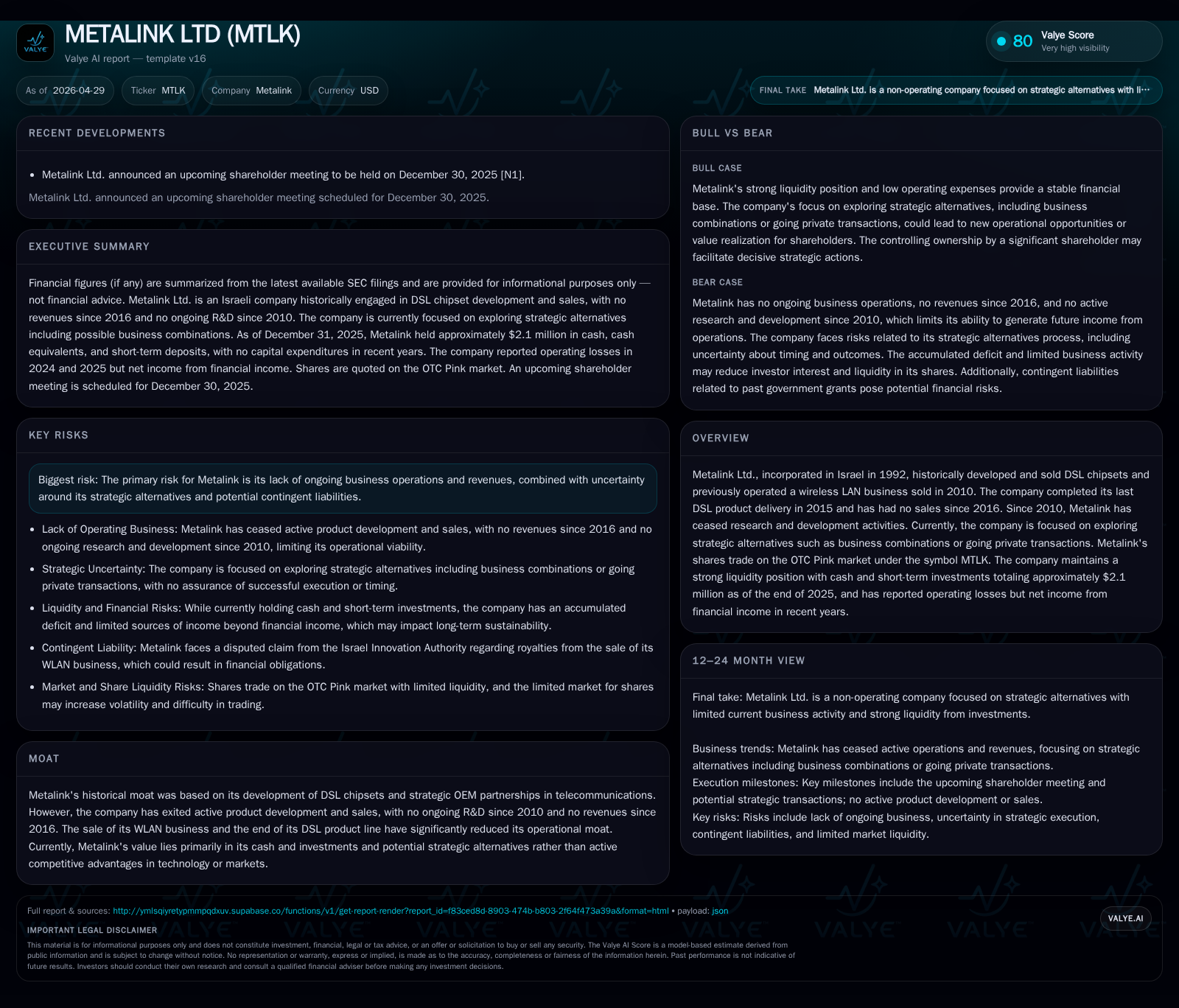
Metalink Ltd, once a developer of DSL chipsets and wireless LAN technology, has ceased revenue-generating operations since 2016 and halted R&D a decade earlier. Its latest filings confirm continued revenue absence but reveal an ongoing effort to pursue strategic alternatives including business combinations or privatization. Despite decades of telecom industry engagement, Metalink's current value lies in its liquidity and potential transactional opportunities rather than product or market presence. Managing the lack of operating revenues alongside execution risks remains critical as the company navigates its future path.
Latest Operating Update: Status and Significance
Metalink Ltd's latest Form 6-K filed on November 12, 2025 [S2] confirms the company's ongoing position as a non-revenue-generating entity with no sales since 2016. The filing reiterates that no capital expenditures were made during recent years and that the company continues to explore strategic alternatives such as business combinations or going private transactions. This marks a definitive pivot away from its historical active participation in telecommunications chipset markets toward a purely transactional posture. The absence of operating revenues is structural, driven by the termination of its DSL product line in early 2015 after an end-of-life notice issued years earlier [S1].
Business Model Evolution: From Telecom Chipsets to Strategic Alternatives
Originally incorporated in Israel in 1992, Metalink’s operative business historically centered on developing and selling DSL chipsets primarily through OEM partnerships with telecom equipment manufacturers [S1][S8]. Between inception and early 2010, it invested in R&D to support proprietary designs aligned with industry standards, shipping its initial chipset in late 1994. However, since divesting its wireless LAN business in February 2010 [S1], Metalink ceased all research and development activities.
In March 2015, Metalink completed its final DSL product delivery generating $450,000 in revenue [S1][F1]. Since then, there have been no subsequent revenues. This cessation effectively ended Metalink’s product-market relevance. With no ongoing R&D or new offerings under development [S1], the company's business model focuses on exploring strategic alternatives — such as mergers, acquisitions, or privatizations — aiming for corporate transformation rather than organic growth.
Competitive Position and Industry Context: Legacy Footprint without Current Product Lines
Metalink once maintained competitive advantages through targeted IP development in DSL modem chipsets during the late-1990s to mid-2000s telecom boom [S8]. Its OEM relationships with large equipment manufacturers carved out niche positioning within telecommunications hardware supply chains.
However, fundamental shifts including technological obsolescence of DSL technology, evolving broadband standards (e.g., fiber optics), consolidation among chipset manufacturers, and intensifying competition eroded its moats by the mid-2010s [S1]. The company’s exit from WLAN operations further truncated its market footprint. By halting R&D post-2010 and discontinuing sales entirely by 2016 [S1][F1], Metalink has effectively become a shell entity with no active participation or differentiation in any current technology segment.
This trajectory typifies challenges faced by semiconductor firms failing to reinvest amidst rapid industry evolution—without innovation or adaptation their ecosystem relevance diminishes inexorably.
Catalysts for Growth: Strategic Transactions as the Core Pathway
With legacy products discontinued over seven years ago and zero existing operations generating revenue, Metalink’s sole pathway toward any material growth is through strategic transactions [S1]. The company explicitly plans to pursue business combinations or "going private" deals including those involving affiliates [S1]. Such options offer potential for injecting operational vitality or unlocking shareholder value through restructuring.
Ownership concentration considerably shapes transaction prospects: CEO/CFO Daniel Magen holds approximately 53.4% of outstanding shares following a self-tender offer completed in February 2017 [S8]. This majority stake can facilitate governance maneuvering conducive to transaction approvals but also poses single-party risk dynamics.
The wider transactional environment is complicated by global economic volatility—Israel’s regional military conflicts reported recently add further execution uncertainty [S23]. Furthermore, lack of current profitability and nonexistent revenue streams limit deal attractiveness absent attractive partners or compensatory valuations.
Risks and Constraints: Revenue Absence and Execution Uncertainties
The paramount risk for Metalink arises from its continued operational dormancy with no revenues since 2016—and no indication that this status will change organically given no R&D efforts since 2010 [S1][F1]. Operating losses are minimal but persistent (approximately $23k loss in FY2025) driven mostly by general administrative costs [F1][S1]. Rising inflationary pressures within Israel impose latent cost risks due to local personnel expenses denominated in NIS while funds flow predominantly in USD equivalents [S1].
A notable contingent liability pertains to a dispute concerning approximately $128k related to royalties claimed by the Israeli Innovation Authority tied to prior government grants; Metalink contests this claim vigorously though has provisioned for it conservatively [S4][S13].
Geopolitical risks connected with ongoing regional conflicts (“Swords of Iron War”) constitute additional external uncertainties potentially affecting investor confidence though current statements anticipate limited direct operational impact [S23].
Finally, as an OTC Pink-listed company with minimal trading volume realities related to share liquidity volatility represent tangible shareholder risks [S16]. The limited public market presence adversely constrains raising capital externally should it ever be required.
Next Steps to Watch: Shareholder Meeting, Alternative Pursuits, and Market Signals
Investors tracking Metalink should monitor pivotal events like the Annual General Meeting scheduled for December 30, 2025 announced per Nasdaq disclosures [N1][S2]. Proxy materials may reveal evolving governance directions or specifics regarding ongoing strategic alternative evaluations.
Subsequent disclosures addressing deal negotiations, partnership announcements, or modifications to ownership structure would be key indicators of progress away from operational dormancy towards corporate transformation. Given the narrow bandwidth of possible catalysts outside transactional success the stock's near-term movements will likely hinge heavily on such developments.
Financial Overview: Liquidity Stability amid Operational Hiatus
Metalink’s financial profile reflects a strong liquidity position with cash and equivalents totaling approximately $37 million as of December 31, 2025, and a current ratio of about 12.19, supported by current assets of $1,926,000 and current liabilities of $158,000 at the same date [F1]. Operating losses remain modest, with a negative operating income of approximately $23,000 in FY2025, driven primarily by administrative expenses [F1][S1]. Net income is positive, largely due to financial income from interest on cash balances ($109,000 in FY2025) [F1][S1].
Cash flow remains stable with positive net cash generated from operations, offset slightly by investing activities related to short-term deposit movements [F1][S3]. No capital expenditures have been recorded in recent years, confirming the absence of asset reinvestment and reflecting the company’s operational pause.
This financial standing supports endurance against short-term funding pressures but does not substitute for transformational growth avenues through strategic deals as operational deficits persist without revenue inflows.
This analysis is grounded strictly on publicly filed SEC documents up through April 29th, 2026 without speculative projections beyond evidenced disclosures. It aims solely to provide detailed context on Metalink Ltd’s current standing as a telecom legacy player turned cash-held shell emphasizing transaction-dependent futures not active business operations. Readers should seek further information from future filings or announcements for updates on transformational progress.
Disclaimer: This is research-only, informational analysis and not investment advice. It may include AI-generated interpretation and general industry context. Always verify important details using primary sources.

Comments