
NutriBand Advances AVERSA™ Fentanyl Development with Kindeva Partnership Under Financial and Regulatory Constraints
Latest quarterly filing highlights FDA progress on abuse deterrent fentanyl patch development amid ongoing operating losses and reliance on service revenues.
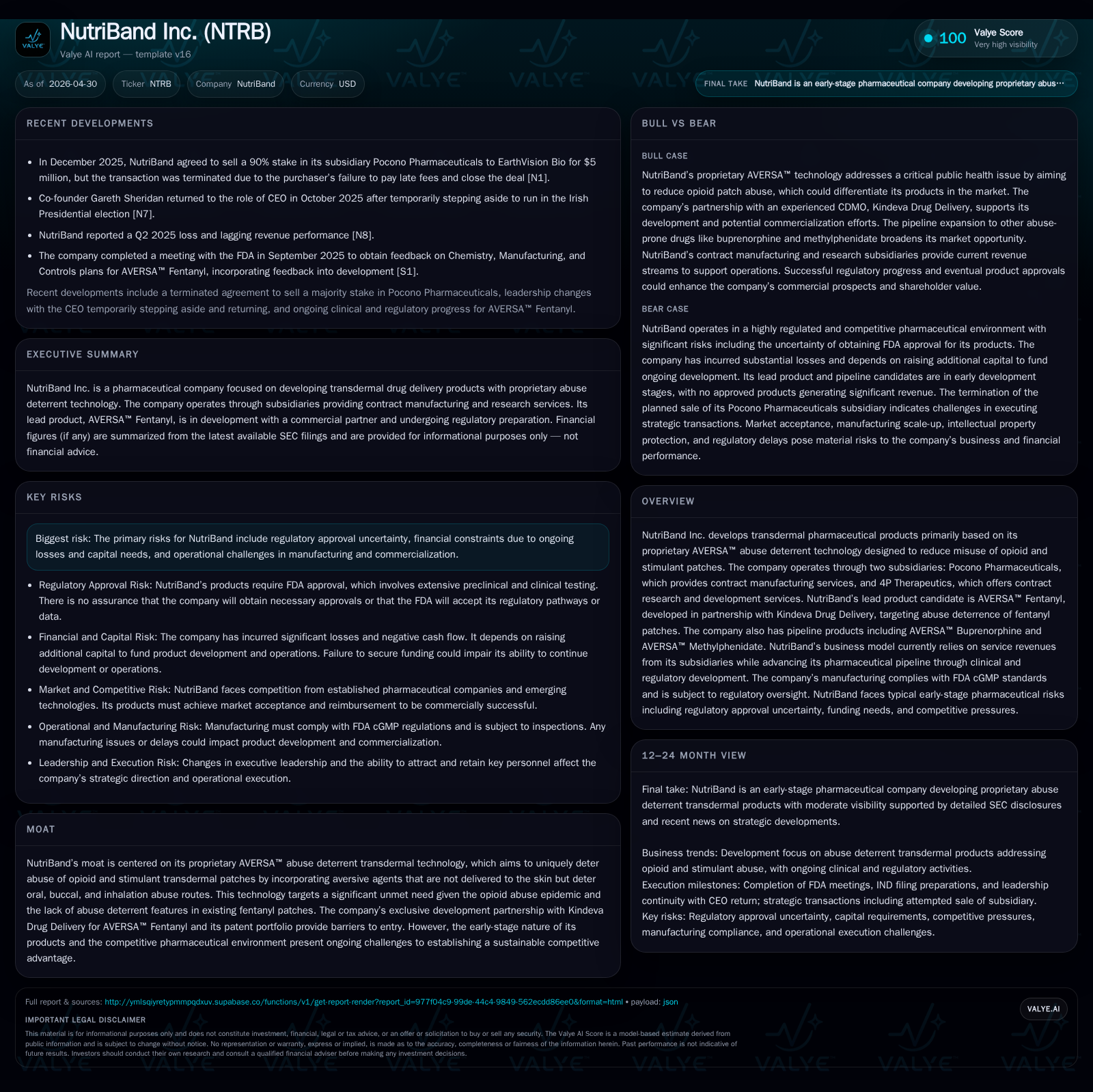
NutriBand Inc. is progressing its lead product, AVERSA™ Fentanyl, through a defined regulatory pathway with the FDA and remains focused on expanding its abuse deterrent transdermal product pipeline. The company's near-term revenue derives primarily from contract manufacturing and R&D services via its subsidiaries, while it continues investment in clinical development efforts. The firm faces standard pharmaceutical start-up risks including regulatory uncertainty, funding needs, and market acceptance challenges. NutriBand’s proprietary AVERSA™ technology addresses a significant unmet need in opioid abuse deterrence but remains early-stage with no FDA approvals yet.
Recent Operating Update
NutriBand’s latest quarterly report filed on December 11, 2025 [S2] reveals focused advancement toward an Investigational New Drug (IND) application submission for its lead product candidate, AVERSA™ Fentanyl. The company recently concluded a Type C meeting with the U.S. Food & Drug Administration (FDA) where it obtained detailed feedback regarding the Chemistry, Manufacturing, and Controls (CMC) development plan needed from clinical trials to eventual commercialization. This is a pivotal milestone confirming that NutriBand’s regulatory approach aligns with FDA expectations for progressing through a 505(b)(2) New Drug Application (NDA) pathway.
Further cementing its commitment to this program is an exclusive commercial development agreement signed earlier in February 2025 with Kindeva Drug Delivery—a specialist contract development and manufacturing organization (CDMO). This agreement superseded previous feasibility arrangements, establishing a long-term partnership under which both parties share developmental costs in exchange for milestone payments linked to progress metrics [S1],[S18].
Financially, NutriBand continues to rely heavily on revenues derived from its two wholly owned subsidiaries: Pocono Pharmaceuticals providing contract manufacturing services mainly for health and wellness customers, and 4P Therapeutics delivering contract research and development services focused on pharmaceutical and medical device clients [S1],[S11]. As such, no revenues are currently generated from pharmaceutical product sales; instead service fees help sustain operations during the significant preclinical/clinical research investment phase.
Business Model
NutriBand operates at the intersection of pharmaceutical product development and ancillary service provision through its dual-subsidiary model. The core business objective centers around advancing a novel portfolio of transdermal drug products based on the proprietary AVERSA™ abuse deterrent technology platform [S1]. This technology incorporates aversive agents into existing transdermal patches without modifying the original drug's pharmacokinetic profile or skin delivery mechanism. The primary value proposition lies in deterring common routes of illicit patch misuse such as chewing (oral), inhalation of extracted substances, or buccal absorption—methods that traditional patches do not address effectively.
Currently, substantial service revenues stem from Pocono Pharmaceuticals' manufacturing capabilities for non-abuse deterrent wellness and over-the-counter products alongside contract R&D revenue contributions from 4P Therapeutics. These revenues provide operational runway while NutriBand deploys capital toward completing safety studies, human abuse potential testing, and eventual commercial process validation required for FDA submission.
The AVERSA™ Fentanyl project exemplifies this business model evolution: it harnesses an already FDA-approved generic fentanyl patch as a reference-listed drug within a streamlined regulatory framework (the 505(b)(2) pathway), adding abuse deterrence efficacy as a critical new indication. This incremental innovation strategy mitigates some risks inherent in new chemical entity development by relying on existing clinical data but remains contingent upon successful demonstration of abuse resistance qualities through laboratory manipulation studies and Phase 1 Human Abuse Potential clinical trials [S9],[S18].
Following AVERSA™ Fentanyl’s anticipated approval target timeline in the mid-2020s horizon — assuming clinical milestones are met — NutriBand plans to expand its platform application towards other controlled substances presenting high abuse risk such as Buprenorphine (opioid disorder treatment) and Methylphenidate (stimulant for ADHD). Moreover, there is exploratory work developing transdermal delivery alternatives for injectable peptide/protein drugs off patent aiming to improve patient compliance via non-invasive administration routes [S5],[S8],[S24].
Industry Structure and Competitive Position
NutriBand operates within the niche but growing sector of abuse-deterrent pharmaceuticals focusing specifically on transdermal delivery systems. The US opioid epidemic has galvanized increased regulatory encouragement towards developing formulations resistant to misuse—creating a unique opportunity gap given that no abuse-deterrent fentanyl patches are currently marketed nationally or worldwide [S9].
Specialized CDMOs like Kindeva provide critical expertise in complex drug-device combination products such as these patches. NutriBand's exclusive partnership grants access to this technological know-how plus manufacturing validation infrastructure critical for scale-up readiness—a non-trivial technical barrier in transdermal drug production.
However, competition includes large established pharmaceutical companies developing alternative opioid formulations including abuse-resistant oral tablets or injectables as well as generic manufacturers undisrupted by deterrence features who might capture price-sensitive market segments.
Patent protections surrounding AVERSA™ technology offer some moat defensibility against direct imitation while regulatory approval first-mover advantage could secure premium branding in this specialized subset of pain management therapies. Yet NutriBand’s early stage status limits its bargaining power commercially.
Growth Drivers
- Regulatory Milestones: Successful completion of IND filing followed by human abuse potential studies will advance NutriBand closer to NDA submission—a key inflection point opening licensing or commercialization pathways.
- Pipeline Expansion: Additional candidates like AVERSA™ Buprenorphine and Methylphenidate broaden potential product offerings leveraging existing platform IP.
- Service Subsidiaries: Pocono Pharmaceuticals’ manufacturing contracts provide recurring revenue streams helping fund R&D activities without immediate need for dilutive financing.
- Partnership Leverage: Exclusive collaboration with Kindeva enables access to world-class CDMO capabilities accelerating time-to-market readiness.
- Addressing Unmet Need: No competing abuse-deterrent fentanyl patches provide significant market opportunity if regulatory approval occurs successfully.
Risks / Watchpoints / Growth Constraints
- Regulatory Approval Uncertainty: Despite planned adherence to FDA guidance via 505(b)(2), any unexpected clinical trial failures or additional data requests could delay or derail approval timelines [S1],[S17].
- Capital Intensity: Ongoing negative cash flow consistent with early-stage pharmaceutical ventures poses liquidity risk; funding future milestones depends heavily on capital raise success.
- Market Adoption & Pricing: Post-approval acceptance will hinge on payer reimbursement policies across fragmented U.S. healthcare systems facing increasing pricing pressures [S12].
- Competition: Larger entities with more comprehensive resources may develop alternative platforms addressing opioid misuse potentially limiting NutriBand’s long-term market share.
- Manufacturing Scale-up & Compliance: Transdermal patch fabrication complexities require maintaining rigorous cGMP compliance; any production hiccups may restrict supply chain reliability [S24],[S26].
- Legal & Cybersecurity Exposure: Pending litigation cases and evolving cyber threats introduce operational risk factors impacting corporate stability [S6],[S17].
What to Watch Next
Investors should monitor:
- Receipt of FDA IND filing clearance enabling commencement of Human Abuse Potential clinical trials.
- Progress reports or updates from the FDA meetings outlining acceptance of CMC plans critical before NDA submissions.
- Clinical trial initiation timelines for AVERSA™ Fentanyl alongside pipeline indications Buprenorphine and Methylphenidate.
- Financial reports indicating cash burn trends relative to available liquidity given no current product sales revenue stream.
- Strategic moves signaling partnerships or licensing deals that may provide non-dilutive funding or commercialization avenues.
- Any changes in regulatory environment impacting opioid therapeutic markets or pricing reimbursement frameworks affecting market entry prospects.
Financial Profile Summary
Latest financial snapshot
| Metric | Value | Period |
|---|---|---|
| Cash & equivalents | $5mm | |
| 2026-01-31 | ||
| Current assets | $5mm | |
| 2026-01-31 | ||
| Current liabilities | $784281 | |
| 2026-01-31 | ||
| Current ratio | 6.36x | |
| 2026-01-31 |
Source: SEC companyfacts cache [F1].
As of January 31, 2026 fiscal year-end per companyfacts [F1], NutriBand reported $2.04 million in revenue primarily attributable to subsidiary service operations rather than product sales. The company recorded an operating loss of $8.32 million and net loss close thereto at $8.23 million reflecting heavy investment in R&D activities essential for next-phase clinical development.
Balance sheet strength remains noteworthy despite losses: cash and equivalents stood at approximately $4.57 million against nominal debt totaling $900 USD resulting in a robust current ratio exceeding 6x—indicating ample short-term liquidity buffers sufficient to support near-term operations pending further capital raises or partnerships.[F1]
The negligible debt level mitigates leverage concerns but reflects reliance on equity financing paths over credit-based funding at this stage typical for pre-revenue biopharma entities focused on product approvals prior to commercialization success.
Conclusion
NutriBand Inc.’s advancement through critical FDA engagement phases underlines cautious but tangible progress toward commercializing its first-in-class AVERSA™ abuse deterrent fentanyl patch amid broader ambitions for its transdermal platform pipeline. While service revenues via subsidiaries provide operational income stability absent product sales, the company remains reliant on successful execution of clinical trials and regulatory milestones against standard biotech risks including capital needs and competitive pressures. Its differentiated technology addresses pressing societal challenges associated with opioid misuse which could translate into meaningful market disruption upon approval — making upcoming FDA interactions pivotal watchpoints for validating this growth thesis.
This analysis is intended solely for informational purposes based on publicly available SEC filings as of April 2026. It does not constitute investment advice.
Disclaimer: This is research-only, informational analysis and not investment advice. It may include AI-generated interpretation and general industry context. Always verify important details using primary sources.

Comments