
XBiotech's Transition and Pipeline Focus Shape Its Near-Term Outlook
Leadership changes and sustained R&D investments are pivotal as XBiotech advances its proprietary antibody therapies.
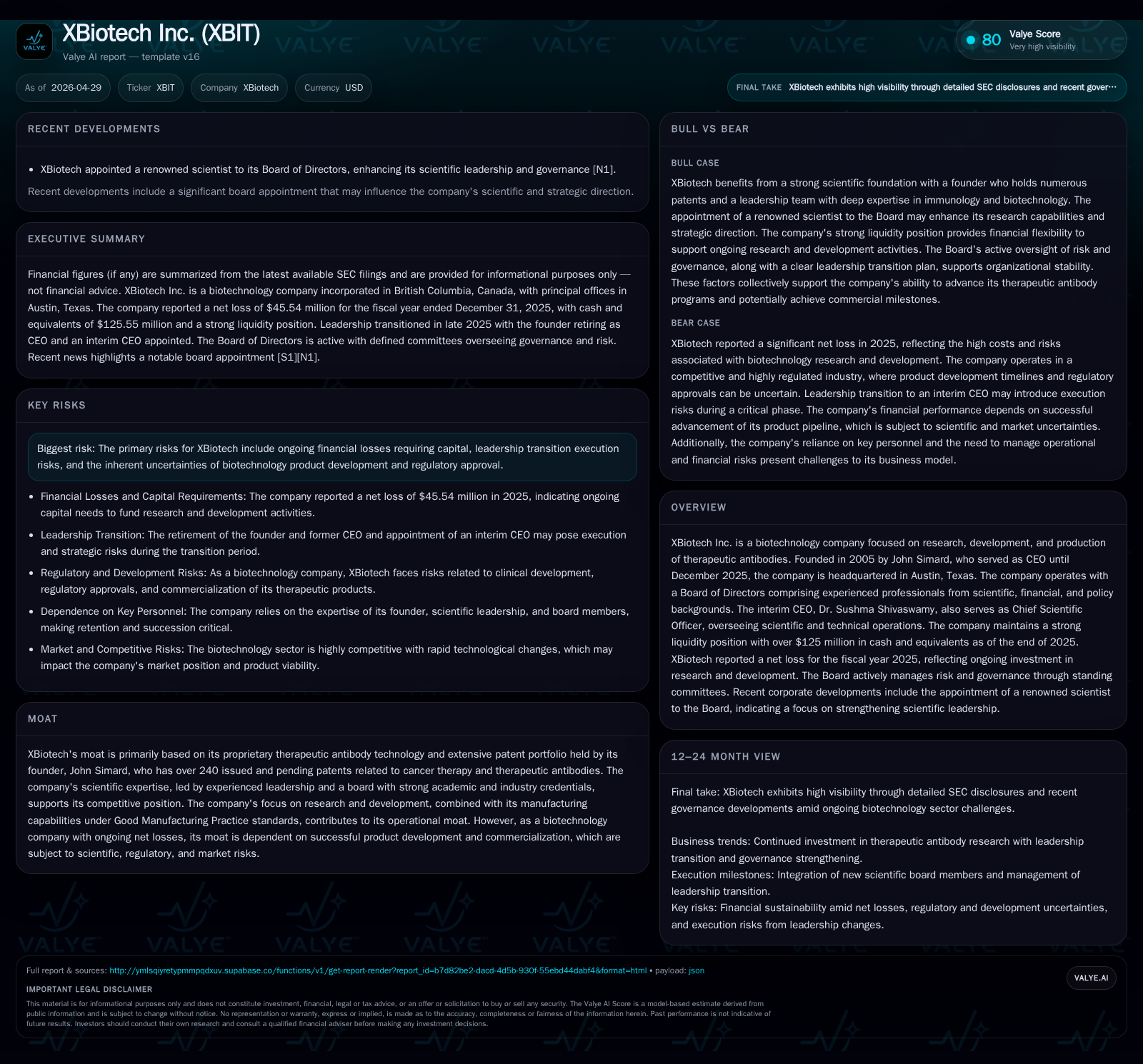
XBiotech Inc. recently completed the fiscal year ending December 31, 2025, with significant leadership transition marked by the retirement of founder and CEO John Simard. The company continues to invest heavily in its proprietary therapeutic antibody platform and pipeline development, sustaining net losses but maintaining strong liquidity. XBiotech's competitive advantage lies in its extensive patent portfolio and specialized manufacturing capabilities. Key risks remain rooted in biotechnological uncertainties and execution of the leadership transition. Near-term growth hinges on successful clinical progression and capital management.
Recent Operating Update
XBiotech's latest quarterly filing dated November 12, 2025 (10-Q) reveals operational stability amid a major leadership transition with founder John Simard stepping down as CEO during the fiscal year [S2]. The company has appointed Dr. Sushma Shivaswamy as interim CEO while she continues as Chief Scientific Officer, indicating a strategic move to retain scientific leadership continuity within executive ranks [S1]. This change is notable since Simard had been the driving force since founding the company in 2005.
Financially, the quarter did not disclose specific revenue figures—reflecting XBiotech's current focus on R&D rather than commercial sales—but underlined ongoing expenditures aligned with advancing clinical programs. The consistent emphasis remains on value creation through pipeline progress rather than near-term profitability or revenue generation [S2], [S1].
Business Model
XBiotech is a biotechnology company that specializes in research, development, and planned commercialization of therapeutic antibodies. Its business model centers around inventing patented antibody technologies targeting diseases such as cancer and inflammation-related conditions. Proprietary technology was developed by founder John Simard, whose portfolio includes over 240 issued or pending patents that form a substantial intellectual property moat.
Revenue opportunities depend primarily on successful clinical development leading to regulatory approval followed by either direct sales or licensing arrangements with larger pharmaceutical companies. Presently, revenues are periodic and tied to milestone payments from potential partnerships or early-stage asset sales rather than product sales.
Margins at this stage are negative due to heavy investment in R&D activities including preclinical studies, clinical trials, manufacturing under Good Manufacturing Practice (GMP) standards, and regulatory processes. Cost structure is therefore predominantly fixed with expenses incurred irrespective of immediate revenue inflows.
Customer adoption is prospective rather than current; end users are ultimately patients receiving approved therapies distributed through healthcare providers if products reach commercialization. Therefore, XBiotech must navigate the complex ecosystem involving regulators, insurers, clinicians, and pharmaceutical partners.
Industry Structure and Competitive Position
The therapeutic antibody market is highly competitive with many players ranging from large diversified biopharma firms to smaller innovative biotech companies. Entry barriers include stringent regulatory requirements, high costs of clinical trials, specialized manufacturing capabilities compliant with GMP regulations, and significant intellectual property portfolios protecting unique modalities.
XBiotech’s strength lies in its proprietary antibody platform backed by robust patents from founder-led innovations. This IP positioning creates differentiation against generic biosimilars or competitive pipelines lacking similar technological attributes. Furthermore, the company’s integration of research with manufacturing helps undergird operational control over development timelines.
However, XBiotech operates without significant commercial revenues currently and relies heavily on successful clinical outcomes—a universal challenge in biotechnology where high attrition rates prevail. Its smaller scale relative to industry giants limits marketing reach post-approval but also offers agility in niche development areas.
Growth Drivers
Several structural drivers underpin XBiotech's growth trajectory:
Pipeline Advancement: Progression of antibody candidates through clinical phases toward FDA approval remains paramount. Positive efficacy/safety data can unlock milestone revenues or partnerships.
Intellectual Property Development: Continuous patent filings expand protective barriers against competition while potentially enhancing licensing attractiveness.
Manufacturing Capabilities: Ability to produce GMP-compliant therapeutic antibodies affords leverage for eventual commercial scale operations or contract manufacturing services.
Strategic Partnerships: Potential collaborations with established pharma companies can provide validation capital and accelerate commercialization pathways.
Scientific Leadership Stability: Appointment of a scientifically credentialed interim CEO ensures continuous focus on innovation critical to maintaining competitive edge.
Demand for novel antibody therapeutics is structurally driven by unmet medical needs in oncology and chronic inflammatory diseases where existing treatments offer partial or limited benefit. As an innovator in antibody formats that may avoid immune suppression side effects common to competitor biologics, XBiotech targets a compelling niche segment.
Risks / Watchpoints / Constraints
Key risks encompass:
Clinical Development Uncertainty: Failures or delays in trials would materially impact valuation given reliance on pipeline success.
Capital Requirements: Despite robust cash reserves ($125.6 million at end-2025), extended R&D timelines necessitate prudent capital management or external financing raising risks dilution or restrictive covenants.
Leadership Transition Execution: Founder departure coupled with interim leadership introduces potential strategic uncertainty; cohesion around vision critical for next growth phase.
Regulatory Hurdles: Navigating FDA approval processes for novel biologics remains complex and resource-intensive.
Competitive Pressure & Patent Challenges: Emerging competitors developing biosimilar products or alternative treatment modalities could erode market opportunity.
What to Watch Next
Future updates should be monitored closely for:
- Clinical trial readouts signaling efficacy or safety profiles for lead candidates.
- Regulatory filings or designations (e.g., fast track status) that could accelerate product approval timelines.
- Partnership announcements reflecting external validation or infusions of capital/ expertise.
- Updates from corporate governance including permanent CEO appointment post-interim period.
- Financial guidance revisions providing clarity on burn rate management amid planned expenditures.
Such milestones will provide more tangible insight into XBiotech’s ability to translate its scientific foundation into commercially viable therapies.
Financial Profile (Brief Context)
Historical performance (annual)
Capital returns and efficiency (annual)
For the fiscal year ended December 31, 2025, XBiotech reported an operating loss of approximately $55.7 million—a widening compared to $42.5 million loss in 2024—primarily driven by increased R&D spend intensified by severance payments following CEO retirement [F1],[S17]. Net loss was $45.5 million for the year reflecting non-operating factors partially offsetting operating losses [F1].
Liquidity remains healthy at about $125.6 million in cash and equivalents with current liabilities just under $8 million yielding a strong current ratio exceeding 16x [F1]. Capital expenditures remain moderate relative to operational costs underscoring focus on research facilities rather than expansion capex [F1].
The company has not paid dividends nor executed meaningful share repurchases recently; capital return is de-prioritized given stage of development [F1], consistent with biotech norms where reinvestment into innovation takes precedence over shareholder distributions.
Executive compensation strategy centers around incentivizing long-term pipeline value creation rather than short-term profitability metrics or TSR performance—a reflection typical within biotech peers emphasizing innovation milestones [S17].
Disclaimer
This analysis is based solely on public SEC filings and known information as of April 29, 2026. It does not constitute investment advice and should be considered informational only.
Disclaimer: This is research-only, informational analysis and not investment advice. It may include AI-generated interpretation and general industry context. Always verify important details using primary sources.

Comments