
KT Corp Accelerates Post-CEO Transition: Unlocking 5G and Digital Services Expansion
KT CORP’s leadership change in early 2026 aligns with a robust operating update highlighting gains in subscriber growth, digital services, and strategic portfolio diversification.
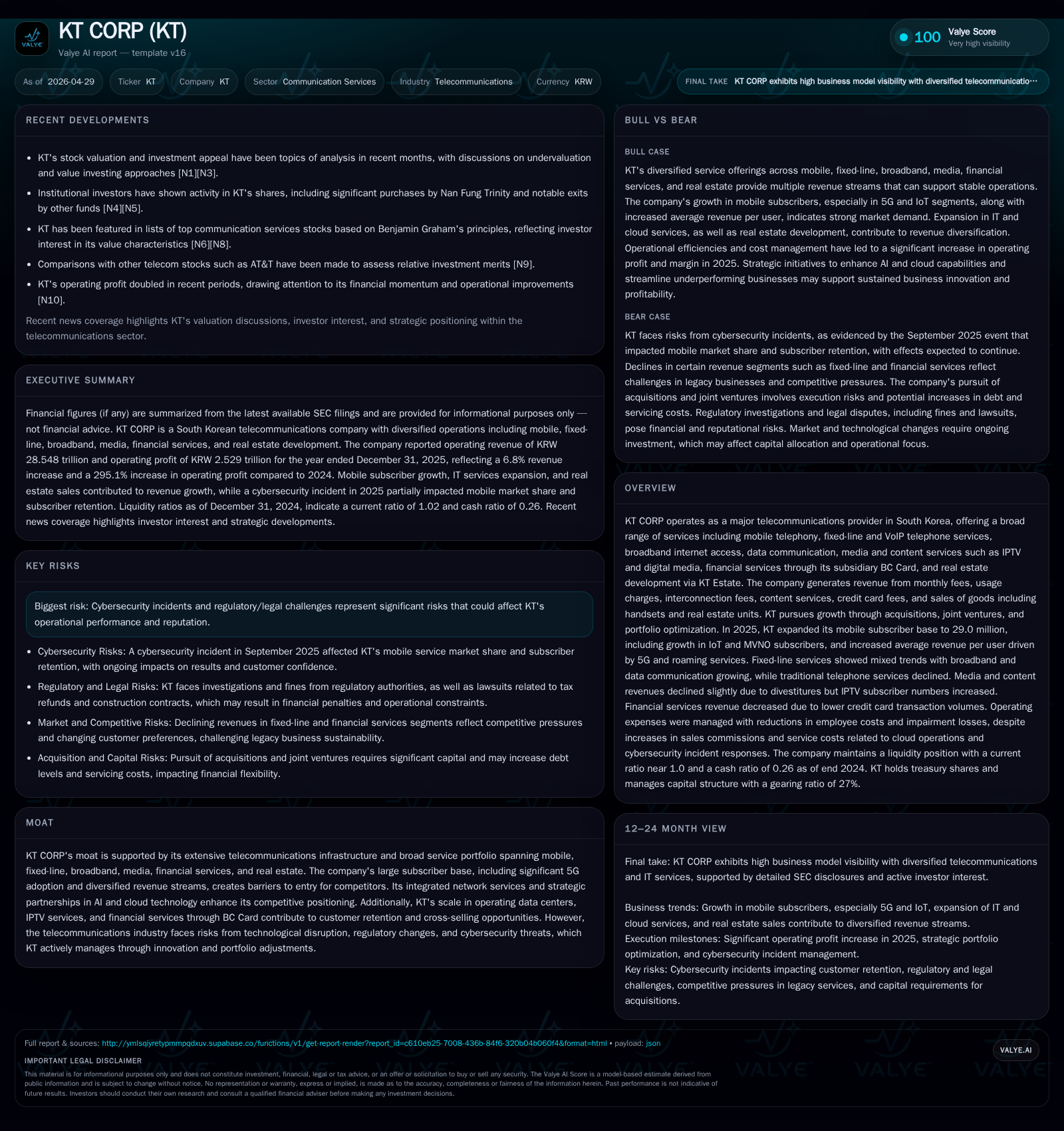
KT CORP appointed Yoon-Young Park as its new CEO in March 2026, marking an internal leadership transition poised to shore up growth momentum. The April 2026 quarterly report confirms ongoing expansion in mobile subscribers, particularly boosted by IoT and MVNO segments, alongside rising ARPU driven by 5G and roaming services. The company’s broad telecom portfolio is complemented by growing media, financial, and real estate ventures that support diversification. While KT faces regulatory scrutiny and cybersecurity risks, it leverages scale, infrastructure integration, and digital innovation to maintain competitive positioning in South Korea’s telecommunications industry.
Leadership Shift and Recent Operating Update
In March 2026, KT Corporation installed Yoon-Young Park as its new CEO [S3], a figure with deep institutional knowledge stemming from previous executive roles including President and Executive Vice President at KT. This leadership move signals a blend of continuity with established corporate values while setting the stage for a strategic refocus amid evolving telecom industry demands.
KT’s Diversified Telecommunications Business Model
KT operates as South Korea's major integrated telecom provider with a multifaceted offering that spans mobile telephony—including fast-growing IoT and MVNO segments—fixed-line voice (both traditional and VoIP), broadband internet access, data communication, IPTV-based media content, financial services primarily through its BC Card subsidiary, and real estate development via KT Estate [S1].
Revenue generation is multifactorial: subscription fees for mobile and broadband services provide steady recurring income; usage charges augment this via roaming and value-added offerings; interconnection fees capture call traffic flows; content-related revenues stem from IPTV subscriptions and digital media sales; financial fees arise from credit card transaction volume at BC Card; finally, sales of physical goods such as handsets and residential/commercial units add episodic spikes [S1]. This breadth enables cross-selling opportunities that can improve customer lifetime value while widening margin profiles.
Competitive Position and Industry Challenges
KT’s competitive moat arises principally from its vast network infrastructure footprint combined with a broad service portfolio that extends beyond traditional telecommunications into media, finance, cloud computing, AI collaborations, and real estate investments. This variety reduces dependency on any one segment while creating entry barriers through bundled service offerings and high switching costs.
The company also benefits from significant scale economies in operating data centers for internet services including IPTV distribution. Strategic partnership initiatives focused on AI-enhanced network management elevate efficiency further [S1].
Nevertheless, KT contends with sustained pricing pressures typical in mature telecom markets alongside regulatory scrutiny evidenced by multiple antitrust investigations related to collaborative bidding infractions dating back to mid-2010s—a challenge that persists with ongoing lawsuits demanding considerable damages [S1]. In 2023, regulatory fines were levied over allegedly unfair advertising practices concerning 5G service performance claims—an issue currently under judicial review [S1]. Added operational risk stems from cybersecurity incidents capable of affecting subscriber confidence or triggering compensatory costs [S1]. Management has responded actively, including SIM card replacements post-incident and compensation packages [S25].
Key Growth Drivers: 5G, IoT, and Media Convergence
A standout growth pillar for KT is heightened adoption of 5G technology spurring increases in both subscriber numbers and ARPU. By December 2024, mobile subscribers reached approximately 26.1 million with a notable uplift driven by IoT devices such as electricity usage monitors linked to Korea Electric Power Corporation [S15]. As of end-2025, total mobile subscribers expanded further toward 29 million including MVNO subscribers who benefit from KT's network leasing arrangements [S1].
This technological proliferation supports higher-tier data plan subscriptions coupled with enhanced roaming service availability which further lifts revenue per user metrics [S15]. Broadband internet access overall showed steady revenue increases despite slight declines in fixed-line voice service demand—indicative of structural shifts favoring high-speed data connectivity [S9].
In parallel, KT’s media/content segment sustains strong IPTV subscriber bases at about 9.5 million by late 2025; upgrades to premium plans contribute positively despite economic headwinds limiting original content production volumes [S12][S17]. The firm’s digital media offerings are intertwined with its broadband infrastructure allowing synergistic cost management.
Moreover, non-traditional business avenues like real estate development powered by KT Estate have made meaningful contributions—a development project in Gwangjin-gu alone generated approximately W1 trillion (~USD million equivalent) in sales during 2025 [S12][S16]. These diversified revenue streams dilute reliance on telecom alone while potentially easing margin pressures.
Risks and Constraints Including Regulatory and Cybersecurity Concerns
KT faces significant risks centered around regulatory compliance and cybersecurity integrity. Historically implicated in antitrust bid-rigging cases involving competitors for public institution contracts between 2015–2017 [S23], the company continues defending ongoing lawsuits collectively seeking damages nearing W28.7 billion. Previous fines include W13.9 billion related to misleading advertising around 5G rollout effectiveness with appeals progressing through the court system [S23].
From April 2021 to April 2024, multiple class action suits emerged citing subpar quality of the company's 5G services resulting in allegations valued around W0.6 billion cumulatively—a relatively modest exposure but one that could amplify depending on judicial outcomes or future litigation trends [S23].
Cybersecurity vulnerabilities manifested notably during the first half of 2025 when a competing mobile operator suffered intrusion events prompting customer migrations to KT services [S13], highlighting both risk exposure in the broader telecom ecosystem but also growth opportunities contingent upon operational trustworthiness.
Capital intensity remains high given necessary investment in network expansion (property & equipment acquisition exceeding W3 trillion annually) plus intangible assets like bandwidth licenses (~W444 billion invested in intangible assets in 2025) [S7][S22]—a structural cost baseline that constrains margin scalability absent offsetting top-line improvements or operational efficiencies.
Upcoming Catalysts and Areas to Monitor
Key near-term operational milestones involve accelerated deployment of next-generation networks aimed at consolidating KT’s technological lead especially within the domestic Korean market where demand for ultra-high-speed connectivity persists. Subscriber acquisition metrics following these rollouts will serve as tangible performance indicators aligned with CEO Park's strategic mandates post-transition [S2][S3][S1].
On the regulatory front, outcomes of lawsuit resolutions connected to historic collusion fines as well as current judicial proceedings on advertising penalties remain material uncertainties requiring close attention. Likewise, progress reports on cybersecurity strengthening initiatives including mitigation measures against data breaches will be vital to monitor given their impact on brand reputation and retention rates [S23][S25].
Strategic partnerships centered around AI-powered network optimization technologies should also be watched closely for the degree they translate into operating leverage or new service introductions enhancing customer engagement across telecom-digital-media-finance verticals [S1]. Finally, developments within KT Estate’s project pipeline offer potential upside diversification outside core communications segments.
Disclaimer: This analysis is based exclusively on publicly available SEC filings up to April 29, 2026 and selected news items without any speculative extrapolation or proprietary insight beyond documented facts. It does not constitute investment advice or recommendations regarding securities.
Disclaimer: This is research-only, informational analysis and not investment advice. It may include AI-generated interpretation and general industry context. Always verify important details using primary sources.

Comments