
Ultralife Corp Strengthens Battery and Communications Portfolio Through Electrochem Acquisition
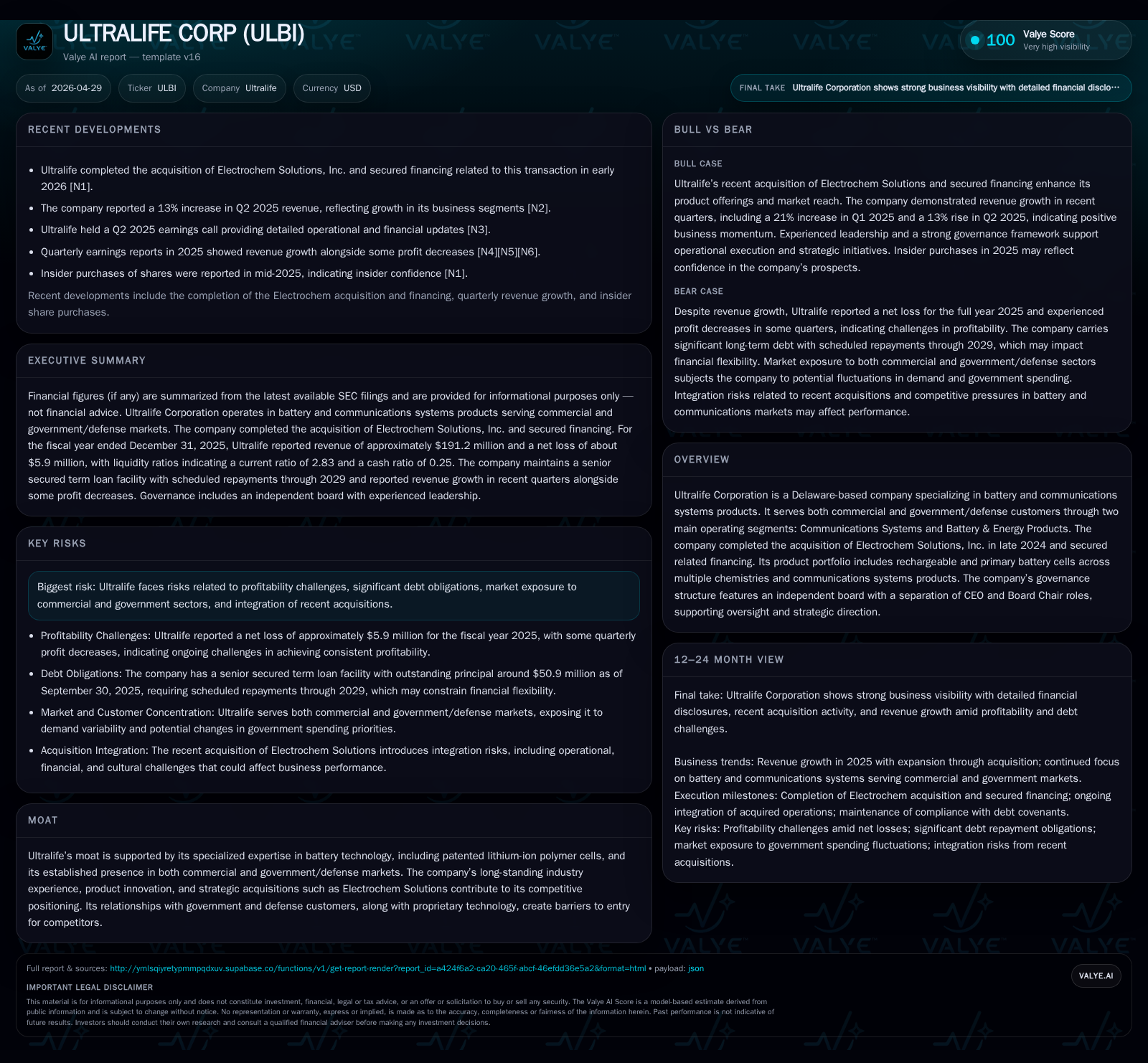
Ultralife’s recent acquisition of Electrochem Solutions deepens its battery technology capabilities and positions it for operational scale while facing profitability and debt servicing challenges.
In Q3 2025, Ultralife completed the acquisition of Electrochem Solutions, adding specialized primary lithium metal and ultracapacitor products that broaden its commercial and defense customer base. This acquisition enhances Ultralife’s manufacturing scale, operating leverage potential, and product innovation pipeline. The company’s dual-segment business model serves distinct markets in communications systems and battery energy products, supported by proprietary technologies and longstanding government relationships. Growth is expected from cross-selling, manufacturing efficiencies, and expansion into adjacent markets. However, profitability pressures persist alongside a $50.9 million term loan that requires disciplined financial management. Monitoring upcoming contract awards and operational synergies will be key to assessing Ultralife’s execution on its growth strategy.
Q3 2025 Operating Update Underscores Strategic Growth Move
Ultralife Corporation's third-quarter filing dated November 17, 2025, highlights the material impact of completing the acquisition of Electrochem Solutions on October 31, 2024 (S2). Based in Raynham, Massachusetts, Electrochem boasts over four decades of expertise designing and manufacturing primary lithium metal batteries and ultracapacitors tailored for energy storage, military applications, environmental monitoring, industrial uses, and utilities globally. This acquisition is critical to Ultralife's strategy to achieve greater operating leverage via enhanced scale and improved manufacturing cost efficiencies.
The goodwill recorded from this deal primarily comprises the value attributed to Electrochem's skilled workforce, engineering capabilities expected to accelerate product development, and anticipated revenue growth driven by expanded market penetration into new customers (S2). Importantly, the majority of this goodwill is nondeductible for income tax purposes but reflects intangible drivers central to future earnings potential.
Ultralife’s Business Model: Dual Segments Driving Innovation
Ultralife generates revenue through two principal segments: Communications Systems and Battery & Energy Products (S1). The Communications Systems segment specializes in ruggedized radios and related communication devices primarily serving government defense customers requiring reliable tactical systems resistant to harsh environments. The Battery & Energy Products segment offers a diverse product portfolio including rechargeable lithium-ion polymer cells protected under patent rights as well as primary lithium metal batteries encompassing thionyl chloride, sulfuryl chloride, bromine chloride chemistries (S1).
Customers include a mix of commercial entities needing dependable energy solutions alongside government agencies with strict regulatory specifications. Contractual relationships tend to embed switching costs due to equipment certification processes and integration complexity. Consequently, recurring revenue streams come from consumable battery replacements aligned with product lifecycle demands.
The recent addition of Electrochem complements this setup by introducing ultracapacitor cells that address power density needs in emerging applications while also extending presence in military-oriented markets previously underserved by Ultralife (S2). This bolsters technological differentiation through proprietary chemistry formulations combined with robust engineering expertise.
Industry Dynamics: Competitive Moats in Specialized Battery and Communications Markets
Ultralife competes within specialized niches characterized by regulatory rigors—particularly in defense contracts where certifications like MIL-STD compliance create high entry barriers (S1). Its patented lithium-ion polymer cell technology adds another layer of defense against commoditization common in general commercial battery segments.
Moreover, longstanding relationships with government customers provide stability via multi-year contract frameworks often coupled with renewal opportunities contingent on performance benchmarks rather than purely price competition (S1). Supply chain considerations include securing raw materials for lithium-based products amid geopolitical volatility that affects pricing but have less near-term impact given Ultralife’s engineering focus on proprietary chemistries.
However, outside defense-centric products where pricing power is more durable due to technical requirements validated by certifications, commercial market pricing faces greater cyclicality based on commodity inputs.
Growth Catalysts: Operational Leverage, Product Expansion, and Defense Sector Penetration
Post-acquisition synergies are at the core of Ultralife’s near-to-midterm growth thesis (S2). The combined entity anticipates capturing gross margin improvements via vertical integration—reducing reliance on third-party suppliers—and supply chain streamlining consistent with lean manufacturing principles.
Electrochem brings long-tenured technical resources instrumental in advancing global new product initiatives spanning both segments (S2). The infusion of engineering talent increases capacity to design next-generation battery packs optimized for military-grade communications gear as well as industrial storage solutions.
Cross-selling platforms enabled by complementary customer bases create avenues for incremental revenue streams with relatively low marketing expense increases. Furthermore, penetration into adjacent markets emphasizing uncompromised safety—such as mining or specialized environmental instrumentation—offers sustainable expansion levers (S2; N1).
Measurable KPIs linked to growth include backlog accumulation from government procurement contracts, win rates for competitive bids in communications equipment tenders, unit shipments of newly launched battery configurations enhancing energy density or lifecycle consistency.
Risks and Constraints: Profitability Pressures, Debt Servicing, and Integration Challenges
Despite positive strategic developments from the Electrochem acquisition, Ultralife continues facing profitability headwinds reflected in an operating loss totaling approximately $5.9 million for fiscal year 2025 (F1). Ongoing investments in R&D coupled with incremental integration costs temper immediate margin improvements (S2).
This facility accrues interest at a variable rate benchmarked plus a margin leading to a borrowing cost proximate to 6.62% (S2).
Transitional risks encompass cultural assimilation between merged entities’ workforces plus operational synchronization across geographically dispersed production sites—a nontrivial endeavor potentially impacting manufacturing throughput if unmitigated (S2).
Market cyclicality further complicates growth projection accuracy since exposure includes both commercial end markets—susceptible to demand swings—and stable yet politically influenced government/defense budgets.
Catalysts to Monitor: Guidance, Contract Wins, and Manufacturing Efficiencies
Looking ahead through early 2026 milestones vital for validating strategic execution comprise scheduled quarterly results for Q4 ended December 31, released presumably around March 2026 (S3). Earnings commentary detailing volume trends across battery packs versus communications products could illuminate sustainable recovery trajectories following integration phase costs.
Government procurement contract awards or renewals represent tangible demand markers signaling successful penetration into defense sectors supported by proprietary products (N1; S3). Commercial product launches leveraging electrochemical innovation or ultracapacitor introductions will be closely watched for uptake metrics indicating expanded market reach.
Operationally achievable gains from lean manufacturing rollout timelines will be crucial—reduction in unit production costs or inventory turnover acceleration may reinforce margin expansion narratives posited post-Electrochem acquisition.
Current Financial Position: Liquidity, Leverage, and Capital Structure Snapshot
Latest financial snapshot
| Metric | Value | Period |
|---|---|---|
| Cash & equivalents | $9mm | |
| 2025-12-31 | ||
| Current assets | $106mm | |
| 2025-12-31 | ||
| Current liabilities | $37mm | |
| 2025-12-31 | ||
| Current ratio | 2.83x | |
| 2025-12-31 |
Source: SEC companyfacts cache [F1].
As of fiscal year-end December 31, 2025 data aggregated from filings paints a balanced liquidity profile supporting operational needs alongside moderate financial risk:
| Metric | Value |
|---|---|
| Cash & Equivalents | $9.35 million |
| Current Ratio | 2.83 |
| Term Loan Principal Outstanding | $50.94 million |
| Borrowing Rate | 6.62% |
Total current assets stand at approximately $105.8 million against current liabilities near $37.3 million translating into a healthy current ratio underpinning short-term solvency (F1). The exclusive reliance on term loan debt without revolver borrowings mitigates refinancing risk but enforces rigid repayment schedules beginning March 31, 2025 onwards per amended credit terms (S2).
It does not constitute investment advice but aims to provide an informed perspective on Ultralife Corporation's operational dynamics post-Electrochem acquisition within its industry context.
Disclaimer: This is research-only, informational analysis and not investment advice. It may include AI-generated interpretation and general industry context. Always verify important details using primary sources.

Comments