
BioAtla’s Merger and Strategic Overhaul Shape Its Clinical and Financial Outlook
BioAtla’s recent merger completion and operational restructuring mark significant shifts in its clinical development focus and capital structure amid funding pressures.
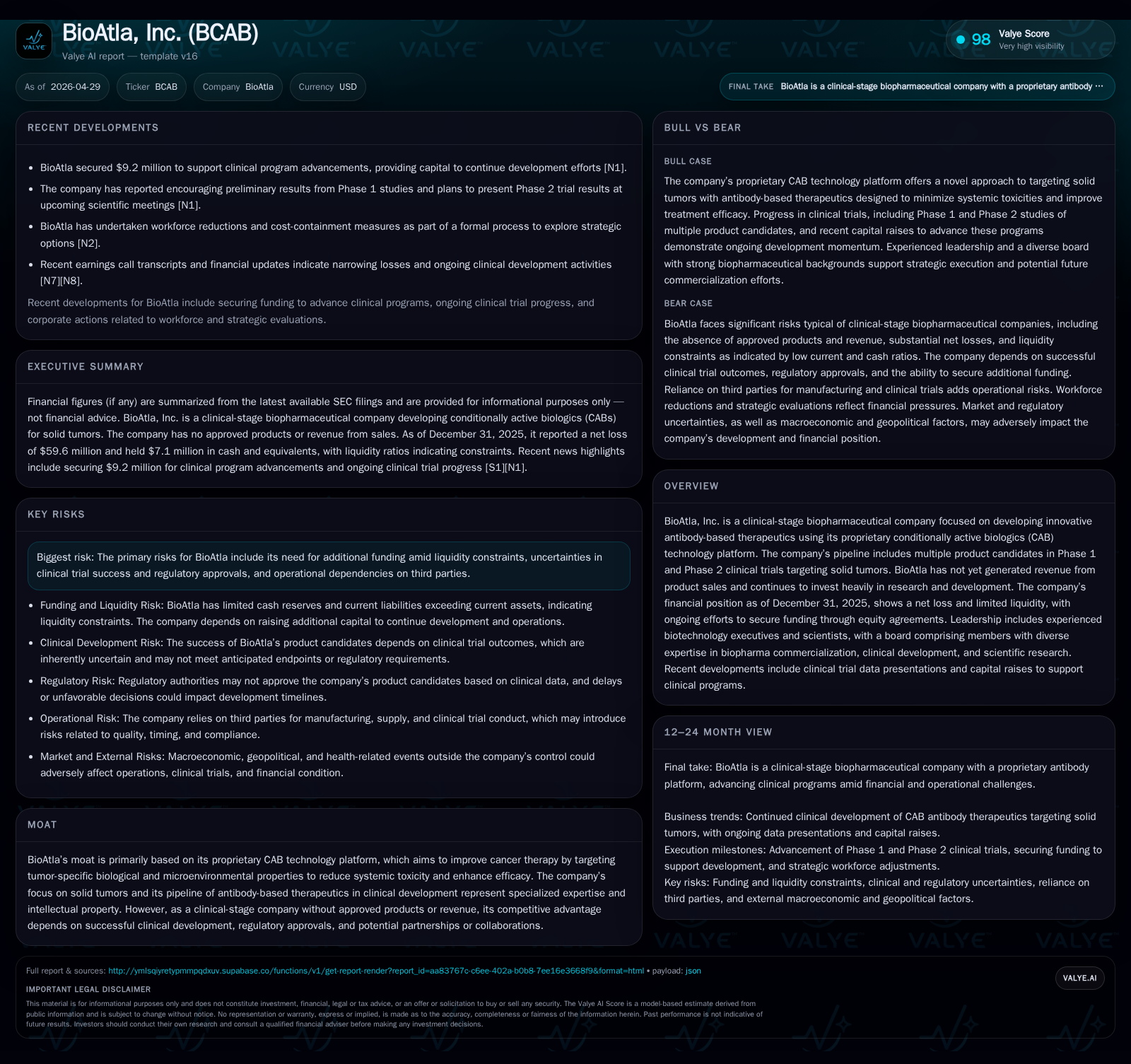
On April 2, 2026, BioAtla finalized a merger consolidating its share structure and concurrently announced a significant workforce reduction as part of a broader strategic review. The company remains focused on advancing its conditionally active biologics (CAB) platform targeting solid tumors through clinical-stage antibody therapeutics. While the CAB technology offers a differentiated approach within oncology, BioAtla faces near-term challenges including liquidity constraints, execution risks from organizational downsizing, and clinical development uncertainties. Upcoming milestones such as clinical data readouts and strategic partnership outcomes will be critical for its future trajectory.
Merger Completion and Operational Restructuring
On April 2, 2026, BioAtla filed its certificate of merger with Delaware authorities, finalizing the Agreement and Plan of Merger effective April 6, 2026 [S3]. This transaction merges the Merger Sub into BioAtla and implements a share consolidation converting every fifty outstanding shares into one common share. This restructuring aims to simplify the equity base amid ongoing financial challenges.
Concurrently, BioAtla disclosed an extensive restructuring program including a workforce reduction of approximately 70%, committed in February and announced in early March [S5][S11]. These cost containment measures accompany a formal process initiated March 2 to explore strategic alternatives such as asset sales or partnerships intended to maximize shareholder value [S5]. This repositioning reflects a response to constrained resources.
Proprietary CAB Technology Platform and Pipeline
BioAtla is a clinical-stage biopharmaceutical company leveraging its proprietary conditionally active biologics (CAB) technology platform to develop highly specific antibody therapeutics primarily targeting solid tumors [S1]. The CAB platform is designed for selective activation within the tumor microenvironment, enabling targeting of antigens difficult to address previously while potentially reducing off-target toxicity.
The pipeline includes multiple candidates in Phase 1 and Phase 2 trials across broad solid tumor indications but currently has no approved products or commercial revenues [S1]. Despite operational scale-backs, investment in R&D continues as BioAtla seeks pivotal clinical validation of this novel approach.
Competitive Positioning
Within oncology biopharma, BioAtla’s CAB constructs offer differentiation by aiming for tumor-selective activation compared to competitors focused on antibody-drug conjugates or immune checkpoint inhibitors. This selectivity could address systemic toxicity limitations seen with other immuno-oncology modalities.
However, typical early-stage biotech risks apply: absence of product revenues limits pricing power; regulatory pathways for novel modalities are lengthy; reliance on third parties for manufacturing and trials adds complexity; patient enrollment challenges persist in solid tumor studies [S1]. The competitive moat depends heavily on successful clinical progression and intellectual property protection.
Growth Drivers
Near-term growth catalysts center on advancing clinical trials toward meaningful data readouts that can validate safety and efficacy endpoints critical for regulatory discussions [S1][N1].
The ongoing strategic options process presents potential catalysts from licensing deals or asset divestitures that could provide capital injections necessary for continued development or expanded market reach [S5]. Collaborations may bring both technical synergies and commercial capabilities.
Risks and Challenges
Liquidity is a significant concern: as of December 31, 2025, cash & equivalents stood at approximately $7.12 million while current liabilities totaled about $21.92 million, resulting in a current ratio of just 0.37—a clear indicator of funding pressure [F1].
The company depends on further capital raises under existing agreements; failure or delay could disrupt trial progress or necessitate deeper downsizing beyond recent cuts [S3][S5]. Clinical risks inherent to early-stage programs remain substantial with uncertainties around endpoint achievement and regulatory acceptance.
Operationally, reducing headcount by nearly seventy percent poses risks to execution capability during an already challenging phase [S11]. Retaining critical institutional knowledge amid these cuts will be important.
Key Upcoming Catalysts
Investors should monitor:
- Clinical trial interim/final data releases validating the CAB platform,
- Outcomes from the strategic options review including potential partnerships or asset sales,
- Updates related to merger integration and governance changes,
- Capital raising activities under standby equity purchase arrangements recently established [N1][S3][S5].
These factors will provide clarity on BioAtla’s ability to navigate near-term challenges toward sustainable growth.
Financial Snapshot at Year-End 2025
Latest financial snapshot
| Metric | Value | Period |
|---|---|---|
| Cash & equivalents | $7mm | |
| 2025-12-31 | ||
| Current assets | $8mm | |
| 2025-12-31 | ||
| Current liabilities | $22mm | |
| 2025-12-31 | ||
| Current ratio | 0.37x | |
| 2025-12-31 |
Source: SEC companyfacts cache [F1].
| Metric | Value (USD) | Period End |
|---|---|---|
| Cash & Equivalents | $7.12 million | |
| 2025-12-31 | ||
| Current Assets | $8.01 million | |
| 2025-12-31 | ||
| Current Liabilities | $21.92 million | |
| 2025-12-31 | ||
| Current Ratio | 0.37 | |
| 2025-12-31 |
This balance sheet snapshot highlights material liquidity constraints amidst continued operating losses exceeding $59 million annually [F1]. Sustained access to funding remains critical for ongoing operations given the absence of revenue generation.
This analysis integrates recent SEC disclosures with publicly available information to assess BioAtla’s evolving strategic position within the biotechnology sector. It focuses on operational developments grounded in regulatory filings without offering investment advice.
Disclaimer: This is research-only, informational analysis and not investment advice. It may include AI-generated interpretation and general industry context. Always verify important details using primary sources.

Comments