
Epsium Enterprise Faces Macau Market Challenges While Exploring Vertical Integration
Board shifts and strategic pivots mark Epsium’s attempt to counteract Macau’s premium beverage market downturn.
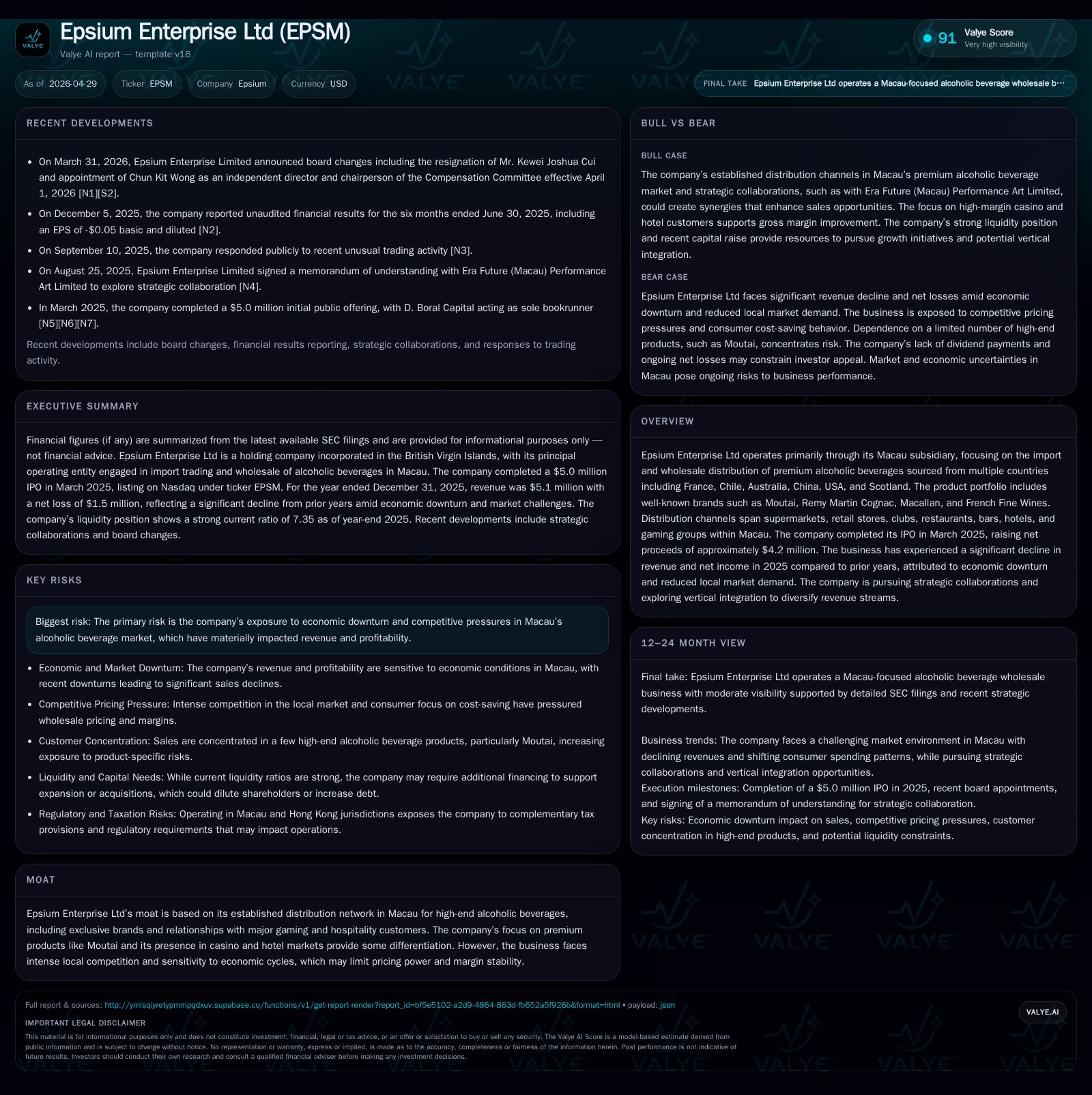
Epsium Enterprise Ltd’s latest quarterly report highlights a significant governance change with the appointment of Chun Kit Wong as an independent director, signaling a sharpened focus on financial oversight during challenging market conditions. The company operates primarily as an importer and wholesaler of premium alcoholic beverages in Macau, serving diverse channels including gaming and hospitality sectors. Despite a rebound in tourism post-pandemic, a prolonged economic downturn has suppressed demand and heightened competition, pressuring revenues and margins. Epsium is pursuing vertical integration and strategic partnerships targeting Macau’s emerging cultural event scene to diversify revenue streams. Its current strong liquidity position provides a buffer for ongoing investments amid operational losses.
Board Changes Signal Strategic Realignment
Epsium Enterprise Ltd reported a notable governance update in its latest 6-K filing dated March 31, 2026. The company’s Compensation Committee chairperson, Mr. Kewei Joshua Cui, resigned for personal reasons unrelated to company disagreements effective March 31. Concurrently, the Board appointed Chun Kit Wong as an independent director effective April 1, assuming memberships on the Audit, Compensation (as Chairperson), and Nominating Committees [S2][N1]. Mr. Wong brings significant experience in corporate finance development roles within Hong Kong-listed entities, emphasizing financial planning and compliance.
This board refresh reflects Epsium's response to intensified scrutiny on governance amidst operational challenges. Appointing an independent director with expertise in financial oversight may help improve transparency and soundness in compensation decisions and audit processes — crucial aspects given prior disclosures of material weaknesses in internal controls over financial reporting [S18].
Business Model: Premium Beverage Import and Wholesale Distribution
Epsium’s core operations revolve around importing premium alcoholic beverages across global brands and distributing them wholesale within Macau’s diverse retail network [S1]. The company sources from France (notably Cognac like Remy Martin), China (Moutai), Scotland (Macallan), Chile, Australia, and the USA. Product assortment spans fine wines, champagnes such as Piper Heidsieck, liquors including Cointreau, and famed high-end Chinese spirits.
Revenue stems mainly from supplying supermarkets, specialty retail stores, bars, hotels, restaurants, clubs, food courts, and large gaming groups known for their substantial beverage demands [S1]. The firm strictly uses formal legal import channels ensuring authenticity of premium product offerings.
This distribution channel breadth allows Epsium exposure across multiple customer verticals that vary by occasion—from everyday retail consumption to luxury hospitality events—though the mix places significant reliance on Macau’s casino-driven tourism economy—a historically volatile sector.
Macau Market Dynamics and Competitive Environment
Post-pandemic reopening beginning January 2023 catalyzed a rebound in visitor traffic (a reported +14.7% YoY increase in inbound visitors during 2025) but did not translate into proportional uplift in beverage sales or spending per tourist [S1][S14]. Non-gaming expenditure declined by 7.3% per visitor while retail sales dropped over 3%, highlighting cautious consumer behavior amid broader macroeconomic uncertainty.
The wholesale alcohol market faced contraction due to this pullback in discretionary spending exacerbated by consumers becoming cost-conscious following a brief "revenge spending" phase immediately post-lockdown [S1]. Meanwhile, local competition intensified sharply starting in 2024 with many players undercutting prices especially in lower tier segments which pressured Epsium's pricing power in wholesale channels. This dynamic complicates margin management considering fixed costs inherent to alcoholic beverage import businesses.
In contrast to general visitor trends, attendees at Meetings-Incentives-Conferences-Exhibitions (MICE) events or performances exhibited roughly twice the average per capita spending on non-gaming items including premium beverages—a structural insight linking Epsium’s strategic pivot toward entertainment-driven consumption [S14].
Growth Initiatives: Vertical Integration and Partnership Synergies
Confronted with cyclical softness in its core wholesale business alongside declining top-line from $29 million (pre-pandemic) down to about $5.12 million by year-end 2025 [F1], Epsium is actively exploring strategic diversification avenues. Notably:
- The company seeks partnerships with performance promotion agencies aligned with Macau's governmental push branding the city as the "Performing Arts Capital." By leveraging these venues hosting international shows and conventions, Epsium aims to integrate premium alcoholic beverage sales directly into event consumption experiences—an initiative designed to enhance product relevance while tapping higher disposable per-customer spends typical for such settings [S1][S14].
- An exclusive agent agreement executed by its Hong Kong subsidiary positions Epsium within biotech-related intellectual property acquisition targeting applications in wine vintage enhancement—a niche aimed at potentially differentiating their wine portfolio technologically and thus possibly commanding better margins or unique market positioning [S1][S8].
These growth efforts hinge on leveraging Macau's evolving cultural ecosystem rather than relying solely on traditional gaming tourism dependencies.
Risk Factors: Economic Sensitivity and Market Competition
Epsium operates with significant exposure to macroeconomic swings impacting both inbound tourism volumes and discretionary spend patterns within Macau's premium alcohol segment [S1]. A persisting economic downturn has materially shrunk demand leading to reduced volumes and forced downward price adjustments due to aggressive competitor pricing strategies.
The competitive landscape includes large-scale distributors with entrenched relationships at major casinos and luxury hotels that demand volume discounts. Additionally, consumer preference shifts towards cost-saving makes convincing end clients challenging without eroding gross margins further.
Operationally, Epsium faces risks related to maintaining cohesive inventory management across multi-origin product lines amidst fluctuating exchange rates affecting cost bases. Also relevant are historical concerns about internal control deficiencies potentially impacting financial reporting integrity if not fully remediated despite ongoing corrective measures [S18].
Key Milestones to Monitor
Investors tracking Epsium should focus on execution markers tied to:
- Implementation progress of vertical integration deals allowing seamless beverage sales at Macau performing arts venues.
- Uptake metrics from newly forged partnerships targeting MICE events attendance linked premium product placements.
- Trends in non-gaming tourist expenditures correlated with gradual economic stabilization or recovery signals within Greater China macro context.
- Further board appointments or governance improvements evidencing maturity towards public company compliance standards. Continuing updates on operational KPIs such as inventory turns or accounts receivable aging will also provide forward-looking insight into earnings quality improvements given past working capital fluctuations [S1][S2][F1].
Latest Financial Snapshot and Liquidity Overview
Latest financial snapshot
| Metric | Value | Period |
|---|---|---|
| Current assets | $13mm | |
| 2025-12-31 | ||
| Current liabilities | $1774990 | |
| 2025-12-31 | ||
| Current ratio | 7.35x | |
| 2025-12-31 |
Source: SEC companyfacts cache [F1].
| Metric | Value |
|---|---|
| Revenue (FY2025) | $5.12M |
| Operating Income | -$1.50M |
| Net Income | -$1.50M |
| Current Ratio | 7.35 |
| Total Debt | $2 |
As of December 31, 2025, Epsium reported revenues precipitously down from prior years at approximately $5.12 million alongside an operating loss close to $1.5 million reflecting severe top-line contraction amid market softness [F1]. Net income was similarly negative.
Despite this profitability pressure, liquidity remains robust with current assets considerably exceeding current liabilities resulting in a current ratio of 7.35—indicative of strong short-term coverage capacity for payables [F1]. Notably total debt is negligible at $2 suggesting minimal leverage burden which gives flexibility for funding strategic initiatives or absorbing near-term shocks without refinancing risks [F1][S3].
Cash flow statements indicate sustained net cash outflows from operations reflecting tightened working capital cycles but recent equity injections from IPO proceeds support a positive overall cash position nearing $2 million year-end 2025 enabling planned investment activity going forward [S3][S4].
This analysis relies exclusively on SEC filings including the company’s most recent quarterly disclosure (Form 6-K dated March 31, 2026) as primary anchor alongside the annual Form 20-F filed April 29, 2026 for additional business model context. No projections or investment recommendations are provided herein.
Disclaimer: This is research-only, informational analysis and not investment advice. It may include AI-generated interpretation and general industry context. Always verify important details using primary sources.

Comments