
PureTech Health Shifts Strategic Focus with Nasdaq Delisting and Advances Pipeline Progress
The company’s simultaneous announcement of voluntary Nasdaq ADS delisting and 2025 year-end results marks a pivotal chapter in its market and clinical development strategy.
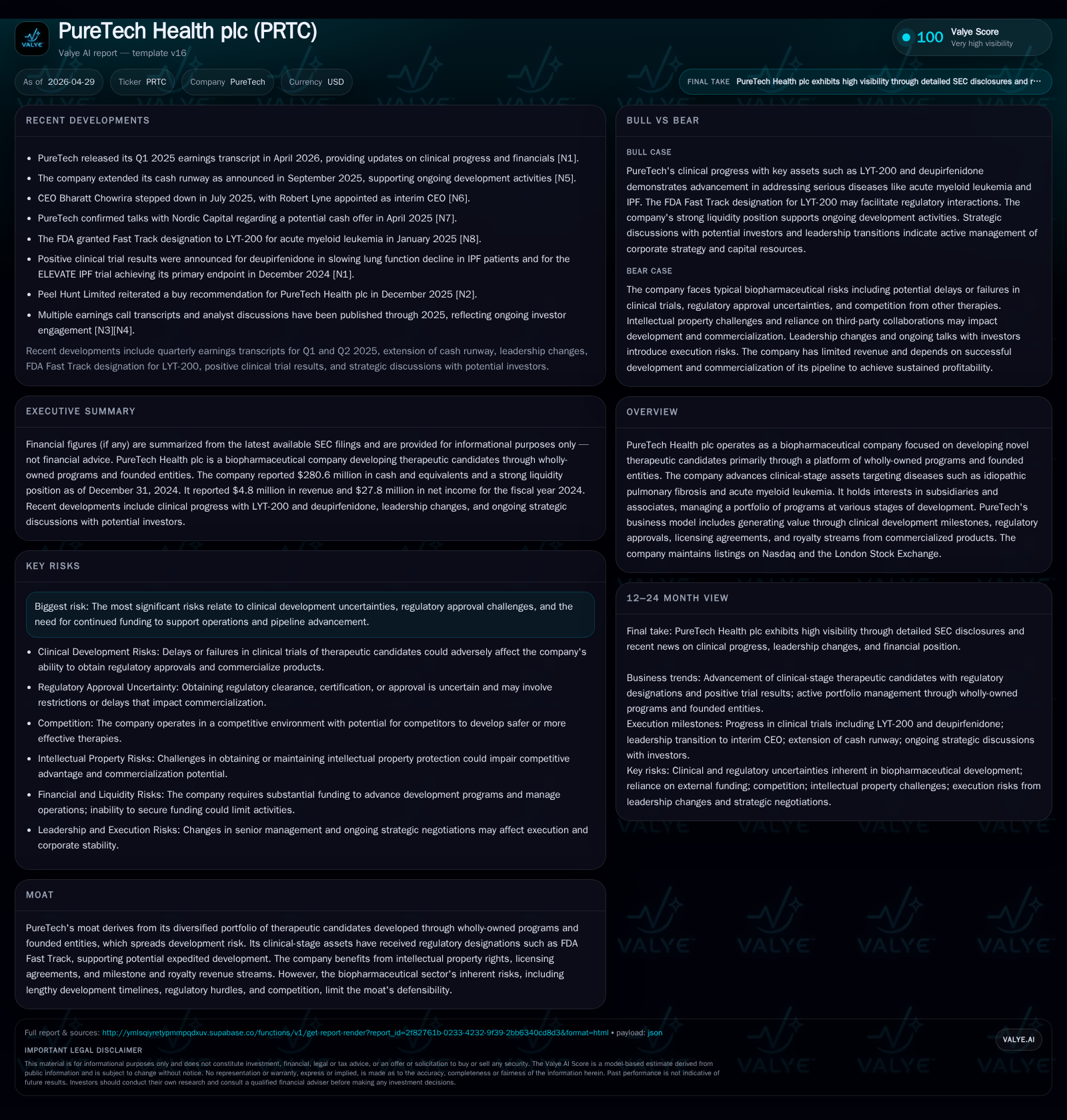
PureTech Health plc recently disclosed its intention to voluntarily delist its American Depositary Shares from Nasdaq, concentrating trading activities on the London Stock Exchange. This strategic market refocus coincides with the release of its year-end 2025 operating results, which highlight meaningful progress across its diversified clinical pipeline. The company’s business model continues to hinge on advancing wholly-owned programs and subsidiaries through clinical milestones, regulatory approvals, and licensing revenue, while maintaining a robust cash position to support further development. Regulatory designations such as FDA Fast Track attest to the clinical relevance of its assets targeting diseases like idiopathic pulmonary fibrosis and acute myeloid leukemia. While PureTech leverages portfolio diversification to mitigate risk, key challenges remain around clinical execution, securing regulatory approvals, and capital requirements.
Recent Operating Update: Dual April 29 Announcements
On April 29, 2026, PureTech Health plc released two significant disclosures that reshape its operational landscape. The company filed its annual results for the year ended December 31, 2025 [S2], detailing comprehensive pipeline progress and financial health. Concurrently, PureTech announced a voluntary delisting of its American Depositary Shares (ADSs) from Nasdaq to concentrate trading solely on the London Stock Exchange (LSE) [S3].
This dual announcement signals a strategic recalibration balancing capital market footprint with focused clinical execution. The firm underscored sustained advances in its therapeutic portfolio during 2025 across wholly-owned assets and Founded Entities emphasizing indications such as idiopathic pulmonary fibrosis (IPF) and acute myeloid leukemia (AML). Such progress aligns with several regulatory designations supporting accelerated development timelines.
By narrowing stock exchange listings to the LSE, PureTech aims to reduce associated compliance costs and streamline shareholder engagement predominantly aligned with its core investor base concentrated in Europe. This move potentially alters U.S. institutional participation dynamics but may enhance operational efficiency in disclosure and governance frameworks.
Business Model: Platform-Driven Innovation and Value Realization
PureTech operates a distinct biopharmaceutical model that centers on cultivating innovation through two channels: wholly-owned programs directly managed by the company and Founded Entities—early-stage companies in which PureTech maintains significant or controlling interests [S1]. This hybrid structure diversifies science risk while enabling value capture across multiple stages of drug development.
Revenue streams are principally milestone-driven; payments originate from achieving clinical trial phases, regulatory approvals, or sales targets agreed under licensing arrangements. In addition, royalties accrue from commercialized products developed within the platform. This diversified mix offers balance between capital-intensive development phases and non-dilutive income streams linked to pipeline success.
The model leverages proprietary intellectual property carefully guarded via patent protections complemented by collaborative licensing deals creating network effects supportive of long-term growth potential. The portfolio approach mitigates concentration risk that traditionally burdens single-asset biotech firms.
Industry Context: Competitive Positioning in Biopharma
In the broader biopharma ecosystem, PureTech navigates a landscape typified by rapid technological change yet burdened with stringent regulatory scrutiny. Success trajectories depend heavily on navigating complex clinical trial protocols coupled with FDA designations like Fast Track status which many candidates in PureTech’s stable have secured [S1]. These designations expedite review processes influencing perceived asset valuation positively.
Competition is robust given numerous entities pursuing treatments for diseases addressed by PureTech’s programs. Entrants with faster clinical progression or superior efficacy profiles may pressure market opportunities. Nonetheless, PureTech's multi-faceted asset approach through both wholly-owned entities and partnerships forms a competitive moat underpinned by intellectual property rights combined with milestone-linked revenues that provide cash flow buffers.
Pipeline Progress and Clinical Development Highlights
The recent filings highlight meaningful activity across key programs including deupirfenidone (LYT-100), targeting IPF—a chronic fatal lung disease—and LYT-200 directed at hematological malignancies like AML [S2][N1]. Several trials advanced phases during 2025 reflecting tactical prioritization on indications demonstrating promising initial efficacy signals.
These developments carry strategic import beyond near-term scientific validation; they are pivotal for unlocking next-stage milestone payments integrated into licensing agreements underpinning revenue generation prospects. Ongoing enrollment metrics and anticipated data readouts chart potential inflection points supporting incremental investor confidence.
Strategic Rationale Behind NASDAQ Delisting
The decision to withdraw ADSs from Nasdaq while concentrating equity trading on the LSE reflects both cost containment measures and prioritization of shareholder engagement aligned geographically with core markets [S3]. Maintaining dual listings entails heightened regulatory compliance requirements including Sarbanes-Oxley costs plus duplicated reporting structures that can reduce capital efficiency.
By consolidating listing venue presence in London—where ordinary shares have traded since 2015—PureTech benefits from streamlined administrative overheads while sharpening focus on investor communications within jurisdictions representing majority ownership.
However, this change also influences liquidity composition; U.S.-based investors reliant on Nasdaq may encounter trading constraints impacting bid-ask spreads or volume profiles. Market participants will closely watch effects on price discovery mechanisms post-delisting.
Growth Drivers: Milestones, Collaborations, and Expansions
Core growth vectors emerge from a combination of sustaining delivery against development milestones triggering contractual payments and broadening collaborative partnerships that extend research capabilities or geographic footprint [S1][N1][S2].
Advancing clinical trials towards late-stage readouts increases visibility into potential product approvals driving licensing deals or eventual commercialization strategies. Recently secured FDA Fast Track designations contribute favorable regulatory dynamics enhancing time-to-market prospects.
Additionally, scaling platform technologies embedded across Founded Entities fosters innovative therapeutic avenues extending beyond existing franchises—enabling diversification into new disease areas or modalities enhancing overall portfolio resilience.
Risks and Constraints: Regulatory, Funding, and Execution Challenges
Despite positive momentum, PureTech faces inherent biopharma risks prevalent industry-wide including lengthy timelines for obtaining regulatory approvals coupled with high capital intensity required for development continuation [S19][S27]. Failure or delays at critical trial junctures could materially impair value creation trajectories.
Funding remains an ongoing concern given dependency on milestone-triggered cash inflows supplemented by external financing rounds; inability to secure capital under acceptable terms can stall operations or force reprioritization of pipeline assets.
Manufacturing complexities of novel biologics or synthetic molecules present additional hurdles potentially affecting supply chain timelines or cost structures. Furthermore, competition from more advanced products risks eroding future market share upon commercialization.
What to Watch Next: Upcoming Catalysts and Market Reactions
Investors should monitor forthcoming clinical trial endpoints particularly those related to IPF and AML programs which may serve as binary events catalyzing revaluation [S2][N1]. Regulatory submissions or designation expansions also represent crucial inflection points offering clearer commercialization timelines.
Post Nasdaq delisting market reaction will provide insight into investor sentiment shifts driven by altered liquidity access scenarios [S3]. Observing trading volumes on the LSE post-transition will be essential for evaluating ongoing shareholder engagement quality.
Additionally, announcements regarding new collaboration agreements or platform extensions could further invigorate growth narratives underpinning longer-term outlooks.
Brief Financial Profile: Liquidity, Capital Resources, and Balance Sheet Strength
As per available data for period ending December 31, 2024—which remains the latest disclosed snapshot—PureTech possessed approximately $281 million in cash and equivalents along with current assets totaling roughly $386 million against current liabilities near $41 million yielding a healthy current ratio above 9x indicative of strong short-term liquidity coverage [F1].
Such financial strength offers sufficient runway to support ongoing R&D expenditures integral to advancing multiple clinical programs without immediate refinancing pressures. However, note these figures predate full disclosure of possible spending plans over subsequent quarters so continuous updates remain essential for dynamic assessment.
This analysis is grounded solely in disclosed SEC filings as of April 29, 2026 ([S1]-[S29]) supplemented by recent earnings transcript commentary ([N1]) and company financial snapshots ([F1]). It avoids speculation beyond verified data focusing on tangible operating facts underpinning PureTech Health plc’s current business trajectory.
Readers should consider industry cyclical characteristics alongside typical biotech sector inherent risks when interpreting strategic moves such as market listing changes combined with pipeline advancement updates presented herein.
Disclaimer: This is research-only, informational analysis and not investment advice. It may include AI-generated interpretation and general industry context. Always verify important details using primary sources.

Comments