
Vita Coco's Asset-Light Model Drives Resilient Growth Amid Supply Chain Pressures
Vita Coco Company, Inc. reported strong early 2026 results, reflecting growth despite increased tariffs and supply chain risks.
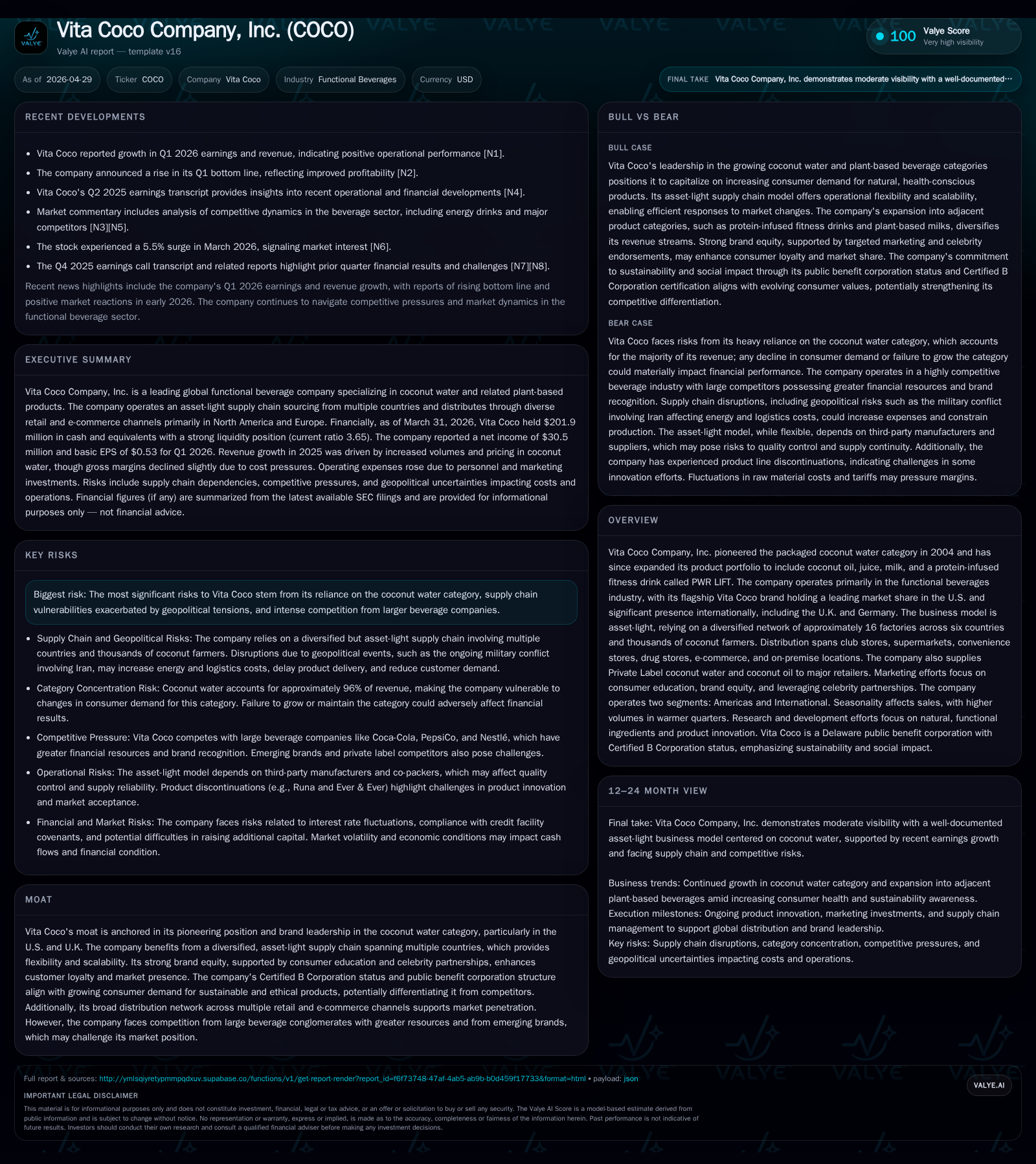
In its latest quarterly filing, Vita Coco Company, Inc. demonstrated robust top-line growth driven by continued dominance in the coconut water category, despite navigating rising tariff costs and geopolitical supply chain challenges. The company’s asset-light business model leverages a diversified global sourcing network and extensive distribution channels to maintain market leadership and flexibility. Growth is primarily fueled by volume increases in key markets and pricing improvements, although margin pressures from tariffs and logistics costs persist. Ongoing risks include geopolitical tensions impacting energy costs and supply chain stability, as well as concentration in the core coconut water segment.
Recent Operating Update
In the first quarter ending March 31, 2026, Vita Coco Company, Inc. reported sustained revenue growth driven by volume gains and price improvements in its flagship Vita Coco Coconut Water brand [S2]. Despite facing a challenging external environment marked by escalating tariffs on imported goods from key sourcing countries and geopolitical instability — notably U.S. and Israeli military operations involving Iran causing energy market disruptions — the company managed to grow its sales while absorbing inflationary pressures [S2].
Gross margins contracted roughly two percentage points to 36.5%, mainly due to higher product input costs including tariffs which averaged an effective rate of around 23% in late 2025 alongside increased freight costs owing to elevated oil prices [S1][S2]. However, favorable pricing actions within the Vita Coco branded portfolio partially offset this margin pressure. The ongoing asset-light supply chain framework contributed to operational resilience by enabling flexible volume allocations across a network of approximately sixteen factories spanning six countries supported by thousands of coconut farmers [S1].
Liquidity remains robust as of quarter-end with cash and equivalents at approximately $202 million against nominal total debt near zero from vehicle financing loans outstanding [F1]. This solid financial position provides a buffer against potential further cost headwinds caused by global trade turmoil or commodity price shocks [F1].
Business Model
Vita Coco pioneered the packaged coconut water category in 2004 and has since expanded into ancillary plant-based beverages including coconut oil products, juices, milks, and protein-infused fitness drinks under its PWR LIFT brand [S1]. Its core business generates revenue primarily through sales of branded Vita Coco products (coconut water comprising about 96% of total revenue) sold via retail partnerships covering club stores (e.g., Costco), supermarkets, convenience outlets, drugstores, e-commerce platforms, and a variety of on-premise settings like fitness centers or airports [S1][S12].
The company operates on an asset-light production model without owning facilities outright; instead it relies on third-party manufacturers who buy raw coconuts locally under Vita Coco's stringent quality standards. This approach allows Vita Coco to adjust nimble production volumes internationally and mitigate capital expenditure risk while maintaining access to expanding consumer markets [S1]. Private Label manufacturing is another meaningful revenue stream serving large retailers primarily in North America and Europe with both coconut water and oil products supplied under retailer brands [S1][S15].
Margins are influenced by channel mix (higher-margin direct-to-consumer vs wholesale), product mix (branded vs Private Label), commodity input cost fluctuations tied to tariffs and freight charges, and promotional investment levels [S11]. Marketing initiatives focus heavily on consumer education regarding coconut water benefits alongside leveraging celebrity partnerships that embed brand image into lifestyle culture [S1].
Industry Structure & Competitive Position
Within the broader functional beverage industry — encompassing natural hydration solutions free from artificial additives — Vita Coco commands the leading market share positions: over 40% in the U.S. coconut water segment and exceeding 80% in the U.K. market [S1]. The global coconut/plant waters category is a niche within functional beverages but growing due to increasing health-conscious consumption trends favoring natural hydration products.
Competition arises from large beverage conglomerates like Coca-Cola (with its Zico brand), PepsiCo (through Naked Juice), regional upstarts offering premium or organic alternatives, plus generic Private Label offerings that compete on price within major retailers [S8][S19]. While these companies have deeper pockets for marketing spend and distribution scale advantages, Vita Coco's pioneering status confers entrenched brand equity which resonates strongly with younger demographics seeking authentic wellness products.
However, Private Label competition presents dual-edged dynamics as Vita Coco supplies these products but also competes with them for shelf space in some channels — heightening customer negotiation complexity [S1][S12]. Additional sanctions or escalation could disrupt material availability or timing causing inventory shortages or inflated costs [S2].
- Category Concentration: Reliance on coconut water for majority revenues exposes Vita Coco to shifts in consumer preferences away from this niche which may be supplanted by newer functional beverage categories unless portfolio diversification succeeds meaningfully [S10][S19].
- Tariff Exposure: Elevated tariffs raising input costs pose margin pressure challenges given competitive retail environments limit passing full cost onto consumers without volume loss [S1][S20].
- Competitive Encroachment: Large beverage conglomerates possess resources to intensify competition through pricing discounts or increased marketing which could erode Vita Coco’s shelf positioning and negotiating leverage with retailers.
- Packaging Supply Chain Dependence: Sole sourcing packaging materials from suppliers like Tetra Pak constrains flexibility; material shortages or cost surges could disrupt manufacturing schedules or increase operating expenses unexpectedly [S16].
- Customer & Distribution Concentration: Heavy reliance on select large retail customers increases credit risk; consolidation trends among retailers can intensify buyer power potentially squeezing margins or reducing shelf presence [S12].
What To Watch Next
Investors should track several key developments reflective of operational execution:
- Trailing quarterly revenues showing sustained organic growth especially outside North America.
- Margin trends relative to evolving tariff regimes or transportation fuel prices.
- New product launches extending beyond core coconut water portfolio evaluated for market reception.
- Updates on Private Label contract renewals or expansions signaling customer confidence.
- Progress in e-commerce channel penetration indicated by DTC volume growth metrics.
- Geopolitical events impacting global energy markets and shipping lane stability with direct operational repercussions.
- Potential regulatory developments around labeling claims pertinent to natural/organic product definitions.
Financial Profile Summary
Latest financial snapshot
| Metric | Value | Period |
|---|---|---|
| Cash & equivalents | $202mm | |
| 2026-03-31 | ||
| Total debt | $3000 | |
| 2025-12-31 | ||
| Net debt | $-202mm | |
| 2025-12-31 | ||
| Current assets | $450mm | |
| 2026-03-31 | ||
| Current liabilities | $123mm | |
| 2026-03-31 | ||
| Current ratio | 3.65x | |
| 2026-03-31 |
Source: SEC companyfacts cache [F1].
As of March 31, 2026 the company holds cash & equivalents of approximately $202 million against negligible total debt of $3 thousand—demonstrating strong liquidity favoring operational agility amid macroeconomic uncertainty [F1]. The current ratio stands at a healthy 3.65 reflecting manageable short-term liabilities versus available assets [F1]. Revenue previously reported for FY2025 was $609.8 million showing an 18% increase year-over-year with net income at $71.3 million underscoring profitable scale gained since IPO in late 2021 [F1][S1].
Operating income has grown steadily reaching over $82.5 million reflective of disciplined expense management even as SG&A expanded due to marketing investments supporting brand awareness campaigns detailed above [F1][S11]. These financial fundamentals indicate a solid foundation supporting continued expansion plans contingent on mitigating identified risks.
Conclusion
Vita Coco Company has leveraged its pioneering role in packaged coconut water into an asset-light yet globally diversified operation enabling expansion amid complex supply chain challenges exacerbated recently by geopolitical tensions. Its strong brand equity combined with a flexible manufacturing strategy underpin resilience while providing avenues for product innovation-driven growth beyond core hydration offerings. Nonetheless notable external risks related primarily to tariff escalation, energy price volatility tied to Middle East conflicts, competitive pressures from large beverage players, and category concentration remain critical factors requiring ongoing strategic management attention. Prospective developments around international expansion traction along with new product introductions will be important indicators signaling sustainability of current momentum.
This analysis is based exclusively on publicly available SEC filings dated up to April 29, 2026 ([S1], [S2], [S3]), company facts ([F1]) data as of March 31, 2026, and relevant market news sources (). It does not constitute investment advice but aims to provide detailed industry-informed insights consistent with recent operating disclosures.
Disclaimer: This is research-only, informational analysis and not investment advice. It may include AI-generated interpretation and general industry context. Always verify important details using primary sources.

Comments