
Nu Ride Inc. Rebuilds After Bankruptcy with Secured Loans and Billboard Leasehold Assets
Post-bankruptcy Nu Ride focuses on secured lending backed by equity interests in billboard leases, seeking operational stability amid niche market risks.
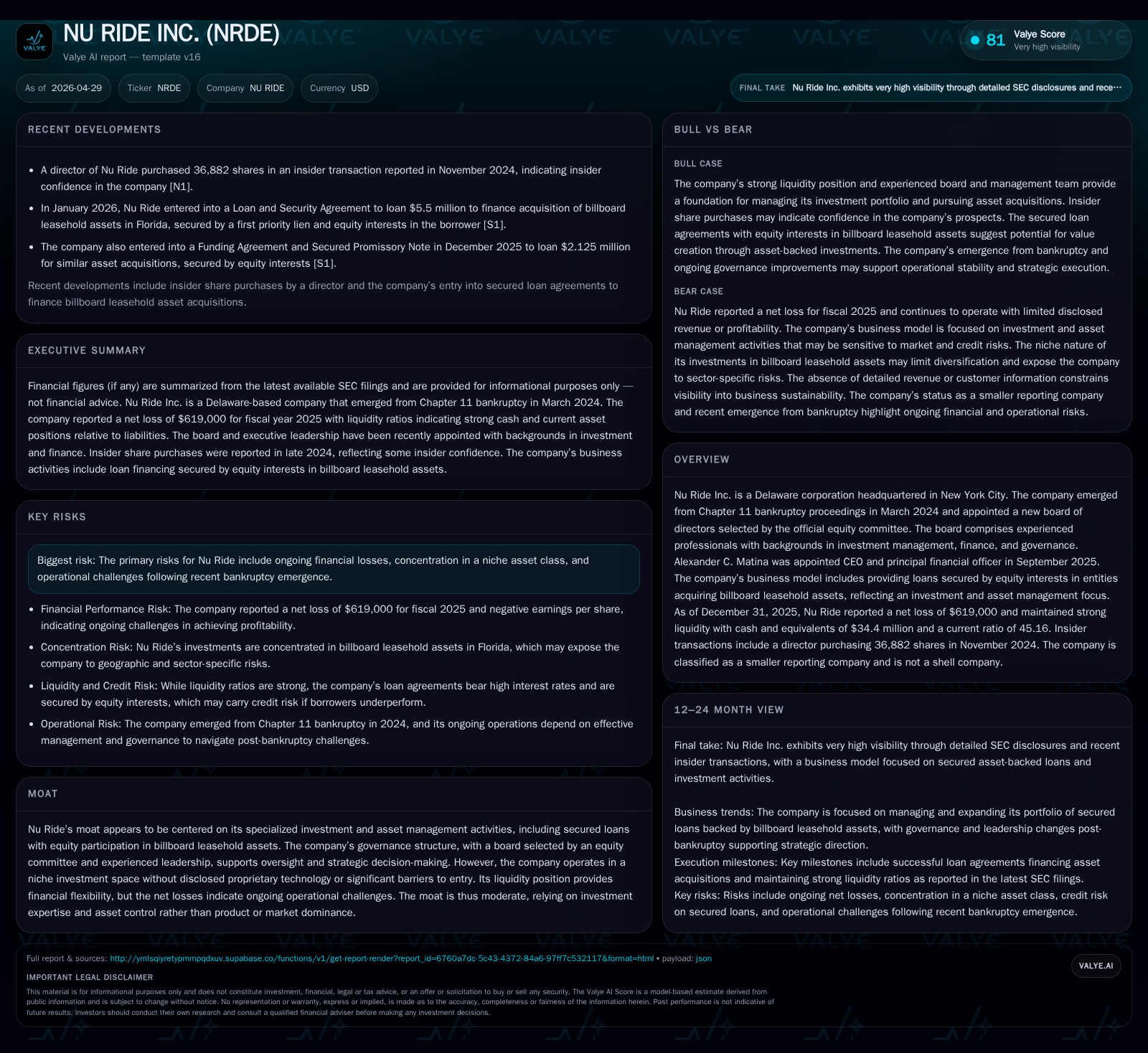
Nu Ride Inc., emerging from Chapter 11 in early 2024, operates as a specialized investment and asset manager providing loans secured by equity stakes in entities that acquire billboard leasehold assets. The company’s latest 10-K/A reveals modest improvement in operating losses and a strong liquidity position with a high current ratio. Its business model hinges on credit risk management and asset control within a niche advertising real estate segment. While governance reforms and leadership changes aim to support strategy execution, structural challenges persist given ongoing losses, concentrated asset exposure, and limited moat from product or market advantages.
Recent Operating Update
Nu Ride Inc.'s most recent quarterly report filed November 13, 2025 [S2] reconfirms continuity in the company’s risk profile since emergence from Chapter 11 bankruptcy proceedings earlier in 2024. The firm explicitly states no material changes to previously reported risk factors during this quarter, signaling measured operational steadiness without alarming new developments.
Significantly, the company has actively deployed capital through secured lending transactions targeting entities acquiring billboard leasehold assets. Two notable loan agreements closed between December 2025 and January 2026 include a $5.5 million loan to Foxpoint Florida II LLC and a $2.125 million loan to Foxpoint Florida LLC [S15][S16]. Both loans are secured by first-priority liens on borrower assets along with pledges of equity interests amounting to approximately 40% total equity ownership, providing Nu Ride substantial collateral and potential equity upside.
Leadership stabilization occurred with the appointment of Alexander C. Matina as CEO in September 2025 [S20], replacing the interim executive provided under M3 Advisory Partners' engagement. Mr. Matina brings extensive investment management expertise spanning public and private markets over two decades, endorsing a strategic recalibration focused on disciplined capital allocation and tighter governance.
Business Model
Nu Ride’s revenue model is principally investor-oriented: it provides corporate loans secured against equity stakes in companies that acquire billboard leasehold assets—a niche real estate-backed credit play combining income generation through interest payments and possible capital appreciation via equity shares.
Borrowers are typically special purpose vehicles set up to hold billboards along highways or urban areas, where leasehold interests represent valuable advertising locations with stable demand drivers albeit subject to local zoning regulations.
The company earns revenue largely from contractual interest payments (the loans carry ~15% annual cash interest) along with incrementally accruing value through partial ownership of these entities upon repayment of loans or eventual monetization of assets [S15]. This hybrid debt-equity structure aligns Nu Ride's returns with both fixed income attributes and long-term asset appreciation potential.
Importantly, the loan agreements are structured with covenants, representations, warranties, and default provisions customary to such secured financings—designed to mitigate credit risk while maintaining strategic influence via sizable equity holdings.
Industry Structure and Competitive Position
Nu Ride operates within a highly specialized corner of alternative investments centered around outdoor advertising leaseholds. This intersection of commercial real estate financing and asset management is relatively niche, limiting direct competitors but also constraining scale opportunities.
The competitive landscape comprises traditional lenders selectively involved in billboard financing alongside private equity or hedge funds engaging in asset-backed lending. However, Nu Ride’s approach stands out due to its blended debt plus equity stake model focusing on long-duration contracts insusceptible to short-term advertising market fluctuations.
Unlike broad advertising firms or digital-first media companies, Nu Ride does not compete on creative or technological innovation but relies on financial engineering expertise and stringent underwriting standards to generate differentiated risk-adjusted returns.
The company's moat is moderate—stemming more from accumulated deal pipeline access, board oversight tightened through an official equity committee post-bankruptcy restructuring, and the legal enforceability of liens plus equity pledges rather than unique product offerings or regulatory shields.
Growth Drivers
Looking ahead, Nu Ride's growth trajectory depends upon several interconnected drivers:
- Loan Portfolio Expansion: Successful origination of new secured loans backed by billboard assets will increase interest income streams while potentially enhancing equity positions if borrowers repay early under incentive reduction terms.
- Capital Recycling: Repayment of existing loans with accrued interest provides cash that can be redeployed into fresh deals or used for corporate purposes supporting sustainability.
- Market Dynamics: Steady demand for outdoor billboard leasing amid evolving advertising channels anchors underlying collateral value; however, competition from digital signage remains a long-term consideration.
- Governance Enhancements: A seasoned board with investment management backgrounds helps refine underwriting criteria, monitor portfolio quality diligently, and adapt strategies responsively amid economic cycles.
- Operational Efficiency: Controlling administrative costs following bankruptcy emerges critical given persistent operating losses despite profit narrowing [F1]. Achieving positive operating leverage could materialize from scaling incremental revenue without proportional cost increases.
Risks & Watchpoints
Several constraints temper optimism surrounding Nu Ride:
- Concentration Risk: Exposure centered on billboard leaseholds limits diversification; adverse regulatory shifts or local zoning challenges could impair collateral values disproportionately.
- Operating Losses: Although improving year-over-year (net loss fell to $619K in FY2025), losses remain entrenched highlighting challenges balancing revenues against administrative overheads [F1].
- Post-Bankruptcy Uncertainties: Despite reorganization completion in early 2024, latent liabilities or covenant compliance matters may arise affecting financial flexibility.
- Credit Quality & Loan Performance: Borrower defaults or delays would strain returns given concentrated portfolio size; securing reliable cash flows depends heavily on effective loan vetting and enforcement capabilities.
- Niche Market Cyclicality: Outdoor advertising can be sensitive to macroeconomic swings impacting advertiser budgets; digital displacement trends require monitoring though less immediate impact occurs due to leased asset structure.
- Limited Competitive Barriers: Absence of proprietary technology or exclusive market access means new entrants could replicate elements of Nu Ride’s model absent scale advantages.
What to Watch Next
Key indicators shaping future assessment include:
- Quarterly updates reaffirming credit portfolio health and confirming absence of loan impairments or defaults.
- New loan originations volume signaling ability to find attractively priced collateralized assets matching strategic criteria.
- Management commentary around cost control initiatives aimed at pushing toward profitability thresholds.
- Equity issuance or insider transactions illuminating confidence levels among leadership cohorts—as past director purchases indicate some insider conviction.
- Regulatory developments affecting outdoor advertising property rights or leasing frameworks across key geographic markets.
Financial Profile Summary
Historical performance (annual)
Capital returns and efficiency (annual)
For fiscal year ended December 31, 2025 [F1], Nu Ride posted an operating loss improved markedly at -$3.76 million vs -$10.89 million prior year reflecting reduced expenses or better revenue capture post-restructuring;
the net loss also shrank substantially to -$619K from -$8.13 million the previous year. However, operating cash flows remain negative at -$7.23 million indicating ongoing cash burn pressure against limited capex needs (unchanged at ~$10 million). Equity remains low at approximately $2.6 million consistent with historical depletion arising from cumulative losses through bankruptcy transition phases.
Disclaimer: This analysis is based solely on publicly disclosed SEC filings as of April 29, 2026, including the latest annual amendment and quarterly reports cited herein. It does not constitute investment advice but aims at objective evaluation of company fundamentals and industry context.
Disclaimer: This is research-only, informational analysis and not investment advice. It may include AI-generated interpretation and general industry context. Always verify important details using primary sources.

Comments