
Two Harbors Investment Advances with Merger Amendment Amid Stable Mortgage Servicing Platform
Two Harbors updates merger terms with CrossCountry Mortgage while maintaining stable operations in its core mortgage servicing business.
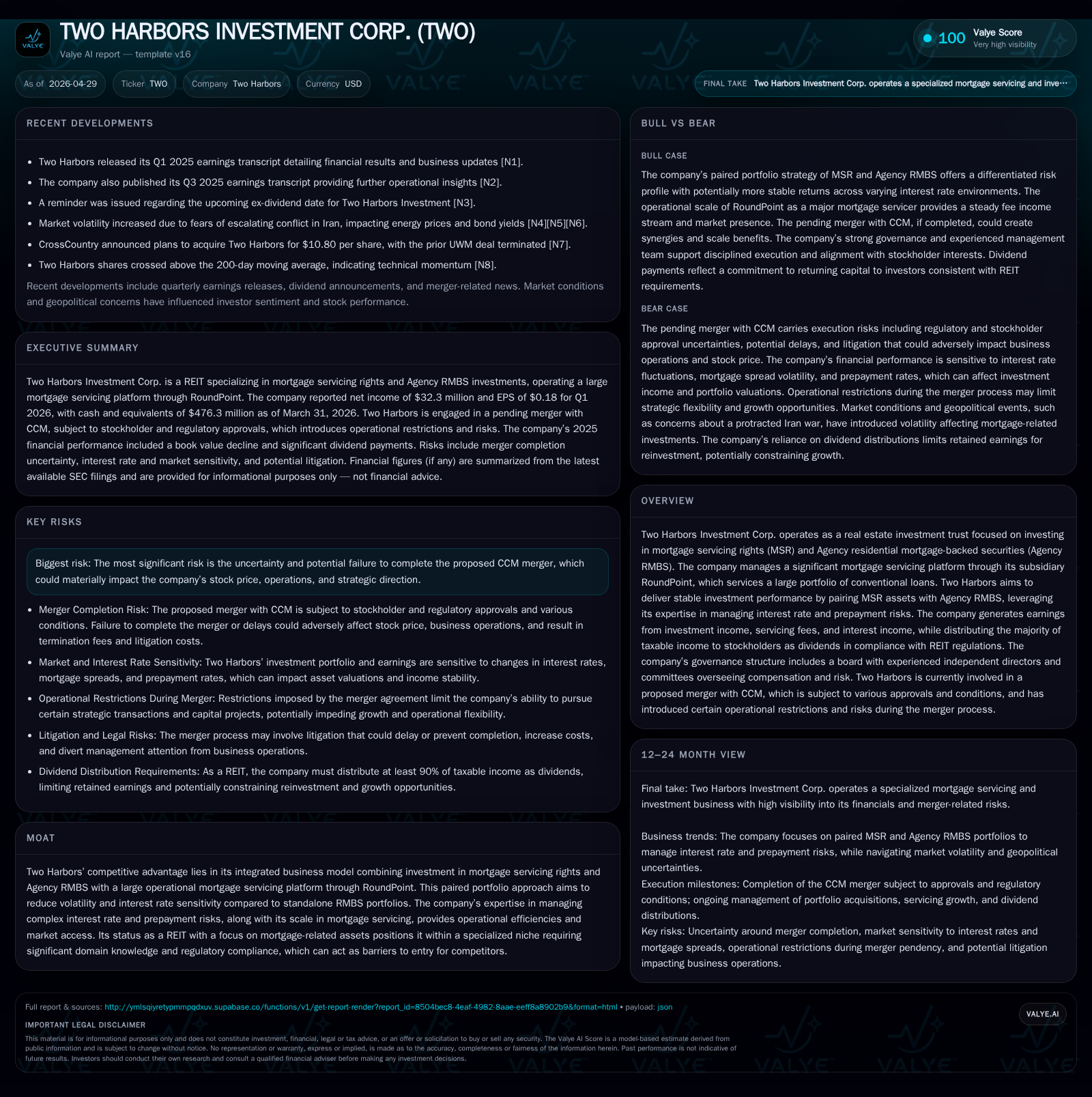
In its latest quarterly filing, Two Harbors Investment Corp. disclosed a First Amendment to its merger agreement with CrossCountry Mortgage, extending conditions and timing uncertainties around transaction completion. The company continues to operate its integrated business model combining mortgage servicing rights investment with Agency RMBS holdings supported by its substantial servicing platform operated through RoundPoint. This model aims to moderate interest rate and prepayment risk, positioning Two Harbors within a niche mortgage REIT sector requiring scale and expertise. However, significant execution risks remain tied to regulatory approvals and stockholder votes for the merger. Near-term operational resilience is underpinned by liquidity and leverage metrics reported at quarter-end.
Latest Quarterly Operating Update and Merger Agreement Amendment
Two Harbors Investment Corp.’s April 29, 2026 Form 10-Q substantially updates investors with a First Amendment to the previously announced merger agreement with CrossCountry Intermediate Holdco (CCM) disclosed on April 28, 2026 [S2][S3]. This amendment revises several conditions precedent governing the timing of closing and introduces additional flexibility but also underscores ongoing uncertainty around completion. Crucially, consummation remains subject to approval by Two Harbors’ common stockholders as well as receipt of required regulatory approvals. The filing explicitly warns that failure to satisfy these conditions could delay or derail the merger entirely.
This development reaffirms that while Two Harbors is pursuing strategic consolidation via CCM, there are significant execution risks ahead impacting stockholder value. Any failure or delay may trigger material adverse effects including sharp declines in common stock price and reputational damage. Management highlights that due diligence and stockholder engagement remain active priorities amidst these contingencies.
Integrated Business Model: MSR Investment Coupled with Agency RMBS and Servicing Platform
As detailed in the company’s April 27, 2026 amended annual report (10-K/A), Two Harbors operates as a specialized real estate investment trust focused on mortgage-related assets combining:
- Investments in mortgage servicing rights (MSR), granting rights to service mortgage loans for fees;
- Holdings of Agency residential mortgage-backed securities (Agency RMBS), securities guaranteed by U.S. government agencies;
- Operation of RoundPoint Mortgage Servicing Corporation, one of the largest servicers of conventional residential loans nationally.
This integrated model strategically pairs interests in MSR assets—which generate servicing fee income sensitive to loan prepayments—with holdings in Agency RMBS which provide interest income but have differing sensitivity to interest rates and prepayments [S1]. By combining these asset classes with a scale servicing platform, Two Harbors seeks to reduce overall portfolio volatility linked to interest rate fluctuations and prepayment variability.
RoundPoint’s substantial loan servicing portfolio drives recurring servicing fee revenue that diversifies income beyond investment gains alone. This operational platform reinforces barrier-to-entry effects through scale economies in technology infrastructure and regulatory compliance. The synergy between asset ownership (MSR) and the servicing operation aligns incentives vertically.
Industry Positioning: Competitive Advantages of Scale and Risk Management Expertise
Within the specialized niche of mortgage REITs focused on MSR and Agency RMBS investments, Two Harbors’ moat stems from:
- Its integrated business model uniquely combining investment assets with servicing operations;
- Scale advantages via RoundPoint’s significant servicing footprint enabling cost-effective loan management;
- Domain expertise in actively managing complex interest rate risk exposures inherent in MSR valuation;
- Regulatory know-how operating under stringent REIT distribution rules requiring stable taxable income flows;
- Switching-cost dynamics driven by borrower relationships managed through RoundPoint’s servicing services.
The company thus occupies a defensible space characterized by operational complexity difficult for new entrants without established infrastructure and regulatory experience [S1][N1]. Furthermore, its internal risk management practices focus on hedging prepayment sensitivities—a critical driver of MSR cash flow consistency—reducing episodic earnings volatility common across the sector.
Growth Outlook: Drivers from Portfolio Optimization and Potential Merger Synergies
Two Harbors’ growth prospects hinge on optimizing its MSR and Agency RMBS portfolio composition calibrated against prevailing interest rate environments where duration positioning adjusts exposure based on yield curve expectations [S2][S3]. The ability to modulate this balance dynamically is a key value driver.
The pending CCM merger if consummated successfully offers anticipated benefits including expanded asset scale, potential operational synergies from integrating platforms, augmented capital base for diversified investments, and enhanced market reach. Cross-selling opportunities could arise within mortgage servicing channels creating incremental fee income trajectories.
Operational leverage inherent in fixed-cost servicing infrastructure can translate marginal growth into disproportionate earnings gains given scalable expense profiles. However, integration execution remains untested with inherent uncertainties.
Risks and Challenges: Merger Completion Uncertainty and Market Sensitivities
Foremost risk factors spotlighted revolve around the CCM merger’s conditionality:
- Completion requires timely regulatory clearance which could be delayed or denied;
- Stockholder approval poses potential hurdles given uncertainty or dissent among holders;
- Either party’s right to terminate under specified circumstances adds deal completion risk;
- Failure to close would prompt negative market reactions damaging share price liquidity;
- Disruption from prolonged merger processes could impair management focus on ongoing operations [S2].
Beyond transaction risks, Two Harbors faces external market environment influences driving prepayment rates variance tied to movements in mortgage refinance activity impacting MSR valuations. Interest rate volatility along with macroeconomic shifts impose cyclical pressures affecting RMBS yields as well.
Restrictions imposed during pendency may constrain strategic agility narrowing deal room for opportunistic moves or alternative transactions [S2].
What Investors Should Watch Next: Regulatory Approvals, Stockholder Votes, and Quarterly Milestones
Key forthcoming catalysts include:
- Stockholder meeting vote dates finalizing decision on CCM merger approval;
- Updates relating to U.S. regulatory agency progress toward transactional consent;
- Monitoring quarterly operational metrics post Q1 report that reflect portfolio performance shifts including MSR attrition rates versus new acquisitions;
- Statements from management during forthcoming earnings calls clarifying timing expectations around merger closure or alternative strategic pathways [S2][S3][N1].
Close attention to proxy materials recently disseminated will elucidate governance stances influencing vote outcomes imminently [S4][S18].
Summary Financial Snapshot
Latest financial snapshot
| Metric | Value | Period |
|---|---|---|
| Cash & equivalents | $476mm | |
| 2026-03-31 | ||
| Total debt | $8.3bn | |
| 2026-03-31 | ||
| Net debt | $7.8bn | |
| 2026-03-31 |
Source: SEC companyfacts cache [F1].
Reflective of latest filings dated March 31, 2026 [F1], Two Harbors maintains $476 million in cash & equivalents against total debt approximating $8.29 billion.
Disclaimer: This is research-only, informational analysis and not investment advice. It may include AI-generated interpretation and general industry context. Always verify important details using primary sources.

Comments