
Euroseas Expands Fleet and Strengthens Charter Coverage with High-Reefer Newbuildings
Euroseas Ltd. boosts fleet capacity through new eco-friendly containerships and extends key charter contracts, positioning for growth amid charter market tightness.
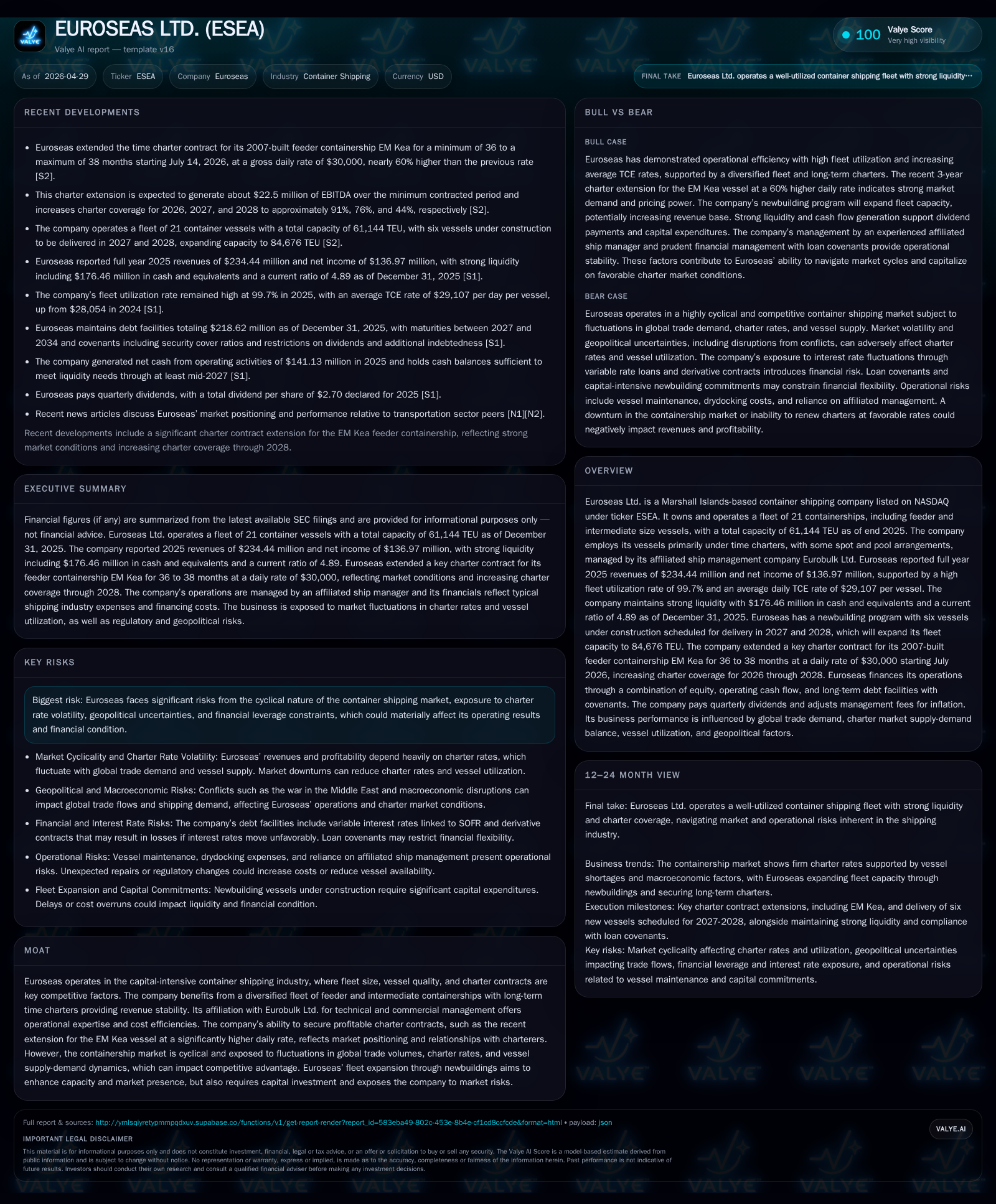
Euroseas Ltd. reported a substantial charter contract extension alongside ordering two advanced high-reefer containerships, reflecting strategic responses to supply-demand imbalances in container shipping. The company operates 21 feeder and intermediate vessels with near-full utilization, backed by solid liquidity and manageable debt. Growth will stem from fleet expansion with six vessels scheduled for delivery in 2027–2028, targeting reefers to capture rising refrigerated cargo demand. Charters cover a significant portion of revenue into 2028, moderating spot market exposure but shipping cyclicality remains a key risk.
Recent Operating Update
Euroseas Ltd.’s latest quarterly report as of April 23, 2026 reveals important developments shaping near-term operating prospects. The company maintains a fleet of 21 vessels comprising 15 feeders and 6 intermediate containerships with aggregate capacity of approximately 61,144 TEU. Following deliveries scheduled for 2027-28—four intermediate plus two feeder newbuildings—fleet size is set to grow by roughly 29% to total capacity near 84,676 TEU [S2]. This expansion aligns with Euroseas’ strategy to broaden scale while renewing its fleet with environmentally-compliant ships.
A notable update is the extension of the charter contract for the EM Kea feeder vessel (3,100 TEU) built in 2007. Starting July 14, 2026, the contract extends for a minimum of three years (up to three years and two months at charterer option) at an increased gross daily rate of $30,000—an uplift of nearly 60% over previous rates. This fixture highlights ongoing tightness in containership availability alongside macroeconomic disruptions and geopolitical effects such as the Middle East conflict maintaining firm charter markets [S2]. This contract alone is expected to deliver around $22.5 million EBITDA over the charter period.
Earlier in March 2026, Euroseas announced an order for two high-reefer containerships (2,800 TEU each) built to EEDI Phase 3 and IMO NOx Tier III environmental standards at Huanghai Shipbuilding Co., China. These vessels will offer more than 1,000 reefer plugs each, addressing emerging structural demand in refrigerated cargo transport where modern tonnage is scarce [S3]. Scheduled deliveries in mid-2028 complement existing orders for six newbuildings slated through late decade.
Business Model
Euroseas operates as an owner-operator of feeder and intermediate-size container vessels primarily focused on seaborne transportation of containerized cargoes. Revenue is mostly derived from time charter contracts — fixed-rate agreements that provide predictable daily hire income typically spanning one to several years — complemented by spot charters and participation in pooling arrangements.
Operational management is provided through Eurobulk Ltd., an affiliated ship manager delivering technical oversight and commercial brokerage services. This integrated approach yields cost efficiencies and timely positioning within global trade routes. Fleet utilization metrics are highly indicative; Euroseas sustained very high utilization (~99.7%) in recent periods evidencing efficient deployment [S1].
Revenue mechanics hinge on calendar days multiplied by vessel employability; fixed charters lock-in daily time charter equivalent (TCE) rates while spot exposures introduce volatility. Vessel mix spans feeders (2,800-3,100 TEU) suitable for regional/short-sea trades and intermediates (4,253 TEU) that service longer-haul regional corridors. The recent order of specialized reefers broadens service differentiation targeting temperature-controlled cargo segments.
Margins benefit from stable fixed contracts mitigating short-term market swings but depend on securing profitable charter rates on renewals or new hires amid cyclical industry conditions. Management fees under Master Management Agreement (approximately $1,024 per day per vessel) scale predictably reflecting eurozone inflation adjustments [S19].
Industry Structure and Competitive Position
The container shipping sector is characterized by capital intensity requiring significant investment in vessels amid fluctuating global trade volumes and supply-demand balances affecting freight rates. Euroseas occupies the niche of smaller containership operators emphasizing feeder and intermediate vessels rather than mega-containerships dominating deep-sea lanes.
Competition involves peers owning similar vessel classes offering time charters primarily backed by liner companies or logistics providers requiring reliable tonnage. Euroseas benefits competitively through:
- Diversified fleet structure allowing flexible deployment,
- Long-term charters ensuring steady revenue streams,
- Affiliated management sharpening operational control,
- Investment focus on eco-design compliant vessels enhancing future regulatory alignment.
However, like all players in this market segment it remains sensitive to cyclical downturns triggered by trade slowdowns or overcapacity from ship deliveries globally.
Growth Drivers
The company’s growth trajectory centers on several pillars clearly delineated by the latest filings:
Fleet Expansion & Modernization
Six newbuildings are contracted across feeder and intermediate sizes with scheduled deliveries between late 2027 and late 2028 poised to increase fleet capacity significantly over current levels (~38% uplift). These include two specialized high-capacity reefer vessels addressing rapidly expanding refrigerated container trades driven by fresh produce globalization and pharmaceuticals cold chains [S2,S3,S1].
Charter Contract Extensions & Market Positioning
The extension of EM Kea’s charter at substantially higher daily rates signals a tightening supply environment boosting achievable day-rates across the fleet. Combined with additional fixtures reflecting strong relationships with top-tier charterers this underpins earnings visibility through multiple years ahead into volumes accounting for over three-quarters of vessel days in next two years [S2].
Environmental Regulations & Eco-Efficiency Premiums
Newbuildings conforming to International Maritime Organization strictures (EEDI Phase III/IMO Tier III NOx limits) position Euroseas competitively amidst rising regulatory burdens increasingly penalizing older polluting tonnage. Eco-design features promise lower fuel consumption offering operational cost advantages critical for margin preservation.
Risks / Watchpoints / Growth Constraints
Despite positive developments several risks warrant monitoring:
- Market Cyclicality: Container shipping earnings remain vulnerable to global trade fluctuations impacting charter rates especially when long-term contracts mature exposing exposure to spot market volatility.
- Charter Rate Volatility: While fixed charters currently dominate revenue base (~91% coverage for full-year 2026), coverage tapers significantly beyond that horizon increasing risk exposure from weaker markets.
- Geopolitical Uncertainty: Ongoing tensions causing disrupted shipping lanes or tariff regimes could depress demand or increase operating costs unpredictably.
- Financial Covenants: Lending agreements impose security cover ratios and leverage limits potentially restricting dividend distributions or compelling asset sales if breached during stress periods limiting financial flexibility [S1,S6].
- Capital Requirements: Funding equity portions of newbuilding installments (~$120M+) alongside regular drydock cycles requires sustained cash generation or access to capital markets without dilutive conditions impact.
What To Watch Next
Investors should track several key execution indicators:
- Delivery progress of six newbuild vessels currently slated for mid-to-late decade arrival,
- Renewal or extension status of major time charters beyond early expiries such as those set between late 2026 and early 2029,
- Charter rate trends particularly pricing power on feeder vs intermediate segments post-contract rollovers,
- Cash flow generation relative to capital expenditure demands including timing of payments for pending orders,
- Compliance updates regarding loan covenants amid changing vessel valuations under dynamic freight rate conditions,
- Potential expansions into additional specialized containership segments pending watchful announcements given current option rights under shipbuilding contracts.
Financial Profile (Latest Snapshot)
Latest financial snapshot
| Metric | Value | Period |
|---|---|---|
| Cash & equivalents | $176mm | |
| 2025-12-31 | ||
| Total debt | $219mm | |
| 2025-12-31 | ||
| Net debt | $42mm | |
| 2025-12-31 | ||
| Current assets | $192mm | |
| 2025-12-31 | ||
| Current liabilities | $39mm | |
| 2025-12-31 | ||
| Current ratio | 4.89x | |
| 2025-12-31 |
Source: SEC companyfacts cache [F1].
Euroseas maintains strong liquidity with cash & equivalents totaling approximately $176 million against total debt near $219 million yielding a net debt position close to $42 million as of December-end 2025. Current ratio stood at a healthy ~4.89 reflecting comfortable working capital buffers [F1].
This analysis is based exclusively on information disclosed in SEC filings dated through April 29, 2026 including Form 20-F annual reports and Form 6-K interim updates as well as publicly available news sources cited herein. No investment advice or price forecasts are expressed or implied.
Disclaimer: This is research-only, informational analysis and not investment advice. It may include AI-generated interpretation and general industry context. Always verify important details using primary sources.

Comments