
Park Ha Biological Technology Advances China Skincare Franchise Despite Operating Losses
Recent governance shifts and Nasdaq compliance revival support Park Ha’s franchise expansion within a highly competitive Chinese skincare market.
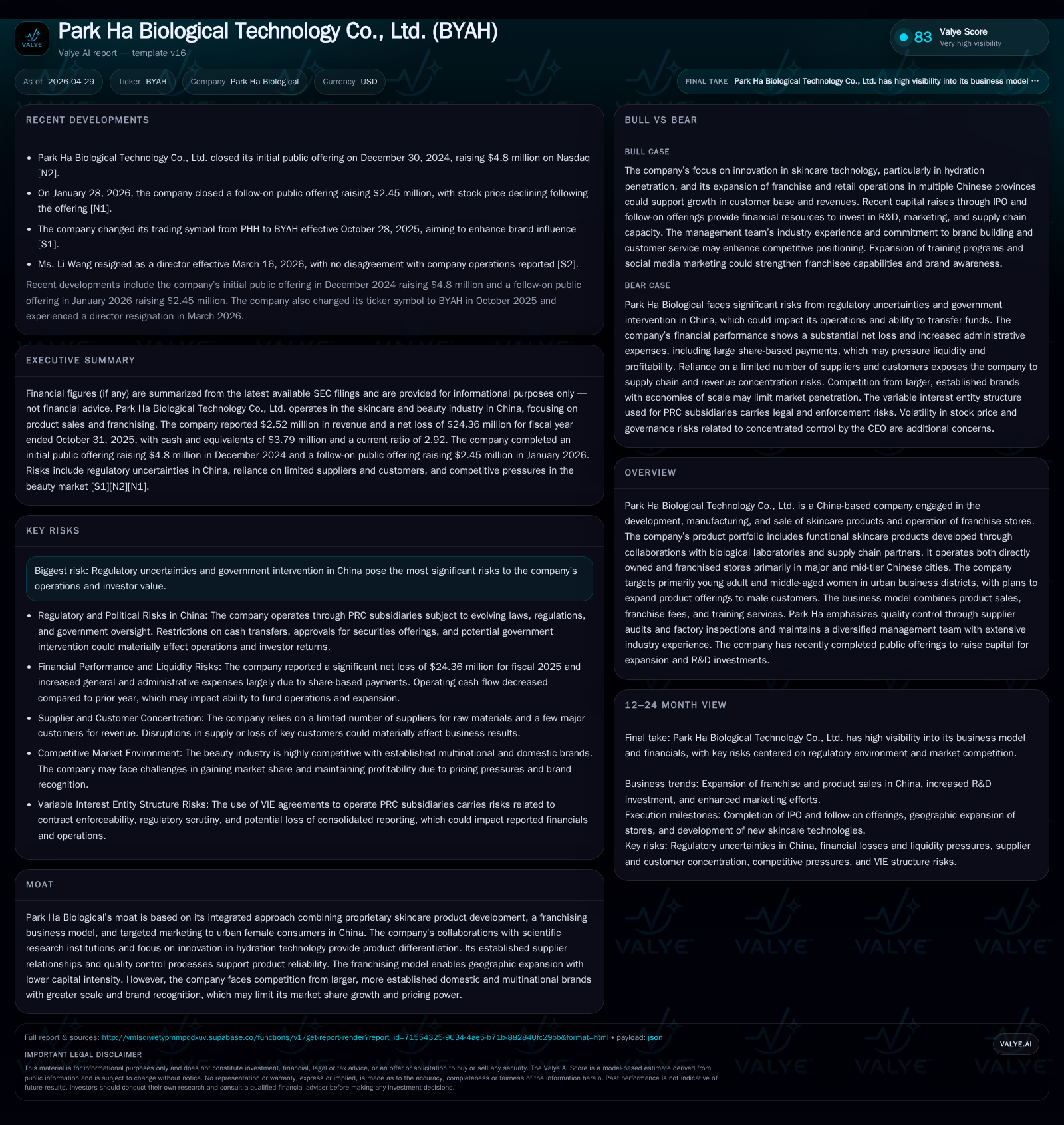
In its March 2026 quarterly filings, Park Ha Biological Technology reported the orderly resignation of a board director and regained compliance with Nasdaq’s minimum bid price rule, key signals of stabilized corporate governance and market standing. The company continues to pursue growth through an integrated business model blending proprietary skincare products with franchising revenue streams focused on urban Chinese women. Intense competition from larger domestic and multinational players constrains its pricing power, while regulatory unpredictability in China adds operational risk. Park Ha’s path forward hinges on expanding its franchise network, extending brand reach—including toward male consumers—and maintaining stringent quality controls amid evolving beauty industry dynamics.
Recent Operating Developments and Governance Update
Park Ha Biological Technology disclosed in its March 16, 2026 Form 6-K that Ms. Li Wang resigned as a director effective the same day. The resignation was explicitly stated not to be due to any disagreement with company operations or policies [S2]. This transition can be seen as an orderly governance change rather than a disruptive event. Earlier in March, the company received formal notification from Nasdaq confirming it had regained compliance with the minimum bid price requirement of $1.00 per share after maintaining shares above this threshold for at least 10 consecutive business days through early March 2026 [S3]. This milestone relieves immediate delisting concerns following prior notices about trading symbol changes and reverse stock splits during late 2025 [S4]. Together, these disclosures underscore a stabilization of Park Ha's listing status and board composition amidst ongoing strategic efforts.
Park Ha's Business Model: Franchise-Driven Skincare Innovation
Park Ha operates an integrated skincare business centered on developing functional products supported by collaborations with biological labs and supply chain partners [S1],. Its revenues derive from three main streams: proprietary product sales through both direct and franchised retail stores; franchise fees paid by independent operators; and ancillary training services provided to franchisees. This model leverages an asset-light approach whereby physical presence expands via franchising rather than wholly-owned store rollouts alone.
The company targets primarily young adult to middle-aged women in urban business districts across major and mid-tier Chinese cities, tailoring product formulations around their needs for hydration and skin health innovation. Quality assurance is emphasized through stringent supplier audits and factory inspections which are critical given Chinese consumers' growing preference for trusted scientific efficacy claims amid a crowded skincare landscape. Initiatives are underway to broaden appeal by developing products aimed at male customers, representing potential diversification beyond the core female demographic.
Competitive Position in China's Dynamic Beauty Industry
Operating within China’s intensely competitive beauty sector [S1], Park Ha confronts domestic conglomerates and international multinationals benefiting from established brand equity, broader marketing budgets, extensive distribution networks, and pricing leverage. The firm’s moat rests on its proprietary R&D collaborations focusing on hydration technology innovations combined with a franchising platform that enables agile market reach without proportional capital deployment.
However, brand loyalty towards incumbents poses switching cost challenges for new entrants like Park Ha, necessitating continuous innovation and effective localized marketing to sustain competitive visibility. The ability to maintain consistent product quality is vital given heightened consumer scrutiny following wider industry scandals affecting lesser-known labels.
Growth Drivers: Geographic Expansion and Brand Extension
Park Ha aims to accelerate geographic coverage by deepening penetration in mid-tier Chinese cities beyond initial major urban centers where it already operates stores directly or via franchises [S1]. Marketing budgets are being strategically increased to support brand building aligned with this expanded footprint.
Capital raised through a January 2026 registered offering—netting approximately $2.45 million—is earmarked primarily for expanding directly operated stores reflecting management’s desire for selective control over flagship retail experiences even as franchising remains the predominant growth vector [S4]. Incremental unit economics indicate that increasing the number of franchisee contracts correlates directly with revenue uplift given fee structures tied to store openings and operational scale.
Additionally, extending product lines to male consumers addresses untapped demand segments within Chinese urban markets, potentially diversifying revenue streams beyond traditionally female-targeted skincare lines. Success here would depend on culturally attuned marketing campaigns transforming gender norms around personal care.
Risks and Constraints: Regulatory Uncertainties and Competitive Pressures
Park Ha faces notable risks stemming from its complex operating environment in China [S1], particularly government intervention risks highlighted extensively in the 20-F filing [S28]. Regulatory scrutiny over cross-border capital flows could impair liquidity flexibility since funds held domestically may be subject to transfer restrictions or oversight limiting reinvestment outside PRC jurisdictions. Furthermore, ambiguous interpretations surrounding "de facto management body" definitions under PRC tax law threaten potential reclassification of offshore holding entities as taxable resident enterprises imposing additional withholding taxes on dividends or distributions to shareholders [S1].
Competition risk remains elevated as higher-scale incumbents possess greater brand recognition allowing more aggressive promotional tactics which could depress pricing power or require costly marketing spend increases that erode margins. Compliance with evolving data security regulations promulgated by Chinese authorities—particularly relating to foreign-listed firms—is another disruptive factor introducing compliance costs or operational delays impacting product launches or financing activities.
Monitoring Key Milestones and Upcoming Catalysts
Investors should prioritize tracking the quarterly evolution of franchisee contracts signed as this metric serves as a leading indicator directly tied to revenue growth rates given contractual fee arrangements [S1]. Equally critical is monitoring order fulfillment timing reliability as delays could impair brand reputation negatively affecting renewal rates among franchisees. Progress in diversifying into male skincare segments will also be important to assess early consumer acceptance levels following new product introductions.
Corporate governance developments merit continued observation especially following recent board changes [S2], as stability at the top can signal execution consistency. Additionally, maintaining Nasdaq listing compliance is an ongoing attention point given prior challenges [S3] along with regulatory filings related to share capital increases or equity incentive plans indicating management’s planned incentivization strategies.[S4]
Financial Overview: Liquidity and Profitability Snapshot
Liquidity appears adequate with cash & equivalents totaling about $3.8 million at fiscal year-end representing a current ratio near 2.9x signaling comfortable short-term liability coverage [F1]. The freshly raised $2.45 million registered offering proceeds augment this runway providing funds explicitly allocated towards direct store operations expansion in line with stated strategic priorities [S4].
Realizing positive operating margins will require translating expanding franchise contracts into profitable scale while carefully managing fixed costs related to marketing and administration to avoid margin erosion seen historically.
This analysis synthesizes publicly filed information available through SEC disclosures up to March 2026 and company factual data verified as of October 31, 2025. It aims solely to provide an informed operating overview without implying any investment guidance or recommendation.
Disclaimer: This is research-only, informational analysis and not investment advice. It may include AI-generated interpretation and general industry context. Always verify important details using primary sources.

Comments