
GDS Holdings Advances China Data Center Expansion with Improving Profitability
GDS's Q4 2025 results underscore operational growth through increased capacity commitments and margin improvements amid ongoing industry and regulatory challenges.
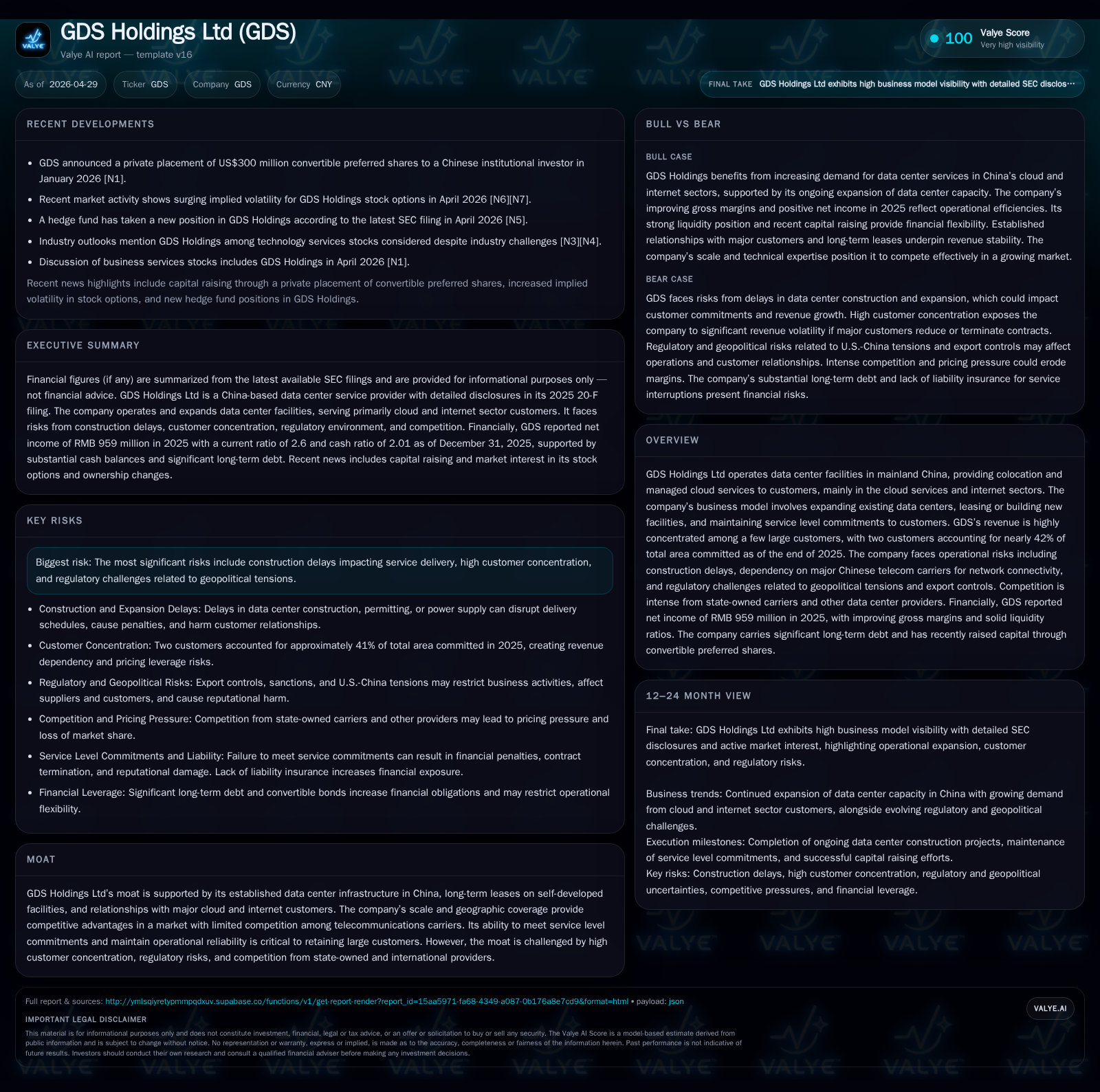
In its latest quarterly filing for Q4 2025, GDS Holdings Ltd reported solid progress in expanding its net floor area under commitment and improving utilization rates, driving a 10.8% revenue increase to RMB 11.43 billion alongside a turnaround to net income of RMB 959 million. The company continues to navigate capital-intensive expansion with robust pre-commitment levels on new facilities, leveraging its geographically diverse high-performance data centers in China. However, GDS faces risks related to customer concentration, construction delays, and regulatory uncertainties inherent in the Chinese data center market. The firm’s strategic focus on carrier-neutral colocation services and managed cloud offerings supports demand growth from leading cloud and internet companies, while capital structure and liquidity remain adequate to support near-term expansion plans.
Latest Operating Results and Why They Matter
GDS Holdings Ltd’s latest quarterly filing as of March 17, 2026 [S2] reveals meaningful operational progress that frames its near-term outlook positively. Full year 2025 net revenue increased by 10.8% year-over-year to RMB 11.43 billion while the company achieved net income of RMB 959 million reversing previous losses [S1]. This improvement reflected higher revenue-driving commitments coupled with better utilization rates within existing data centers. As of December 31, 2025, GDS operated over 668,000 square meters (sqm) of net floor area in service across China with an impressive customer commitment rate of about 93% maintained over recent years [S1][S14]. Utilization also ticked up modestly to 75.5%, an improvement indicative of deeper customer footprint penetration beyond initial contract commitments.
The company’s under-construction capacity stood at nearly 74,000 sqm by year-end, already featuring a high pre-commitment level above two-thirds of that space secured by customers prior to completion—highlighting continued confidence from large cloud clients [S1]. These figures evidence GDS’s strategic emphasis on balancing growth-capacity rollouts with demand visibility—a critical consideration given the long lead times typical for hyperscale data center projects.
Business Model and Service Value Proposition
GDS's business model focuses on providing premium colocation services augmented by managed cloud offerings within China’s rapidly expanding digital economy hubs [S1]. Revenue streams predominantly arise from leasing net floor space in carrier-neutral data centers equipped to support high power densities necessary for AI workloads and large enterprise applications [S1]. These leased spaces come under long-term contracts typically ranging from three years for third-party facilities up to twenty years for self-developed centers [S1]. This tenure variation reflects GDS’s mix of owned versus leased properties.
Customers primarily consist of major public cloud providers and leading internet companies, underpinning stable recurring revenues but also introducing acute risk via high concentration—two customers alone represented close to 42% of total area committed as of end-2025 [S20]. Pricing structures blend fixed charge components often capped by lease agreements with variable billing aligned to actual service usages such as power consumption or bandwidth consumption [S24].
Critical to the offering is the company’s ability to maintain stringent service level agreements demanding uninterrupted uptime and connectivity across multiple telecom networks—a complexity heightened by dependency on local carriers for network access [S1]. GDS positions itself as carrier neutral enabling customers flexible access broadly across China's largest telecommunications networks along with global public clouds hosted locally.
Operating margin drivers hinge on efficient capex deployment into scalable facilities paired with disciplined cost control on administrative expenses including share-based compensation reductions seen recently [S1][S18][S24]. Capital intensity remains significant due mainly to equipment purchases, land rights acquisitions, and extensive buildouts [S18].
Competitive Environment and Industry Dynamics
China’s data center sector is fragmented yet fiercely competitive involving dominant state-owned carriers alongside private operators such as GDS who compete largely on premium infrastructure readiness and geographic coverage [S1][N6]. The regulatory environment introduces additional complexity due to licensing rules governing value-added telecommunications services provided through VIE contractual structures rather than direct foreign ownership—adding operational uncertainty [S1].
Power availability constraints at local levels also impose bottlenecks affecting project timelines alongside government permit requirements whose delays have previously impacted delivery schedules [S1]. Successfully negotiating these layers while preserving rapid build cycles is essential for market leadership.
GDS's scale—their portfolio covering primary economic hubs—and expertise in managing colocation contracts among demanding clients form tangible moat elements [S1]. However, intense competition persists especially from state-backed providers who benefit from financing advantages. Geopolitical considerations also weigh as export controls and changing Chinese regulations influence international partnerships.
Key Growth Drivers Shaping Demand Expansion
The primary driver of GDS’s growth lies in continued strong adoption trends within China’s hyperscale cloud computing ecosystem fueled further by rapid AI technology deployments requiring massive compute infrastructure stacks [N6][S1][S18]. Increasing pre-commit rates on facilities under construction signal sustained demand visibility beyond near term.
Asset monetization strategies incorporating ABS issuance backed by institutional investors alongside listing asset stakes via REIT structures demonstrate innovative capital recycling that supports reinvestment without excessive equity dilution or debt buildup [S21][S22]. Geographic diversity spanning economic hubs mitigates localized demand cycle risks.
Long lease portfolios provide revenue stability whereas ongoing capacity sourcing—including developing greenfield sites or converting industrial buildings—remains vital amid rising land costs and local utility constraints [S1][S18]. Maintaining this pipeline responsiveness ensures revenue growth alignment with escalating market demands.
Risks and Challenges to Watch
Operational challenges center around construction delays due largely to contractor issues or slow approvals impacting ability to meet committed delivery deadlines potentially triggering penalties or strained client relationships [S1]. Regulatory risks emerge from PRC government scrutiny over VIE contractual frameworks plus stringent adherence required for IDC licensing rights which if lost or revoked could disrupt operations materially [S19][S1].
Customer concentration presents business risk should any top client decrease footprint abruptly given that two largest customers represent close to half the area committed base; this limits pricing power insulation though long contract terms offer partial mitigation [S20].
The business requires substantial upfront capital investment before any corresponding revenue accruals can occur; while liquidity appears adequate today based on a current ratio above 2.5 supported by CNY14.3 billion in cash reserves, total debt remains elevated at roughly CNY25.9 billion necessitating vigilant capital structure management especially amid potential interest rate volatility or refinancing risks [F1][S4][S5].
Ongoing geopolitical tensions inject policy uncertainty affecting technology exports or cross-border cooperation which may indirectly pressure operating cost inflation or limit preferred vendor relationships.
Upcoming Milestones and Performance Indicators
Key metrics to monitor include quarter-to-quarter changes in net floor area committed where upticks imply strengthening backlog quality; shifts in utilization rates among existing leases reflecting customer ramp profiles; facility energization schedules completing new projects; progress against REIT or ABS milestones impacting capital availability; plus expense line trends notably share-based compensation strategies described for ongoing cost rationalization [S2][S12][S24].
Regulatory approvals impacting new site licenses or expansions likewise bear watching given the sector nuances in mainland China licensing requirements.
Financial Snapshot Supporting Operational Insights
Latest financial snapshot
| Metric | Value | Period |
|---|---|---|
| Cash & equivalents | 14,305,958,000 CNY | |
| 2025-12-31 | ||
| Total debt | 25,903,545,000 CNY | |
| 2025-12-31 | ||
| Net debt | 11,597,587,000 CNY | |
| 2025-12-31 | ||
| Current assets | 18,547,457,000 CNY | |
| 2025-12-31 | ||
| Current liabilities | 7,128,359,000 CNY | |
| 2025-12-31 | ||
| Current ratio | 2.6x | |
| 2025-12-31 |
Source: SEC companyfacts cache [F1].
Liquidity remains sufficient with substantial cash balances relative to short-term obligations supporting working capital needs despite ongoing heavy capex spending totaling approximately RMB4.6 billion last year primarily directed toward property enhancements and new data center development projects [F1][S18][S25][S26]. Debt load includes both short-term borrowings as well as significant long-term loans commonly structured around project finance facilities tied closely to individual sites’ expected cash flows reducing refinancing risk overall though demands constant oversight given sizable interest expenses near RMB1.63 billion recorded during FY2025 [F1][S9][S14].
Overall financial health supports continuation of expansion initiatives while gradual margin improvements reflect operating leverage gains amid lifting utilization rates.
This analysis is based solely on publicly available SEC filings as cited without reliance on any non-public information. It does not constitute investment advice or recommendations regarding securities issued by GDS Holdings Ltd or any other entity.
Disclaimer: This is research-only, informational analysis and not investment advice. It may include AI-generated interpretation and general industry context. Always verify important details using primary sources.

Comments