
Agios Pharmaceuticals Advances Rare Disease Franchise While Managing Operational Losses and Cash Reserves
Q1 2026 results highlight ongoing commercialization of mitapivat products and pipeline progress amid continued net losses.
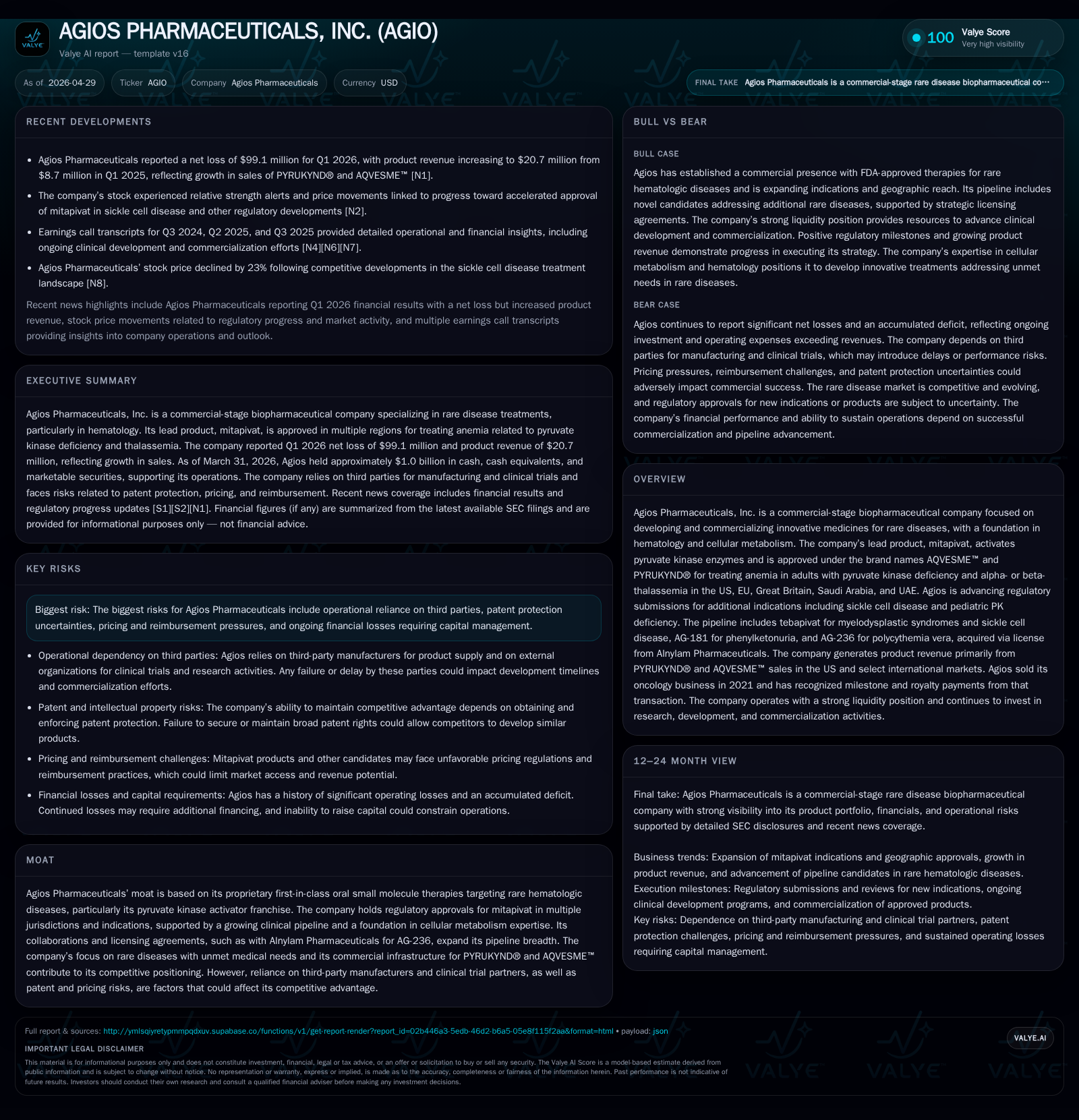
Agios Pharmaceuticals' first quarter 2026 filing underscores pivotal developments in its rare disease therapeutics business, driven by commercial sales of mitapivat-based treatments PYRUKYND® and AQVESME™. The company maintains a strong cash position to support clinical pipeline advancement, including sickle cell disease and pediatric indications, even as net losses deepen due to R&D and commercial expansion costs. Reliance on third parties for manufacturing and regulatory hurdles remain operational risks amid a competitive landscape focused on rare hematologic diseases.
Recent Operating Update
Agios Pharmaceuticals reported its Q1 2026 results in the Form 10-Q filed April 29, 2026 [S2], complemented by an 8-K release outlining operational highlights on the same date [S3]. The company recorded a net loss of $99.1 million in the first quarter, up from $89.3 million year-over-year, driven by increased research & development expenses alongside expanding commercialization activities primarily for PYRUKYND® and AQVESME™, its oral mitapivat therapies targeting rare hematologic diseases. Cash, cash equivalents, and marketable securities stood at roughly $1 billion as of March 31, providing significant liquidity to fund ongoing operations through the next twelve months without requiring additional capital raises [F1],[S2],[S5].
Notably, Agios continues to recognize royalty income from contingent payments related to the prior sale of its oncology business to Servier Pharmaceuticals in March 2021, although the oncology portfolio itself has been divested [S2],[S11].
Business Model Overview
Agios operates as a commercial-stage biopharmaceutical company specializing in innovative treatments for rare diseases spotlighting hematology and cellular metabolism. The core commercial revenues arise from sales of mitapivat-based products—PYRUKYND® approved broadly outside the U.S. (including EU, UK, Saudi Arabia) and AQVESME™ approved in the U.S.—which activate pyruvate kinase enzymes addressing anemias caused by pyruvate kinase deficiency (PKD) and alpha-/beta-thalassemia.
Revenue mechanics revolve around selling these proprietary small molecule therapies through specialty distributors in the U.S., who then provide drugs to pharmacies or directly dispense to patients. Pricing is subject to complex rebate agreements with payors including government mandates and private insurers reflecting negotiated discounts, which is typical for orphan drug products targeted at small patient populations with high unmet medical needs but intense cost scrutiny [S1],[S26].
The company’s business model depends heavily on progressing its pipeline candidates through late-stage development: tebapivat targets myelodysplastic syndromes (MDS) and sickle cell disease (SCD), AG-181 addresses phenylketonuria (PKU), while AG-236—licensed from Alnylam Pharmaceuticals—focuses on polycythemia vera. These pipeline assets represent both extensions of their core metabolic approach and entry into additional rare blood disorders, intending to increase future product revenue beyond current mitapivat approvals [S1]. Strategic collaborations like licensing enrich the pipeline breadth.
Industry Structure and Competitive Position
Operating within the niche yet scientifically complex realm of rare hematologic diseases, Agios’ competitive moat is established by its proprietary oral pyruvate kinase activators—the only small molecules addressing enzymatic deficiencies causing hemolytic anemia conditions like PKD. Regulatory approval across multiple countries grants them exclusivity that shields against generic competitors temporarily. Their expertise combining hematology with cellular metabolism creates scientific differentiation less easily replicated.
However, reliance on third-party contract manufacturers exposes supply chain risks common in specialty pharma where production scale-up is critical but complicated for specialized formulations. Similarly, execution risk arises from outsourcing clinical trials covering challenging-to-recruit patient groups typical in rare disease indications. Furthermore, pricing power faces pressure as payors globally implement cost-effectiveness assessments limiting drug reimbursement despite rarity-driven premium pricing potential [S1],[N9],[N10].
Competitive threats include other pyruvate kinase activators such as Novartis' competing agents that recently achieved clinical milestones in sickle cell disease trials impacting AGIO’s stock volatility earlier this year [N9]. Also critical is maintaining patent protection breadth for mitigation against biosimilars or alternative modalities.
Growth Drivers
Key growth vectors for Agios encompass:
- Geographic Expansion: Continued approval rollouts outside the U.S., especially within European Union member states plus regions like Saudi Arabia where AQVESME™/PYRUKYND® enjoy commercial traction.
- Indication Expansion: Accelerated regulatory submissions underway aiming at sickle cell disease—a larger patient base presenting significant market opportunity—and pediatric PK deficiency segments promise scale-up potential beyond adult indications reported thus far [N11],[N12].
- Pipeline Progression: Successful late-stage clinical trial results advancing tebapivat and AG-181 toward filing milestones could unlock new durable revenue sources diversifying dependency beyond current mitapivat sales.
- Partnerships & Licensing: Ongoing collaboration deals such as with Alnylam Pharmaceuticals for AG-236 broaden therapeutic scope into related chronic hematologic diseases.
- Increased Market Penetration: Growing awareness among hematologists on oral alternatives to transfusion-dependent management creates adoption tailwinds within target specialist treatment centers.
Operational KPIs likely influencing growth include prescription volume uptake trends of PYRUKYND®/AQVESME™, clinical trial enrollment pace for pipeline candidates, timeline forecasts for filing submissions/approvals in SCD/pediatrics, and market share gains within their niche clinic segments.
Risks and Constraints
Several risks temper growth aspirations:
- Manufacturing Dependence: Outsourced commercial supply chains introduce vulnerability around production disruptions leading to potential shortages impacting prescribing confidence.
- Clinical Development Uncertainty: Often protracted enrollment cycles due to rarity of conditions raise timeline risk; negative trial outcomes remain possible slowing regulatory progress.
- Regulatory Environment: Pricing controls globally threaten revenue sustainability; adherence to evolving health technology assessment criteria may cap price realizations despite medical benefits.
- Patent Protection & Competition: Patent cliffs or narrower-than-expected intellectual property coverage can invite generic competition reducing exclusivity periods critical for recuperating R&D investments.
- Ongoing Operating Losses: Despite product sales ramping up, substantial quarterly net losses persist due primarily to high fixed costs allocating toward R&D pipelines expansion plus commercial scaling; sustained profitability remains uncertain [S26].
- Market Volatility: Stock valuations vulnerable to news around competitor trial successes/failures or shifts in reimbursement landscape inducing investor caution as evidenced by share price swings earlier this year [N9],[N10].
What To Watch Next
Investors should monitor upcoming milestones such as:
- Clinical trial readouts for tebapivat across MDS and sickle cell disease cohorts expected mid-to-late 2026.
- FDA decisions surrounding accelerated approval applications for PYRUKYND® in sickle cell disease and pediatric PK deficiency.
- Commercial launch metrics post-AQVESME™ U.S approval including prescription capture rates relative to forecasts.
- Updates on licensing deals or strategic partnerships enhancing pipeline depth or geographic reach.
- Quarterly financial disclosures focusing particularly on R&D spend trajectory versus commercial revenue growth signaling path toward breakeven profitability.
Financial Profile Summary
Latest financial snapshot
| Metric | Value | Period |
|---|---|---|
| Cash & equivalents | $114mm | |
| 2026-03-31 | ||
| Current assets | $835mm | |
| 2026-03-31 | ||
| Current liabilities | $59mm | |
| 2026-03-31 | ||
| Current ratio | 14.19x | |
| 2026-03-31 |
Source: SEC companyfacts cache [F1].
As of March 31, 2026, Agios possessed total current assets of approximately $835 million against current liabilities near $59 million resulting in a robust current ratio exceeding 14x indicative of strong short-term liquidity [F1]. Cash & cash equivalents alone totaled about $114 million complemented by nearly $932 million in marketable securities classified predominantly under Level 2 fair value inputs supporting financial stability until positive cash flow generation materializes [S2],[S16],[S18].
Operating expenses rose consistent with widening R&D investments supporting late-stage pipeline trials alongside buildout costs for marketing PYRUKYND® and AQVESME™ internationally. Net losses widened reflecting these strategic bets though product revenues represent emergent positive inflection points following initial FDA approvals starting in early 2022 through late 2025 rollout phases [F1],[S26].
This analysis synthesizes Agios Pharmaceuticals’ recent SEC filings ([S1]-[S27]) with company facts ([F1]) and relevant industry context without providing investment recommendations.
Disclaimer: This is research-only, informational analysis and not investment advice. It may include AI-generated interpretation and general industry context. Always verify important details using primary sources.

Comments