
Incyte Corp Faces Patent Expiry Pressure while Advancing Product Diversity and Global Partnerships
Incyte’s latest quarter reveals strong sales resilience from JAKAFI amid pending patent challenges, with diversification efforts critical for sustainable growth.
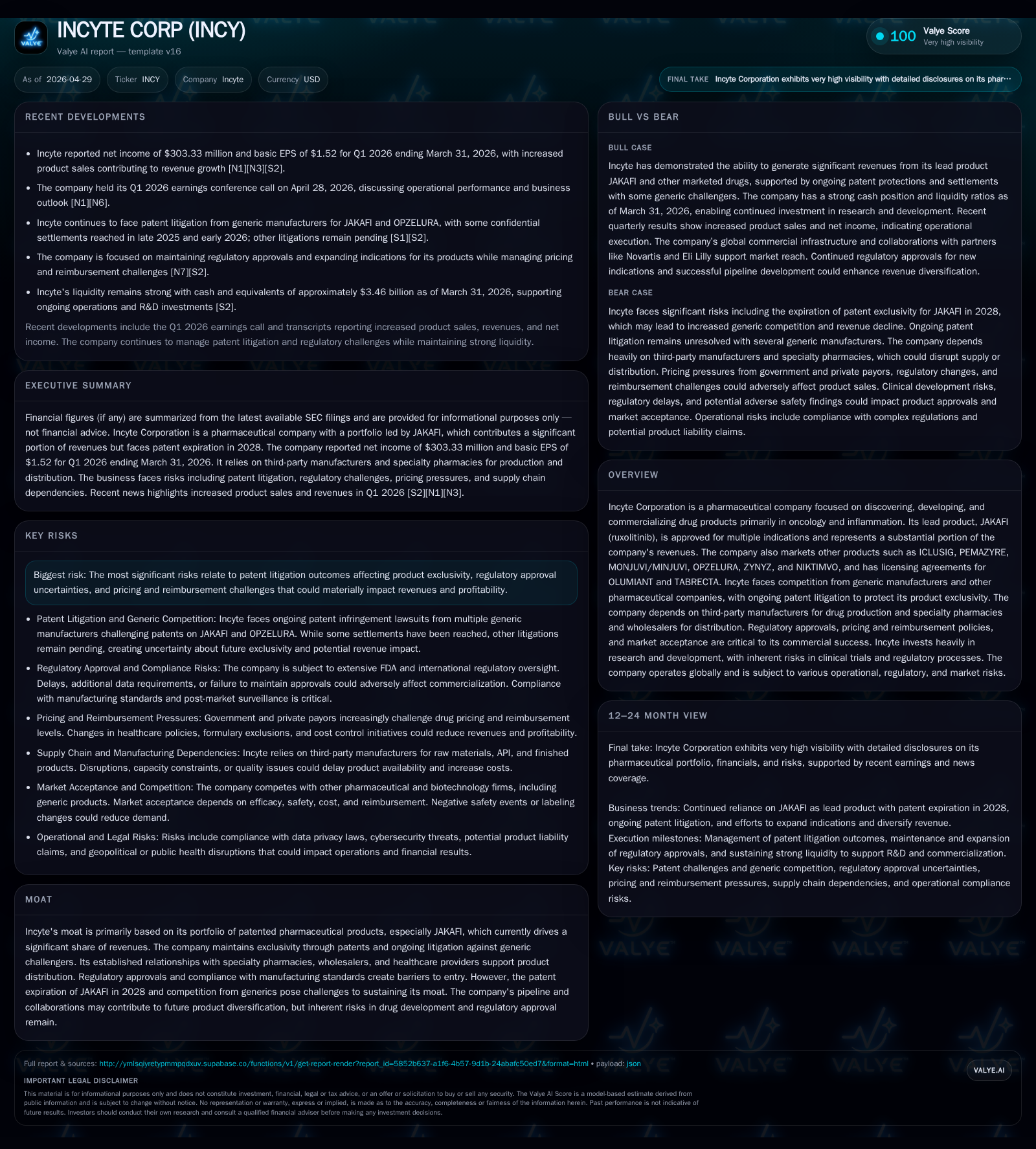
Incyte Corporation’s Q1 2026 results demonstrate continued reliance on its lead oncology drug JAKAFI for revenue generation, even as patent protection for this flagship product approaches expiration in 2028. The company is actively defending its intellectual property against multiple generic rivals and expanding its product portfolio through licensing deals and new drug launches. Key growth drivers include pipeline advancement, geographic market expansion via partnerships, and ongoing regulatory approvals. However, significant risks remain from patent litigation outcomes, reimbursement pressures, and manufacturing dependencies. Monitoring upcoming clinical readouts and legal developments will be essential to assess Incyte’s ability to maintain its competitive moat and revenue momentum.
Recent Operating Update: Q1 2026 Highlights
Incyte Corporation filed its latest Form 10-Q for the quarter ending March 31, 2026, revealing sustained commercial performance driven primarily by its lead oncology product JAKAFI (ruxolitinib) [S2]. Despite facing generic entry threats that will materialize with patent expirations scheduled in June and December 2028 (including pediatric extensions), JAKAFI sales remain robust this quarter with acceptance across key treatment indications like myelofibrosis (MF) and polycythemia vera (PV). Meanwhile, the firm is pursuing label expansions and combination therapies aimed at prolonging product lifecycle value.
The company reaffirmed that although other products such as ICLUSIG (for chronic myeloid leukemia), PEMAZYRE (for cholangiocarcinoma), MONJUVI/MINJUVI (lymphoma treatments), OPZELURA (topical JAK inhibitor) among others contribute incremental revenues, their impact is modest relative to JAKAFI’s current scale. The recent quarterly report also disclosed ongoing patent infringement litigations initiated in response to Abbreviated New Drug Applications (ANDAs) filed by several generics including Apotex, Hikma Pharmaceuticals USA Inc., Sun Pharmaceutical Industries Inc., Granules India Ltd., Dr. Reddy’s Laboratories Inc., Eugia Pharma Specialties Ltd., and Alkem Laboratories Ltd. These challengers submitted paragraph IV certifications against patents covering ruxolitinib compounds expiring in mid-to-late 2028 [S23]. Confidential settlements were reached with Hikma and Granules India limiting immediate risks from those defendants while actions against others continue pending.
Beyond patent matters, Incyte has faced regulatory scrutiny reflecting in updated FDA boxed warnings on JAK inhibitors emphasizing risks of cardiovascular events and malignancies. These safety communications affect label claims for JAKAFI and OPZELURA potentially influencing prescriber behavior over longer terms but have not yet materially impacted Q1 usage metrics [S6, S18]. Additionally, changes in reimbursement frameworks especially connected to government programs such as Medicare Part D—impacted by Inflation Reduction Act provisions—and proposed policies like "most favored nation" pricing laws introduce uncertainty around future pricing power [S20,S21].
Business Model
Incyte operates principally as a pharmaceutical developer focusing on oncology and inflammatory diseases. Revenue generation hinges heavily on the sale of proprietary medicines licensed or developed internally alongside royalty income from partners. The core product revenue source is JAKAFI/JAKAVI (ruxolitinib), a Janus kinase inhibitor approved for several indications including MF, PV, and steroid-refractory graft-versus-host disease.
The business model entails discovery R&D investment followed by phased clinical trials often outsourced to Contract Research Organizations (CROs) due to limited internal capacity [S1]. Upon approval, manufacturing is outsourced to third-party suppliers meeting stringent quality standards; distribution leverages specialty pharmacies and wholesalers emphasizing controlled access given indication specificity.
Revenue mechanics rely on patient prescriptions reimbursed by private insurers or government payors under complex coverage policies that dictate usage volumes and price realization. Pricing power largely depends on product therapeutic value perception versus competing therapies coupled with intellectual property exclusivity enforced through patents and litigation.
Margins derive from efficient contract manufacturing agreements but are vulnerable to input cost inflation and potential discounting pressures under payer contracting strategies or pricing legislation.
Innovation strategy centers on advancing current products into new indications or formulations while augmenting the portfolio through acquisitions or licensing; however unexpected failures or write-offs can burden earnings as evidenced by the halt of Escient Pharmaceuticals’ compound development post-acquisition in 2024 [S1,S4].
Industry Structure and Competitive Position
The pharmaceutical industry segment encompassing oncology therapeutics is characterized by high scientific complexity, lengthy regulatory timelines, sizable R&D investments, substantial patent reliance, and intense multi-modal competition from branded innovators, generics, biosimilars, and emerging modalities such as cell therapies.
Incyte competes across multiple fronts: directly in hematology-oncology markets where it faces established pharma giants offering tyrosine kinase inhibitors (TKIs), immunotherapy agents or chemotherapy regimens; indirectly against alternative inflammation drugs; plus potential disruption via novel pipeline entrants operated by biotech peers.
JAKAFI’s market dominance today arises from early mover advantage backed by comprehensive pivotal trial data demonstrating clinical benefits. However patent expiry in fewer than three years introduces imminent threat of revenue erosion unless offset by successful next-gen launches or expanded label uses. Incyte’s legal efforts to preserve exclusivity restrain generic competition temporarily but show mixed outcomes consistent with industry-wide Hatch-Waxman Act challenges [S1,S23,S24].
Partnerships extend geographic reach beyond U.S. borders: Novartis holds rights for JAKAVI outside the U.S. plus TABRECTA globally; Lilly commercializes OLUMIANT worldwide. These collaborations offer scale advantages but limit direct control over marketing execution affecting captured economics [S1,S21].
Operationally dependency on contract manufacturing providers introduces risks related to capacity constraints or supply disruptions—a common industry structural fact that demands rigorous quality oversight protocols.
Growth Drivers
Several avenues underpin Incyte’s pipeline-led growth narrative:
- Pipeline Expansion: Continued clinical development of next-generation indications for ruxolitinib—including combinations leveraging immune checkpoint inhibitors—aims to sustain patient adoption beyond initial uses.
- Product Portfolio Diversification: Incremental revenue streams from recently approved drugs like PEMAZYRE (FGFR2+ cholangiocarcinoma), MINJUVI (lymphoma), ZYNYZ (anal fistula treatment), OPZELURA (topical inflammatory skin disease), NIKTIMVO (bladder cancer) broaden risk profile away from single-product dependency.
- Global Market Penetration: Collaboration-driven commercialization outside the U.S., particularly in growing markets across Europe and Asia via partners like Novartis and Lilly enable access to rising oncology demand internationally.
- Regulatory Approvals: Pursuit of label expansions for existing products seeking FDA or EMA endorsements could unlock additional prescribed populations.
- Lifecycle Management: Exploring deuterated analogs of existing molecules may provide extended exclusivity windows if successful at IP defense level [S1].
- Strategic Acquisitions & Licensing: Selective external investments coupled with licensing agreements aim to augment the technological base though past experience with Escient compounds has tempered expectations somewhat [S1,S4].
Risks / Watchpoints / Growth Constraints
Incyte faces a multifaceted risk landscape common within biopharmaceutical innovators:
- Patent Litigation Risks: The composition-of-matter patents protecting ruxolitinib face multiple ANDA challenges; adverse rulings could accelerate generic entry significantly undermining sales [S23,S24].
- Regulatory & Safety Challenges: Updates such as boxed warnings increase scrutiny; negative safety findings could impair prescribing habits or prompt regulatory constraints impacting commercial viability [S6,S18].
- Pricing & Reimbursement Pressures: The evolving healthcare policy environment introduces downward pricing pressure driven by inflation-linked Medicare discounts or international reference pricing regulations—threatening margin sustainability [S20,S21,S22].
- Manufacturing Dependencies: Outsourced production facilities must meet strict quality standards; any disruption or failure increases supply chain risk exposure potentially delaying product availability [S1].
- Clinical Development Uncertainty: Drug discovery inherently involves high attrition rates—failures during costly later stage trials could impair pipeline replenishment causing revenue gaps [S1,S25,S26].
- Compliance & Legal Exposure: Violations of promotional practices or anti-kickback statutes may invite costly investigations with reputational damage effects [S5,S11,S15].
- Foreign Exchange & Geopolitical Risks: Growing international footprint exposes Incyte to currency volatility plus geopolitical instability affecting operations outside U.S. market dominance regions [S17,S15].
What to Watch Next
To gauge Incyte's medium-term prospects effectively investors should monitor:
- Progression of ongoing patent litigation cases including any settlements or court rulings impacting the timing of generic launches.
- Clinical trial milestones particularly Phase 3 readouts for new indications or combination regimens involving JAKAFI.
- Regulatory updates including FDA/EMA decisions relating to label expansions or new product approvals within pipeline assets.
- Pricing policy developments arising from Medicare Part D reforms or international drug price referencing schemes affecting profitability forecasts.
- Quarterly sales trends especially shifts in JAKAFI usage relative to newly launched products indicating portfolio diversification success.
- Manufacturing capacity announcements or disruptions potentially impacting supply continuity.
- Strategic partnership updates revealing enhanced global market penetration ambitions or new licensing arrangements.
Financial Profile Snapshot
Latest financial snapshot
| Metric | Value | Period |
|---|---|---|
| Cash & equivalents | $3.5bn | |
| 2026-03-31 | ||
| Current assets | $5.5bn | |
| 2026-03-31 | ||
| Current liabilities | $1490mm | |
| 2026-03-31 | ||
| Current ratio | 3.68x | |
| 2026-03-31 |
Source: SEC companyfacts cache [F1].
While Incyte’s financial section is subordinate here to operational considerations given its nature as a growth-oriented pharma company facing imminent patent expiry on a key product line:
| Metric | Value | Period End |
|---|---|---|
| Cash & Equivalents | $3.46 billion | |
| 2026-03-31 | ||
| Current Assets | $5.48 billion | |
| 2026-03-31 | ||
| Current Liabilities | $1.49 billion | |
| 2026-03-31 | ||
| Current Ratio | 3.68 | |
| 2026-03-31 |
The strong current ratio indicates healthy near-term liquidity supporting operating needs despite a large net debt position estimated around $15.63 billion (based on older long-term debt data less cash) which the company appears comfortable managing given no recent concerns disclosed on refinancing risk [F1,S2]. This capital structure reflects typical sector leverage used funding R&D pipelines alongside commercial operations.
Disclaimer
This analysis is intended solely for informative purposes without any investment advice or recommendation to buy or sell securities. It relies exclusively on publicly available filings through April 28–29, 2026. Readers are advised to conduct further due diligence including direct company disclosures before making any financial decisions.
Disclaimer: This is research-only, informational analysis and not investment advice. It may include AI-generated interpretation and general industry context. Always verify important details using primary sources.

Comments