
BILL Holdings Q4 2026: AI-Driven SMB Finance Platform Expands Network and Payment Volume
BILL Holdings reported fiscal 2026 growth in SMB customer base and total payment volume, leveraging AI automation and embed partnerships amid profitability challenges.
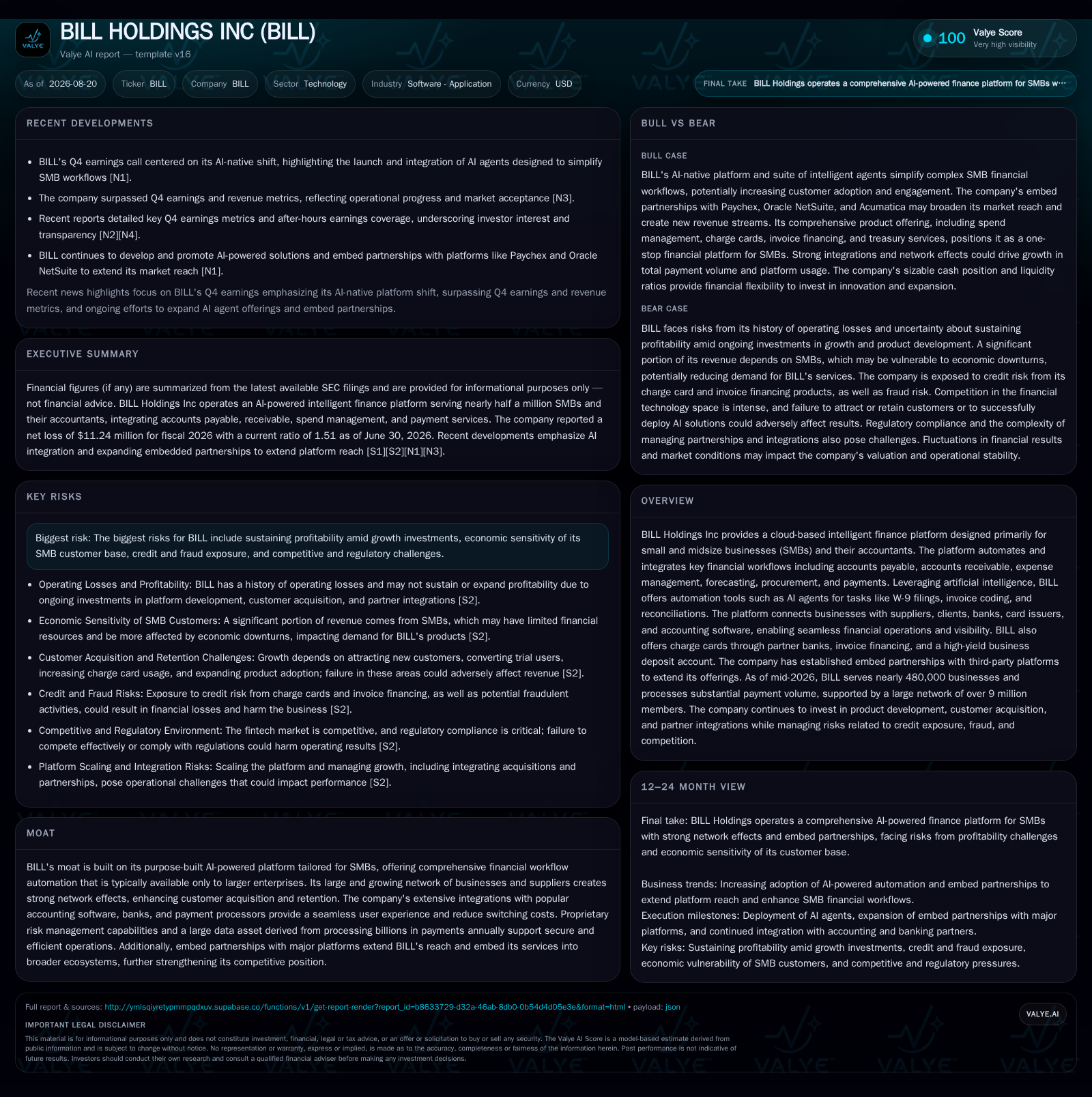
BILL Holdings expanded its platform to approximately 479,300 small and midsize businesses (SMBs) and processed $371.3 billion in total payment volume during fiscal 2026. The company launched AI-powered automation tools and broadened embed partnerships with key software providers to deepen integration and workflow efficiency. Despite these advances, BILL continues to face risks related to credit exposure, fraud, and the economic sensitivity of its SMB customers, which impact its path to sustained profitability. The company’s current liquidity position remains adequate to support ongoing growth and risk management initiatives.
Q4 Fiscal 2026 Operating Highlights and Platform Growth
BILL Holdings Inc reported continued expansion of its AI-powered finance platform for small and midsize businesses (SMBs) in the fiscal year ended June 30, 2026. The platform served approximately 479,300 businesses and processed $371.3 billion in total payment volume (TPV) during the period [S1]. This scale of payment volume and customer base underscores the company’s growing footprint in the SMB financial workflow automation market, a key driver of its transaction fee revenue and network effects.
In fiscal 2026, BILL launched BILL AI, a suite of AI agents designed to automate complex SMB workflows such as W-9 filings, invoice coding, reconciliations, and customer support tasks [S1]. These AI-driven capabilities aim to reduce manual processing costs and errors, enhancing operational efficiency for users. Additionally, BILL expanded its embed partnerships with platforms including Paychex, Oracle NetSuite, and Acumatica, enabling its finance platform to be embedded within widely used third-party software ecosystems [S1]. This "Embed 2.0" initiative extends BILL’s reach and integrates its payment and financial management capabilities more deeply into SMB workflows.
Business Model and AI-Driven Platform Innovation
BILL’s business model centers on providing SMBs and their accountants with an integrated, AI-powered finance platform that automates accounts payable (AP), accounts receivable (AR), expense management, forecasting, procurement, and payments [S1]. The platform also includes spend and expense management products such as charge cards and invoice financing. Revenue is generated through a combination of subscription fees for platform access, transaction fees on payment volume, interchange fees from charge cards, and fees or interest from credit products.
The company’s competitive positioning benefits from network effects created by over 9 million connected members who have paid or received funds electronically using the platform [S1]. This extensive network increases switching costs and platform stickiness. AI-driven automation tailored to SMB workflows further differentiates the platform by reducing manual effort and improving accuracy. Embed partnerships with major software providers enhance customer acquisition and retention by integrating BILL’s services directly into SMBs’ existing financial software environments.
Financial Condition and Liquidity Analysis
As of June 30, 2026, BILL held $1.03 billion in cash and equivalents, supported by current assets of $7.44 billion against current liabilities of $4.92 billion, resulting in a current ratio of 1.51 [F1]. This liquidity position provides moderate working capital adequacy to fund ongoing operations, platform development, and risk management initiatives. The company’s balance sheet reflects substantial liquidity; however, credit risk from its charge card and invoice financing products requires ongoing monitoring [F1][S2].
Revenue growth is supported by the expanding SMB customer base and increasing total payment volume, which drive higher transaction fees and platform monetization opportunities [S2][S3]. However, profitability remains challenged due to investments in growth initiatives and exposure to credit risk, consistent with the company’s history of operating losses [S2][S1]. Capital allocation focuses on research and development of AI capabilities, embed partnerships, and product expansion to enhance platform value [S1].
Risk Factors and Structural Challenges
BILL faces several structural risks impacting its profitability and growth trajectory. Credit exposure arises from its BILL Divvy Card charge card offering and invoice financing products, which depend on spending businesses’ ability to repay balances [S1][S2]. Fraud risk is another material concern, potentially amplified by the use of AI in transaction processing and risk management, which could lead to financial losses and reputational harm if not effectively controlled [S1][S2].
Economic sensitivity of the SMB customer base presents additional risk, as volatile or weakened economic conditions may reduce payment volumes and increase credit defaults [S1][S2]. The competitive landscape is also challenging, with pressure from other fintech platforms and financial software providers requiring continuous innovation and customer retention efforts.
Analytical Conclusions and Scenario Outlook
BILL’s expansion to nearly 480,000 SMB customers and processing over $371 billion in payment volume demonstrates strong platform adoption and network growth, which are critical drivers of its revenue base and competitive positioning [S1]. The scale of active customers and payment volume directly correlates with transaction fee revenue and enhances network effects that increase switching costs and platform stickiness.
The deployment of AI agents and embed partnerships represents a structural enhancement of BILL’s platform capabilities, enabling automation of complex SMB financial workflows and extending reach through third-party ecosystems, which may improve customer retention and monetization over time [S1]. AI-driven automation reduces manual processing costs and errors, while embed partnerships integrate BILL’s services into widely used platforms, lowering customer acquisition costs and increasing usage frequency.
One possible bullish scenario is that if BILL successfully scales its AI automation and embed partnerships, it could achieve higher customer retention and cross-selling, leading to accelerated revenue growth and eventual profitability. This would be supported by continued growth in SMB customer base and payment volume, effective credit and fraud risk management, and successful monetization of embed partnerships [S1][S2]. Observing increasing revenue growth rates, improving operating margins, and higher customer retention would confirm this outlook.
Conversely, a bearish scenario would arise if economic downturns weaken SMB financial health or credit and fraud risks materialize, leading to revenue pressure and margin compression that delay profitability and growth [S1][S2]. Rising credit loss provisions, declining payment volume growth, and negative operating margin trends would support this interpretation.
Watchpoints
Key metrics to monitor include quarterly growth in active SMB customers and total payment volume, trends in operating margins and credit loss provisions, adoption and monetization rates of AI agents and embed partnerships, changes in cash and liquidity position, and customer retention and cross-selling performance. These indicators will provide insight into the sustainability of BILL’s growth and profitability trajectory.
In summary, BILL Holdings’ fiscal 2026 results reflect significant platform scale and AI-driven innovation that underpin its competitive positioning in the SMB finance automation market. However, managing credit and fraud risks alongside economic sensitivity remains essential for translating growth into sustained profitability.
Disclaimer: This is research-only, informational analysis and not investment advice. It may include AI-generated interpretation and general industry context. Always verify important details using primary sources.

Comments