
BioNTech SE Faces Profitability Challenges Despite Strategic Partnerships and Diversified Pipeline
BioNTech’s recent financial performance highlights persistent losses driven by R&D investments and restructuring amid evolving COVID-19 vaccine demand.
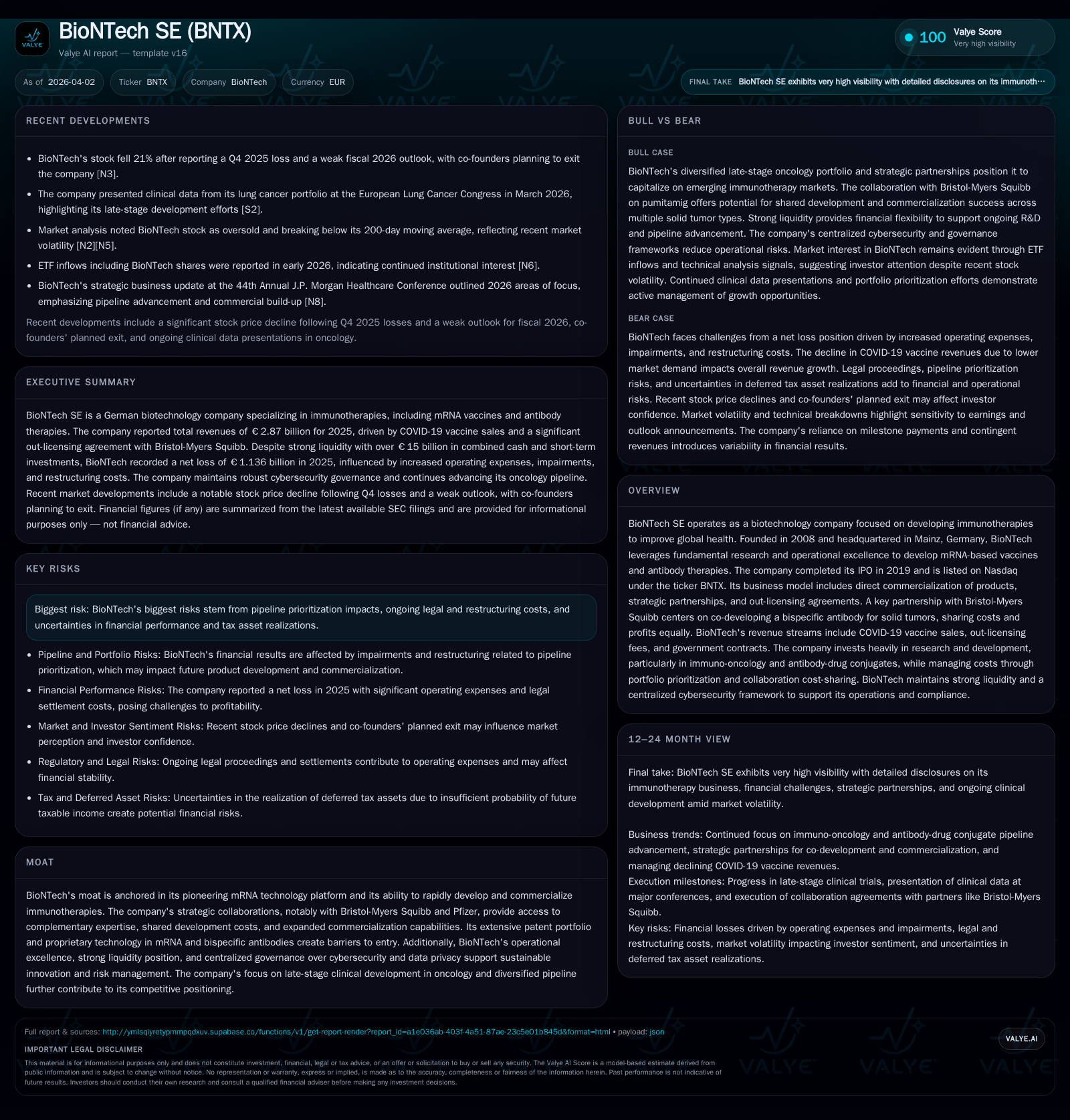
BioNTech SE, a pioneer in mRNA therapeutics, reported a substantial net loss in FY2025 following a decline in COVID-19 vaccine revenues and increased operating expenses related to pipeline prioritization and legal settlements. Despite these setbacks, the company continues to invest heavily in immuno-oncology, antibody-drug conjugates, and strategic collaborations, notably with Bristol-Myers Squibb. Its robust liquidity and patent moat underpin growth prospects, but future profitability hinges on successful late-stage clinical outcomes and effective cost management.
Overview
BioNTech SE has established itself as a frontrunner in mRNA-based immunotherapies since its founding in 2008. Leveraging pioneering science coupled with operational rigor, the company rapidly scaled commercial production of vaccines during the pandemic era while building out diversified pipelines targeting oncology and infectious diseases [S1]. Listed on Nasdaq since 2019 under ticker BNTX, it operates primarily from Mainz, Germany.
Historical Financial Performance
The trajectory from rapid growth to recent operational losses is rooted chiefly in fluctuating COVID-19 vaccine demand and strategic pipeline recalibrations. Revenues peaked at €3.82 billion in 2023 but softened to €2.75 billion in 2024 before stabilizing at €2.87 billion in 2025 [F1][S1]. The COVID vaccine segment contracted by 18% year-over-year in 2025 amid waning market requirements for booster doses across major geographies [S18][S20]. Favorably offsetting this was a new revenue category—out-licensing fees from the Bristol-Myers Squibb (BMS) co-development agreement—which generated €613 million following an upfront payment of $1.5 billion and expectations for up to $7.6 billion in milestones [S10][S18]. Other governmental contracts and one-time effects played smaller episodic roles.
Despite revenue resilience, BioNTech’s operating loss widened to €1.4 billion with net loss totaling €1.14 billion for FY2025 compared to a €665 million loss in the prior year [F1][S1]. This deterioration stemmed from multiple cost pressures including:
- Increased inventory write-downs (+€37 million YoY)
- Legal expenses related to settlements amounting to over €132 million
- Portfolio prioritization impairments (€71.6 million)
- Employee-related charges connected to restructuring (€57 million)
R&D investment remained elevated at roughly €2.1 billion but exhibited a slight decline compared to 2024 owing partially to joint cost sharing with BMS on their bispecific antibody programs [S4][S5]. Sales & marketing expenditures rose by c.62% reflecting ongoing commercial build-up beyond vaccine launches [S4]. General & administrative expense declined slightly due to prudent external service management.
Historical performance (annual)
| FY | Net ($bn) | Net YoY |
|---|---|---|
| 2025 | -1.1 | -70.8% |
| 2024 | -0.7 | -171.5% |
| 2023 | 0.9 | -90.1% |
| 2022 | 9.4 |
Source: SEC companyfacts cache [F1].
Capital returns and efficiency (annual)
| FY | Div ($mm) | ROE% |
|---|---|---|
| 2025 | -5.9 | |
| 2024 | 484 | -3.4 |
| 2023 | 484 | 4.6 |
| 2022 | 484 | 47.0 |
Source: SEC companyfacts cache [F1].
Growth Prospects and Pipeline Focus
From the corporate disclosures [S2][S3], BioNTech’s future growth hinges heavily on its immuno-oncology programs and particularly its antibody-drug conjugates (ADC) alongside bispecific antibodies developed jointly with Bristol-Myers Squibb (BMS). The BNT327 (pumitamig) bispecific is positioned broadly against multiple solid tumors with development and commercialization costs shared equally between both parties [S10]. The strategic collaboration brings both upfront capital injection and contingent milestone upside while diversifying revenue beyond vaccines.
Additionally, presentation of clinical data at the European Lung Cancer Congress (ELCC) underlines its late-stage portfolio ambitions targeting lung cancers—a critical global oncology market segment [N1][S2]. These specialized assets are designed to address high unmet needs leveraging BioNTech’s mRNA platform expertise.
However, ongoing COVID vaccine revenue baseline shrinkage will likely cap near-term topline expansion unless offset by new product launches or partnerships [S18]. Management’s portfolio reprioritization—including asset impairments—indicates rigorous pipeline resource allocation toward candidates with measurable near-term commercial potential [S4][S9].
Financial Forecast Considerations
Explicit future financial guidance for FY2026 was not disclosed but monitoring key metrics will be critical:
- Revenue trends from COVID-19 vaccines in light of seasonal demand fluctuations.
- Recognition of deferred revenues linked with BMS anniversary payments expiring through 2028.
- Milestone achievements triggering contingent payments within collaborations.
- Operating expense trajectory reflecting clinical trial acceleration versus restructuring benefits.
Market reaction following Q4 FY25 results was notably negative with share price corrections surpassing 20%, partly influenced by co-founders’ exit plans causing investor uncertainty [N4][N2]. This suggests elevated volatility around upcoming quarterly disclosures.
Capital Allocation and Returns Analysis
While BioNTech reported widening net losses translating into approximately -5.9% ROE based on latest equity levels as of end-2025, capital expenditures appear mainly invested toward internal innovation rather than shareholder distributions [F1]. Robust cash balances exceeding €7.6 billion provide liquidity cushion supporting sustained R&D activities despite losses.
Dividends or buybacks were not materialized recently indicating the company’s preference for financing growth organically and through strategic collaborations such as that with BMS that inject upfront funds while sharing risk burdens [F1][S10]. Effective cost discipline has been implemented in general administrative functions showing incremental margin pressure relief but restructuring costs have temporarily offset those gains [S4][S9].
Operational Excellence and Risk Management
BioNTech continues strengthening governance particularly around cyber risk as ISMS implementation became company-wide by 2024 with dedicated oversight committees involving supervisory board members and executive roles for COO and CISO functions consolidated recently [S22]. These measures enhance data privacy controls crucial for safeguarding proprietary mRNA technologies and clinical trial data integrity.
Risks remain tied to ongoing litigation exposures, pipeline clinical uncertainties impacting commercial forecasts, tax asset realizations debated under IAS rules, plus evolving regulatory landscapes across multiple jurisdictions where BioNTech operates [S6][S7].
Conclusion
BioNTech SE faces a pivot point transitioning from pandemic-driven revenues toward sustainable growth enabled by innovation in oncology immunotherapies and strategic partnerships that de-risk development costs while boosting financial resources. While losses widened significantly through FY2025 primarily due to portfolio rationalization charges and softer vaccine sales, the sizable cash reserves combined with milestone-rich collaborations provide runway for advancing late-stage clinical assets.
Investors should closely watch execution on bispecifics and ADCs alongside sales recovery or diversification beyond traditional vaccine markets. Operational cost efficiencies balanced against necessary R&D investment will determine if BioNTech can reverse earnings declines while maintaining leadership advantage via patented mRNA technology.
This report compiles publicly available company filings and recent news without providing investment recommendations or price targets.
Disclaimer: This is research-only, informational analysis and not investment advice. It may include AI-generated interpretation and general industry context. Always verify important details using primary sources.

Comments