
Bogota Financial Corp. Strengthens Market Position Through Loan Portfolio Resilience and Deposit Strategy
Bogota Financial Corp.’s Q2 2026 results highlight steady loan portfolio performance supported by disciplined underwriting and a competitive yet balanced deposit pricing approach.
Bogota Financial Corp., the holding company for Bogota Savings Bank, demonstrated operational resilience in its 2026 Q2 filings, maintaining a diversified residential and commercial loan mix consistent with conservative underwriting standards aligned with Fannie Mae and Freddie Mac guidelines. The bank's net interest margin stability amid a competitive New Jersey market stems from effective deposit management that balances competitiveness without pursuing highest market rates. Despite pressure from larger regional banks and credit unions, the company’s localized focus and regulatory discipline preserve its credit quality and funding stability. Monitoring loan demand shifts and deposit flow dynamics will be critical near-term indicators of growth sustainability.
Conservative Growth Anchored in Q2 Portfolio Stability
Bogota Financial Corp.'s second quarter 2026 filing reveals ongoing portfolio stability anchored by a diversified loan book primarily focused on one- to four-family residential real estate loans alongside commercial and multi-family real estate lending [S2]. This diversification across fixed- and adjustable-rate structures reflects an intentional balance to manage interest rate risk exposure. The bank's net interest margin (NIM), a critical profitability metric in the regional banking sector, maintained relative steadiness despite the broader economic environment characterized by rising rates [S3]. Such NIM stability suggests effective asset-liability management and balanced product pricing.
Importantly, there was no material uptick in non-performing loans or delinquencies reported during this quarter [S2], signaling that credit quality remained intact amid potential headwinds posed by adjustable-rate product sensitivity. This credit resilience corroborates historical patterns of conservative underwriting detailed in prior annual disclosures [S1]. As loan growth is often cyclical in response to local economic factors influencing demand for mortgages and commercial financing, the current steady state indicates cautious management calibrated for durability rather than aggressive expansion.
Loan Underwriting Discipline Balances Credit Risk in Competitive Market
The company's underwriting philosophy aligns with industry best practices by adhering closely to Fannie Mae and Freddie Mac guidelines for residential loans [S1]. These standards are widely accepted benchmarks ensuring conservative qualification criteria, including income verification, creditworthiness checks, and prudent debt service coverage thresholds. For commercial and multi-family real estate loans—typically larger balances accompanied by greater inherent risk—Bogota Financial applies tighter loan-to-value ceilings (generally up to 70% for commercial collateral) along with minimum debt service coverage ratios around 1.25x to ensure sufficient cash flow to meet obligations [S4][S6].
Such measured standards place Bogota Financial favorably relative to many community banks susceptible to loosening underwriting during credit upswings but also reflect an awareness of risks borne from the inherently cyclical nature of real estate markets. Moreover, adjustable-rate loan segments have embedded annual and lifetime interest rate caps limiting sudden payment spikes that could trigger borrower distress; however, rising benchmark rates do increase default risk slightly in this segment [S4]. The rigorous review processes—including requirement for periodic financial statement updates from commercial borrowers—further fortify ongoing portfolio vigilance.
Capitalizing on Core Deposits: Pricing Strategy Amid Funding Challenges
Deposits remain the cornerstone of Bogota Financial Corp.’s funding model [S7]. In its core New Jersey market territory, the company maintains a broad suite of deposit accounts targeted at both retail individuals and municipal entities—municipal deposits comprised roughly 7% of total deposits as of year-end 2025 [S7]. Pricing strategy intentionally aims for competitiveness without necessarily being the highest yield provider in the region. Weekly monitoring of competitor rates fosters agility in deposit product adjustments while avoiding excessive funding costs that could erode net interest margins.
This approach sustains deposit base stability essential for long-term liquidity management given that deposits fund a majority of the loan portfolio. Maintaining such a balanced funding cost framework is particularly critical as Bogota competes locally against well-resourced regional banks offering attractive rates alongside nimble credit unions seeking community deposits. Excessively aggressive deposit pricing could pressure margins or spur rapid cost fluctuations detrimental to efficiency ratios.
Regional Competitive Pressures Shape Strategic Positioning
Operating exclusively within New Jersey confines Bogota Financial Corp. to a mature market cluster intensely contested by larger regional players such as Valley National Bancorp and People's United Financial as well as growing credit union networks [S1]. While Bogota’s local brand recognition offers moat-like benefits derived from longstanding community presence since its origins in 1893 [S1], scale disadvantages limit expansive growth or pricing power.
The firm's mutual holding company structure further underscores its community bank identity but also subjects it to regulatory frameworks emphasizing capital reserves and prudent risk management over aggressive deployment strategies [S1]. This status entails both strength—stable governance aligning interests of employee stockholders—and constraint—less flexibility compared to publicly traded peers with extensive capital raising capacity.
Growth Drivers Tied to Local Market Dynamics Despite Industry Headwinds
Growth catalysts for Bogota hinge on favorable local economic conditions supporting housing demand including residential construction activity and multi-family property investment cycles [S3][S1]. Demographic trends underpin sustained demand for mortgage products while ancillary opportunities exist via cross-selling insurance, wealth management referrals through its subsidiary Bogota Securities Corp., and consumer banking services [S1][S3].
Additionally, recent merger discussions with GSL Savings Bank signal potential strategic moves toward scale economies or market expansion subject to regulatory approval [S5], which if successful could alleviate some competitive pressures but introduce integration complexities.
Navigating Risks: Credit Quality, Regulatory Oversight, and Liquidity
Key vulnerabilities rest primarily on credit risks inherent in exposure to adjustable-rate loans sensitive to future interest rate increases potentially translating into higher delinquency frequencies [S4]. Regulatory risk also persists in the form of ongoing supervision by New Jersey Department of Banking & Insurance alongside Federal Reserve mandates enforcing capital conservation buffers under community bank leverage ratio rules [S1][S22].
Liquidity risk is prudently managed through primary reliance on deposits supplemented occasionally by Federal Home Loan Bank advances when necessary—a common practice among savings institutions—but heavy dependence on local deposit inflows requires continuous attention especially under fluctuating competitive rates or economic slowdowns [S7][S21]. Cybersecurity governance receives explicit board-level oversight reflecting contemporary operational risk awareness [S1], contributing positively to enterprise risk management posture.
Upcoming Catalysts: Monitoring Loan Demand and Deposit Flows
Near-term operational milestones focus on quarterly trend analysis in loan origination volume particularly within construction loans given their higher risk profile linked to development cycles [S10]. Monitoring non-performing loan ratios will serve as an early warning mechanism if borrower stress emerges due to rate hikes.
On the funding side, tracking shifts in deposit balances vis-à-vis competitor pricing changes will illuminate liquidity maneuverability prospects amidst regional funding strife [S7]. Furthermore, regulatory announcements regarding any alterations in capital adequacy requirements or leverage ratio thresholds remain pivotal watchpoints affecting strategic capitalization decisions.
Financial Profile Discussion: Capital Structure and Liquidity Snapshot
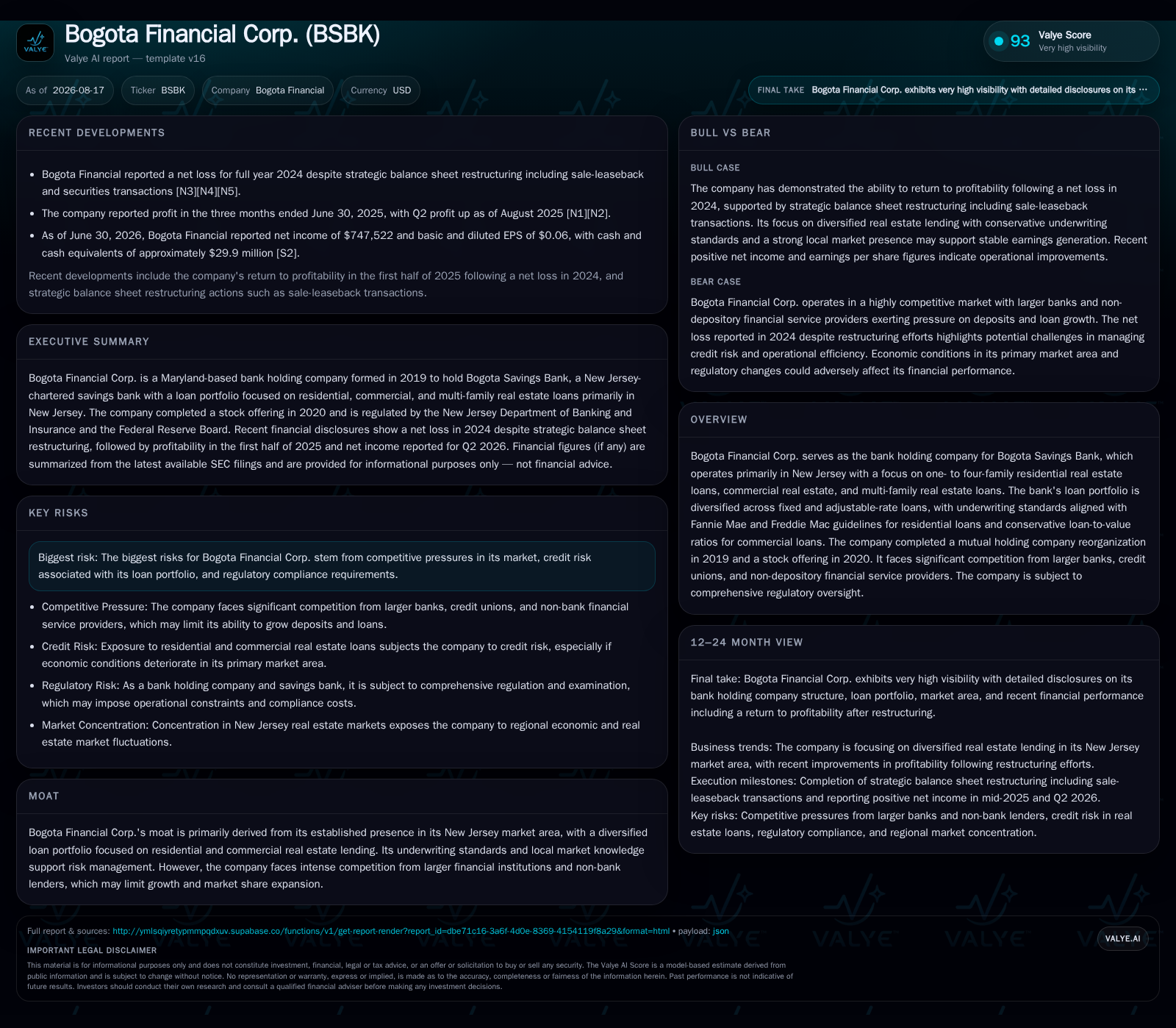
As of June 30, 2026, Bogota Financial Corp. held approximately $29.9 million in cash and cash equivalents providing ample liquidity reserves commensurate with its modest asset scale typical of community thrifts [F1][S2]. Balance sheet disclosures indicate no significant fluctuations or new debt issuances disrupting prior capital structures characterized by conservative leveraging aligned with well-capitalized designation under federal norms [S22][S24].
Capital buffers exceed minimum regulatory thresholds with leverage ratios comfortably above proposed declines from 9% to 8% under Community Bank Leverage Ratio (CBLR) framework considerations—signaling sound capitalization supportive of prudent growth ambitions without heightened vulnerability to regulatory constraints or capital calls [S22][S24].
In aggregate, Bogota Financial Corp.’s financial health remains aligned with its business model focusing on careful portfolio stewardship combined with disciplined funding approaches adapted for competitive local markets.
This analysis centers on publicly disclosed operating results through August 2026 filing sources without forward-looking forecasts or investment research views. Industry context draws upon established regional banking sector knowledge reflecting typical value chain roles, KPIs relevant for savings institutions engaged predominantly in mortgage lending funded chiefly via deposits. Interpretation prioritizes recent operating disclosures evidencing ongoing portfolio strength despite macroeconomic headwinds shaping short-term performance outlooks.
Disclaimer: This is research-only, informational analysis and not investment advice. It may include AI-generated interpretation and general industry context. Always verify important details using primary sources.

Comments