
Blue Star Foods Charts Next Phase of Sustainable Seafood Growth
Blue Star Foods’ latest quarterly report highlights its strategic emphasis on scaling recirculating aquaculture salmon production and pursuing targeted acquisitions under ongoing financial pressures.
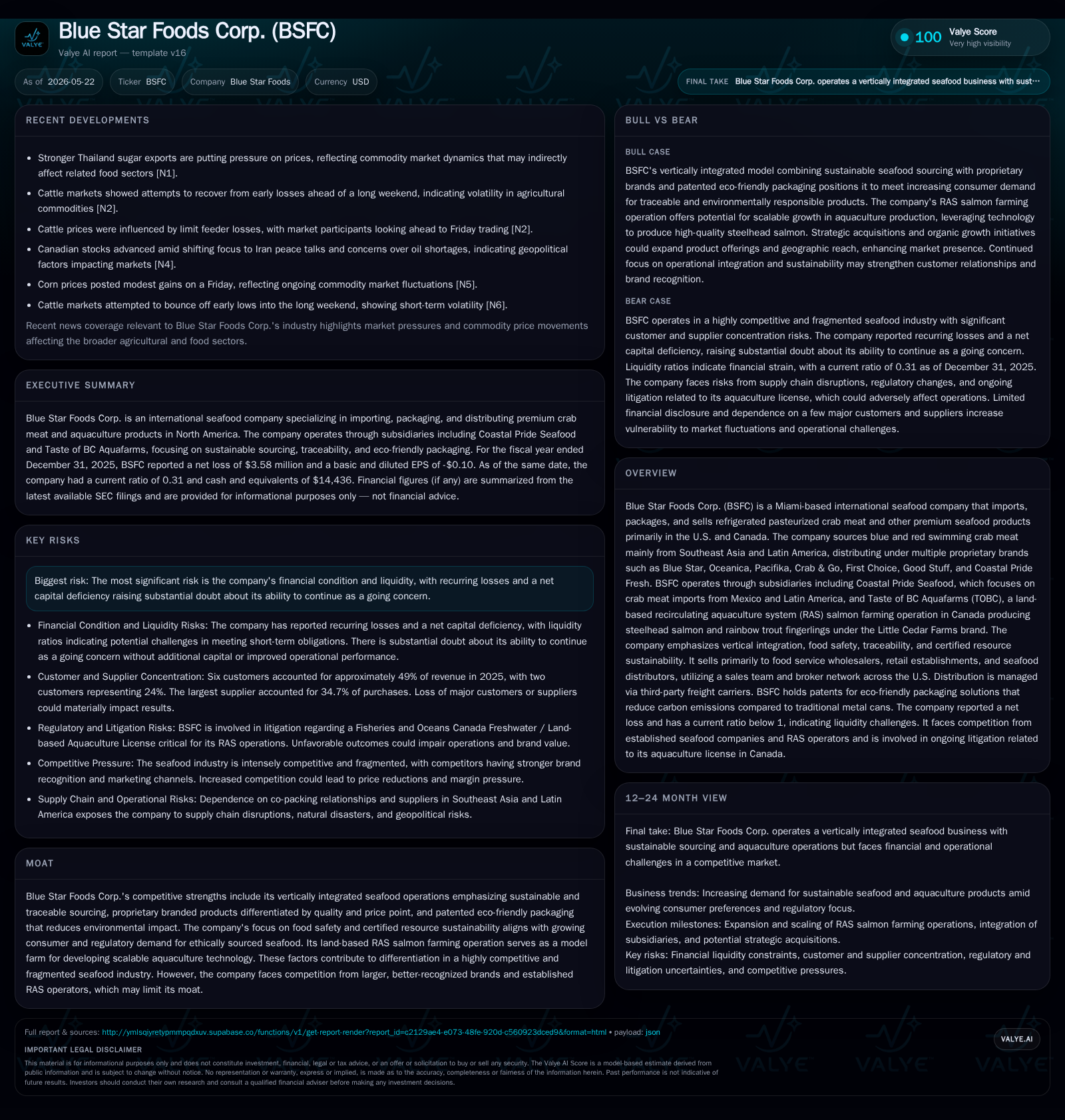
In its 2025 Q3 filing, Blue Star Foods confirmed progress in developing its land-based recirculating aquaculture systems (RAS) salmon farming business, aiming for a scalable 21,000 metric ton production by 2028. The company continues to integrate its seafood import and processing subsidiaries while dissolving less core entities. Vertical integration through proprietary brands and sustainable sourcing remains a strategic focus amid intense competition and significant financial challenges. The near-term growth strategy revolves around expanding RAS capacity in Canada and selectively acquiring companies that complement its sustainable product portfolio. Financially, recurring losses and liquidity constraints persist, raising going concern risks.
Latest Quarterly Developments and Their Significance
Blue Star Foods Corp.'s November 2025 10-Q filing ([S2]) offers the latest snapshot of operational focus as the Company pivots toward scaling its land-based recirculating aquaculture system (RAS) salmon farming business through its subsidiary Taste of BC Aquafarms (TOBC). While the dissolution of non-core subsidiaries Afritex Ventures Inc. and John Keeler & Co. was completed by end-2025 ([S1]), BSFC's priority now centers on expanding TOBC’s modular RAS capacity to produce steelhead salmon at a target of 21,000 metric tons by 2028 ([S1],[S4]). This ambitious scale-up hinges critically on BSFC securing equity capital market funding and additional debt facilities to finance sequential builds of standardized modules ranging from 1,500 to 3,000 metric tons each located primarily in British Columbia.
This near-term filing update underscores the company's strategic direction away from legacy operations towards growth within sustainable aquaculture—signaling operational consolidation coupled with a push for organic growth complemented by acquisition-led expansion.
Business Model and Operational Scope
Blue Star Foods' business model is multi-faceted but anchored on vertically integrated seafood operations combining importation, packaging, branded distribution of premium crab meat products, and pioneering RAS salmon fingerling production ([S1],[S20]). Revenue generation derives primarily from sales of refrigerated pasteurized blue and red swimming crab meat sourced mostly by co-packing partnerships throughout Southeast Asia (India, Indonesia) and Latin America (Brazil, Peru), marketed under numerous proprietary brands including Blue Star, Oceanica, Pacifika, Crab & Go, First Choice, Good Stuff, Coastal Pride Fresh alongside sustainable RAS-produced steelhead salmon branded Little Cedar Farms ([S1],[S12],[S17],[S20]).
The import segment relies heavily on third-party production coupled with contract co-packers audited for food safety regulations such as FDA-approved HACCP plans and BRC certifications ensuring traceability and resource sustainability ([S17]). Distribution spans food service wholesalers, retail establishments, and seafood distributors across the US and Canadian markets ([S12],[S20]). Import logistics employ LTL freight contracting without asset ownership—reflecting typical cost-control practices for regional cold-chain distribution.
The TOBC subsidiary complements the import segment by developing a bio-secure land-based fish farming operation using recirculating aquaculture systems that allow controlled environment steelhead salmon production (~100 tons annually currently) that serves as a prototype for scalable expansion modularized into standardized units for replication across strategic Canadian locations ([S1],[S4],[S20]). This vertical integration imparts advantages around supply chain sustainability credentials increasingly demanded by end consumers amid regulatory scrutiny.
Industry Positioning and Competitive Dynamics
BSFC operates within an intensely competitive seafood sector characterized by fragmentation at both traditional import/processing levels as well as newer technology-driven aquaculture realms ([S7]). Among traditional competitors for crab meat are Tri Union Frozen Products (Chicken of the Sea Frozen Foods), Phillips Foods, Harbor Seafood, Newport International and Twin Tails Seafood Corp—entities with greater scale or brand recognition capable of exerting pricing pressure ([S7]).
In the emerging segment of land-based RAS salmon farming where TOBC competes, principal competitors include Atlantic Sapphire—a publicized leader geographically proximate in North America—alongside Aquaco, Nordic Aquafarms, Whole Oceans, Kuterra, and Pure Salmon known for advanced technological deployment or scale advantages ([S7]).
BSFC seeks differentiation through patented environmentally friendly packaging innovations with reduced carbon footprint versus metal cans dating back years in commercial use ([S4]), integrated food safety compliance frameworks ensuring reliable quality benchmarks ([S17]), certified resource sustainability policies that resonate with consumer preference shifts towards ethical sourcing ([S4]), plus planned vertically integrated balanced offerings spanning fresh crabmeat imports through domestically farmed salmon products. However, limited brand visibility relative to peers combined with smaller operational scale constrain immediate competitive leverage.
Growth Drivers: RAS Expansion and Strategic Acquisitions
Long-term growth hinges significantly on executing BSFC’s internal goal to expand TOBC’s RAS farm capacity to produce 21k MT steelhead salmon by 2028 through constructing multiple standardized modular farms situated mainly in British Columbia ([S1],[S4]). This plan requires successfully raising substantial external capital—equity infusion coupled with debt financing—to fund costs of replicable farm units sized between 1,500 MT to 3,000 MT each aligned along proven operational footprints. Achieving these production milestones represents a measurable KPI signaling progress toward scalability.
Concurrently, BSFC pursues acquisitive expansions targeting companies that broaden species diversification beyond crabs and salmon fingerlings while introducing additional proprietary technologies aligned with sustainable seafood frameworks ([S1],[S4]). These acquisitions aim not only to extend geographic reach but also unlock margin enhancement opportunities through integrating eco-conscious premium product ranges—catering to consumer willingness-to-pay uplifts linked to certified green credentials.
Organic growth drivers also include expanding customer penetration within food service wholesalers, retail chains across US/Canada markets—where growing demand for sustainable seafood intersects shifting consumer health trends—and improving marketing-sourcing synergy across operatives supporting better inventory management and distribution efficiencies ([S4],[S12]).
Risks and Constraints: Financial Condition and Market Factors
Despite strategic ambitions rooted in vertical integration and innovation adoption, Blue Star Foods faces steep operational headwinds. Principal risk lies in chronic financial stress underscored by recurring operating losses compounded by liquidity shortages; the company reported an operating loss of $2.3 million alongside net loss exceeding $3.5 million in fiscal 2025 despite some improvement from prior years ([F1]). Liquidity metrics are strained: year-end current assets totaled approximately $1.16 million versus current liabilities near $3.69 million yielding an impaired current ratio around 0.31—a level reflecting serious working capital deficiency restricting day-to-day flexibility or investment scope ([F1]).
Customer concentration risk is material as six customers accounted collectively for roughly half of all revenue in 2025 with two alone representing about a quarter—a profile exacerbating earnings volatility if any key relationships degrade or contractual terms shift unfavorably ([S7],[S12]). Also notable are unresolved legal disputes regarding control over essential freshwater aquaculture licenses linked to TOBC’s operations plus contentious lease termination actions threatening core facility tenancy—all contributing uncertainty while potentially disrupting scaled salmon production endeavors ([S1],[S5],[S24]).
Commodity price fluctuations inherent in crab meat notably impact gross margins given dependence on seafood market pricing dynamics beyond the company’s control ([S1]). Regulation escalations across FDA compliance, trade tariffs affecting imports from Southeast Asia/Latin America suppliers introduce additional cost variability risks along with export restrictions challenging cross-border distribution consistency ([S5],[S23],[S25]). Intellectual property protection remains a vulnerability area due to possible infringement claims or insufficient safeguards diminishing competitive advantage or innovation monetization potential ([S16],[S18]).
Finally macroeconomic factors such as global economic uncertainty or declines in discretionary consumer spending may materially affect demand volumes for premium seafood categories making revenue forecasts less predictable ([S8],[S19]).
Near-Term Catalysts and Monitoring Points
Key operational milestones warrant close attention including:
- Accessing sufficient capital resources from equity markets or lenders needed to finance sequential construction phases of expanded modular RAS farms targeting cumulative output of 21k MT steelhead salmon by late-decade completion dates ( [S1],[F1])
- Resolution progress concerning contested aquaculture licenses integral to TOBC’s legal right to continue biological transfers underpinning fingerling production capacity expansion ( [S5])
- Outcomes from lease dispute adjudication impacting physical facility continuity essential for maintaining stable production footprints ( [S5])
- Execution speed against targeted acquisitions aimed at diversifying species offerings while integrating operational synergies purportedly boosting margin structures ( [S4])
- Market acceptance monitoring post-introduction of new premium branded eco-conscious products that might confer pricing power enhancements offsetting raw material cost inflation pressures ( [S4]) Collectively these factors will shape BSFC’s ability to navigate operational execution risks while positioning itself competitively within evolving sustainable seafood demand landscapes.
Historical Financial Performance Overview
Historical performance (annual)
Capital returns and efficiency (annual)
A summary table illustrates Blue Star Foods’ recent operating performance indicating persistent losses but marked improvement trends:
Despite year-over-year reductions in losses especially during fiscal 2025 compared with prior years showing severe cash burn episodes early in the period [F1], BSFC remains unprofitable with net negative cash flows indicative of ongoing capital needs. Capital expenditures have trended sharply downward consistent with operational consolidation though further investment will be necessary to realize planned RAS expansions [F1]. Negative equity at year-end ($-2.36 million) underscores balance sheet stress requiring recapitalization efforts [F1].
This analysis synthesizes Blue Star Foods Corp.'s most recent filings highlighting structural shifts toward scalable aquaculture production allied with enduring financial constraints characteristic of emerging seafood enterprise models prioritizing sustainability credentials amid competitive fragmentation. Keeping watch over upcoming funding milestones alongside resolutions to licensure disputes will be critical markers shaping BSFC's functional viability beyond near-term operational consolidation.
Disclaimer: This analysis is informational only without investment advice or research views.
Disclaimer: This is research-only, informational analysis and not investment advice. It may include AI-generated interpretation and general industry context. Always verify important details using primary sources.

Comments