
Cavco Industries Reinforces U.S. Manufactured Housing Leadership with Diversified Production and Financing
Cavco leverages a vast production footprint and integrated finance services to sustain growth amidst raw material cost volatility and financing constraints.
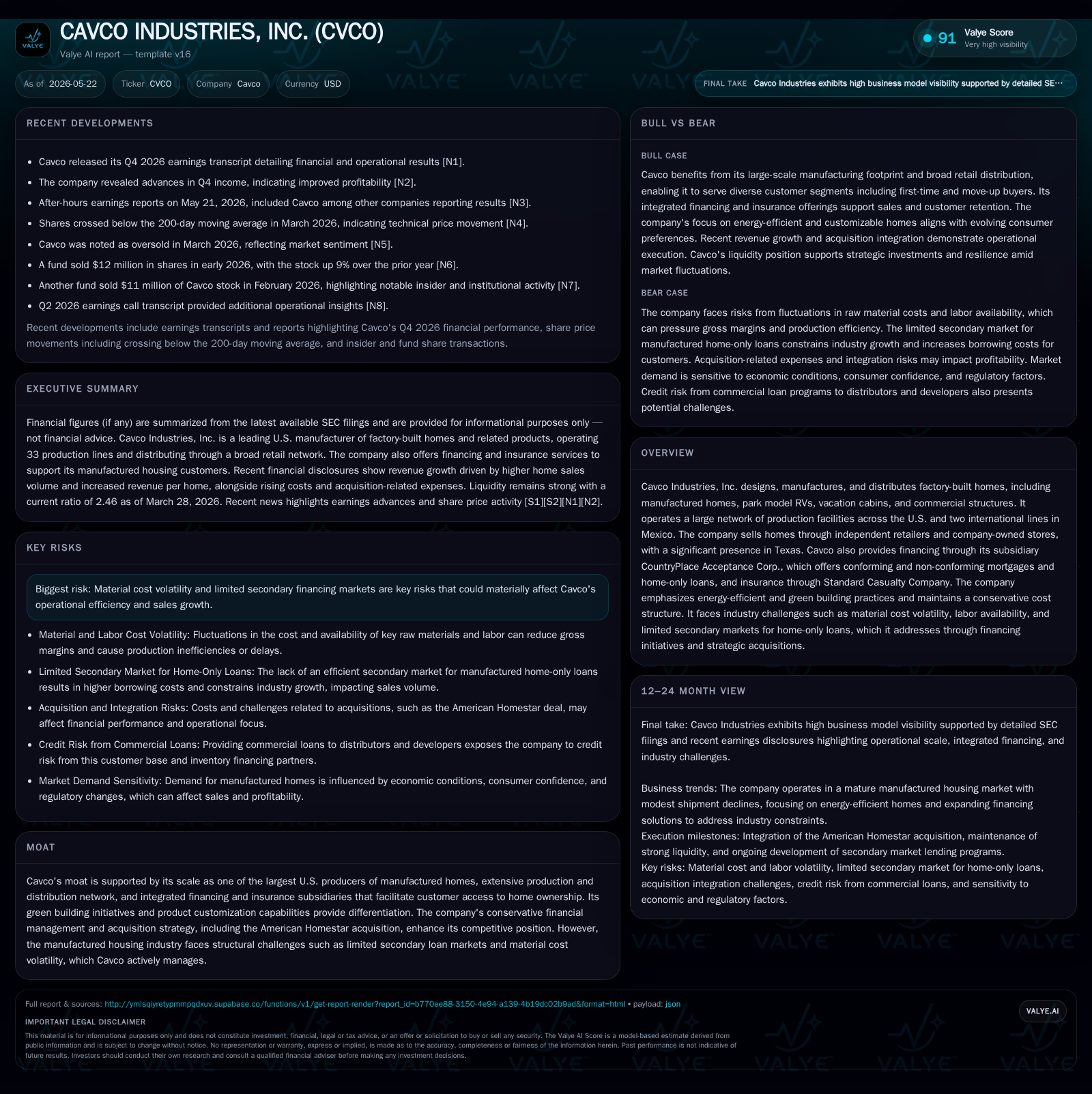
In its latest quarter, Cavco Industries operated 33 domestic and two international production lines, expanding capacity while navigating volatile raw materials and labor markets. The integration of CountryPlace Acceptance Corp.'s financing and Standard Casualty Company's insurance offerings strengthens customer access in a fragmented manufactured housing market. Despite persistent challenges like limited secondary markets for home-only loans, Cavco’s diverse product mix, green building emphasis, and acquisition strategy support its competitive positioning. The company’s robust balance sheet, highlighted by $237 million in cash and negligible debt, underpins its strategic flexibility as it pursues growth through production expansion and financial innovation.
Latest Quarterly Operating Update
Cavco Industries reported continued expansive operations as of the quarter ended December 27, 2025, running a total of 33 manufacturing lines across key U.S. states including Oregon, California, Texas (with three lines), Arizona (three lines), Pennsylvania (two lines), North Carolina (two lines), Georgia, Minnesota, Indiana, Wisconsin, Tennessee, Virginia, Florida (two lines), Oklahoma, New Mexico, Idaho, and additionally two plants in Ojinaga, Mexico [S2]. This extensive footprint reflects the company's strategic focus on broad geographic coverage enabling market penetration and supply chain efficiencies.
The company continues to face notable input cost fluctuations across critical materials — wood products, steel components, gypsum wallboard, windows and doors — which exert pressure on gross margins when incremental costs outpace the ability to adjust sales prices efficiently. Cavco's operational strategy includes diligent pricing actions balanced against competitive forces in the manufactured housing sales environment [S2][S1]. Labor availability levers remain integral to managing production throughput amid tight labor markets.
Commercial loan originations notably increased by $29.8 million year-over-year over the nine months ended December 27, 2025 compared to the prior period while consumer loan originations declined by $11.2 million over the same timeframe [S2]. The shift reflects Cavco's effort to enhance financing options for wholesale customers such as distributors and community developers alongside traditional consumer mortgage products—a diversification aligning credit solutions with customer segments' needs
Business Model: Factory-Built Homes and Financial Services Integration
Cavco’s principal revenue is generated from designing, manufacturing, and distributing factory-built homes composed of manufactured homes (HUD code compliant), park model RVs designed for vacationers or seasonal occupancy, vacation cabins primarily targeted at resort or leisure markets, and commercial structures built within factory environments allowing modular efficiency gains [S1][S2]. Sales are transacted primarily wholesale through an independent retailer network complemented by company-owned storefronts concentrated significantly in Texas.
Beyond physical homes sales generating substantial top-line volumes ($2.16 billion factory-built housing revenue for fiscal year ending March 28, 2026), Cavco enhances buyer accessibility via vertical integration into financing and insurance streams. CountryPlace Acceptance Corp., a wholly-owned subsidiary licensed as a Ginnie Mae issuer/servicer and Fannie Mae/Freddie Mac seller/servicer offers residential mortgages including conforming loans adapting traditional bank standards alongside non-conforming home-only loans tailored for manufactured housing purchasers struggling with conventional credit channels [S1]. This embedded finance model reduces friction at purchase points by broadening credit availability within Cavco’s distribution ecosystem.
The insurance arm through Standard Casualty Company provides property casualty coverage chiefly oriented toward manufactured home owners holding policies that align with unique risk profiles inherent in this asset class—enhancing client retention potential while supporting community-based lending initiatives promoted within finance activities [S1]
Industry Framework: Market Positioning and Competitive Dynamics
As one of the largest U.S.-based producers by reported wholesale shipments in this niche segment known for fragmentation among smaller players with local or regional footprints, Cavco commands scale economies from facility breadth coupled with cross-selling reach via financing/insurance bundling capabilities [S1][S6]. The recent acquisition of American Homestar Corporation further consolidates market share within Texas—a high-density manufactured housing state—strengthening supply capacity and product portfolio diversity across price points
Green building initiatives permeate product development aimed at sustainability-conscious buyers through energy-efficient envelopes incorporating renewable materials plus off-grid-friendly designs integrating solar energy readiness—a differentiator amidst rising environmental regulation pressure influencing housing drivers. Additionally, conservative cost structures coupled with stringent operational discipline balance cyclicality risks inherent in construction material pricing volatility.
Nonetheless industry-wide headwinds endure including shortages or allocation challenges for skilled labor impacting throughput; specialized regulatory frameworks dictating zoning or HUD compliance; ongoing constrained liquidity markets particularly manifesting in inefficient secondary markets for home-only loans distinguishing manufactured home credit from traditional stick-built mortgage securitizations [S1]. These factors collectively temper growth but also elevate barriers to entry preserving incumbents’ competitive moats.
Growth Catalysts: Production Expansion Amid Financing Innovations
Key growth vectors hinge on maximizing utilization rates across the scale of lines while selectively expanding capacity where regional demand supports higher volume throughput. The addition of American Homestar’s facilities shows strategic efforts to consolidate high-growth corridors.
Further acceleration stems from innovative financing approaches funneling commercial loans to distributors/community operators who require capital to finance inventory or property portfolios supporting Cavco sales exposure—this reduces friction for buyers indirectly accessing homes via operator-facilitated pathways rather than solely consumer-direct mortgage origination [S2][S1]. Increased investment in home-only lending programs aims to circumvent current systemic bottlenecks limiting availability of competitively priced manufactured housing finance.
Energy-efficient green product launches cater increasingly to consumer segments valuing utility cost savings aligned with macro sustainability trends fostering incremental pricing power despite raw material inflationary pressures.
Operational Risks: Raw Material Volatility and Credit Market Challenges
Volatile pricing across key inputs such as timber products—often linked to broader commodity cycles—and steel exacerbate margin management complexities given timing mismatches between cost inflation events versus ability for rapid price escalation at retail levels.
Labor scarcity risks persist especially in specialized factory roles required in multi-stage manufacturing processes spanning assembly line skillsets plus finishing trades impacting overall productivity metrics.
From a credit risk perspective formidable structural challenges remain due to minimal institutional participation creating an illiquid secondary market for manufactured home-only loans which translates into elevated borrowing costs for consumers relative to site-built alternatives—this market inefficiency caps penetration potential unless corrective financial architectures evolve collaboratively within industry stakeholders where Cavco actively participates [S1][S2].
Additionally exposure arises from credit losses related to commercial partner defaults given lending program expansions toward non-traditional borrowers requiring tight underwriting oversight.
Key Operational Milestones and Upcoming Catalysts
Order backlog remained relatively stable at approximately $195 million wholesale value as of fiscal year-end March 28, 2026 compared to prior-year positioning although exact order realization depends on distributor cancellations permissible before production initiation—a notable volatility factor intrinsic to industry practice [S1]. Monitoring backlog conversion ratios will be critical in upcoming quarters signaling demand firmness vs transient booking activity.
Execution progress integrating American Homestar assets remains pivotal alongside continuous refinement of financing programs expanding commercial loan reach into new client strata servicing community owners/developers incentivized by bespoke credit solutions lowering barriers-to-entry.
Strategic capital deployment following Board approval of a $150 million stock repurchase initiative announced May 2026 signals robust confidence backed by the strong balance sheet providing optionality without encumbering liquidity or leverage profiles [S3]
Financial Profile: Balance Sheet Strength and Profitability Trends
Financially Cavco presents a robust liquidity position evidenced by approximately $237 million in cash & cash equivalents against negligible total debt levels circa $338 thousand as of March 28, 2026 resulting in net cash surplus approximating $236 million—reflecting prudent capital structure choices supportive of both organic growth investments and shareholder return programs [F1][S2][S3]
This financial flexibility supports continued investments in production capacity expansion initiatives as well as ongoing innovation in financing offerings mitigating some traditionally restrictive barriers confronting manufactured housing market growth potential.
This analysis draws exclusively upon recent SEC filings () supplemented by latest company facts ([F1]) without speculative assumptions beyond documented disclosures. Cavco Industries remains positioned as a leading vertically integrated participant in factory-built housing benefiting from extensive production scale paired with financial services integration designed to enhance customer accessibility amid enduring industry cyclicality challenges. The content here is intended solely for informational purposes consistent with internal investment analysis policies without constituting investment advice or research views.
Disclaimer: This is research-only, informational analysis and not investment advice. It may include AI-generated interpretation and general industry context. Always verify important details using primary sources.

Comments