
Williams-Sonoma Strengthens Multi-Channel Retail Edge with Q1 2026 Momentum
Q1 2026 results demonstrate Williams-Sonoma’s effective execution of its proprietary product design and multi-channel strategy, underpinning sustained growth amid competitive specialty retail dynamics.
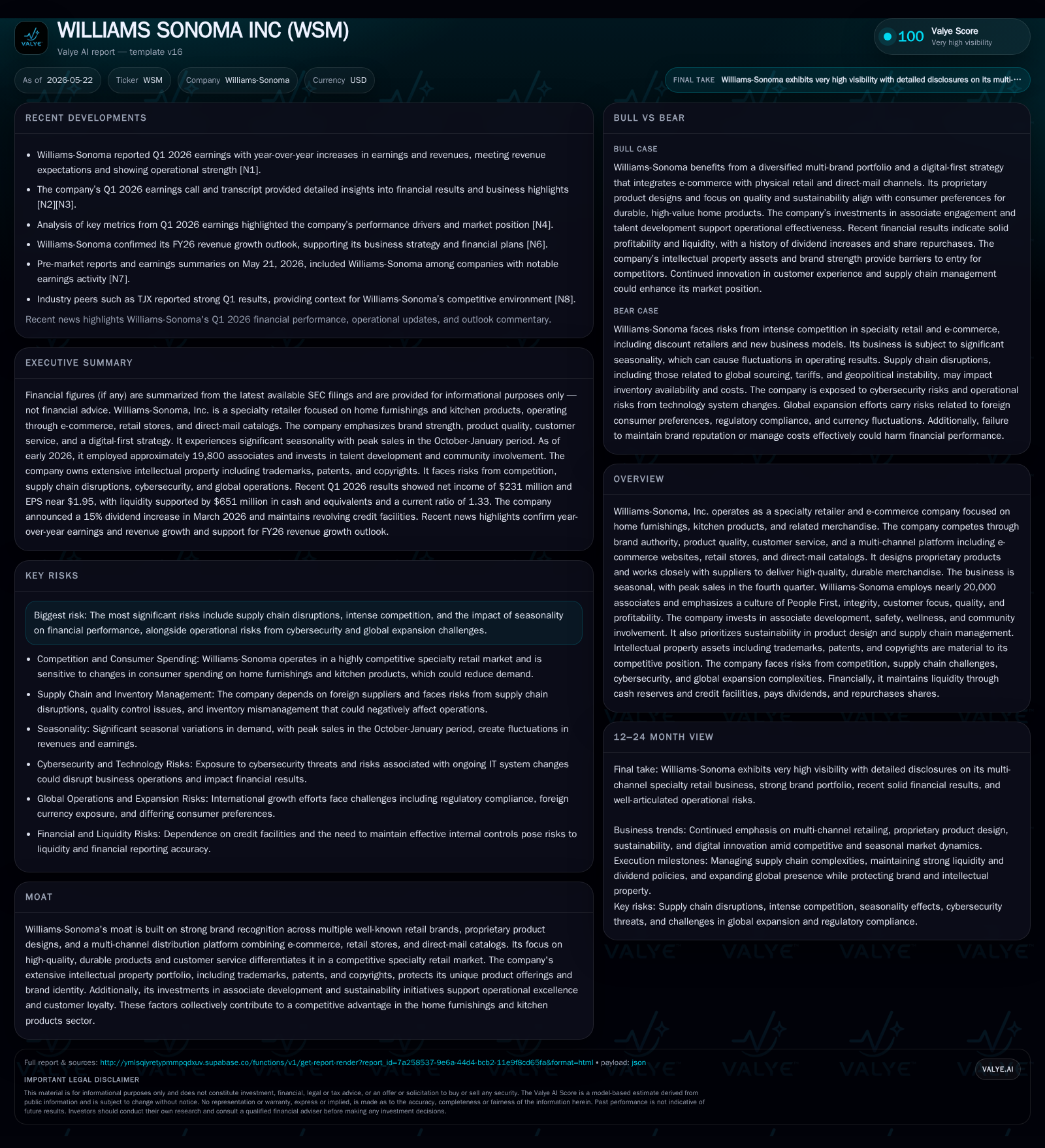
Williams-Sonoma reported a first quarter that met revenue estimates and surpassed earnings expectations, reflecting strong demand for its home furnishings and kitchen products across its integrated e-commerce, retail, and catalog channels. The company's business model leverages in-house design and multi-channel distribution to differentiate product offerings within a competitive specialty retail landscape. Growth drivers include continued digital expansion, a strong seasonal sales cycle, and innovation pipeline resilience. Risks persist around supply chain volatility, seasonality impact, and intensifying competition from discount and digital-native retailers. The firm maintains healthy liquidity with no debt and a solid current ratio, supporting further investment in growth initiatives.
Q1 2026 Results Highlight Sustained Revenue and Profit Growth
Williams-Sonoma’s first quarter fiscal year 2026 (ended May 3) demonstrated continued momentum as revenues met consensus at approximately $5.3 billion (latest available top-line figure) while net income exceeded expectations, driven by disciplined cost controls and efficient multi-channel fulfillment [S2][S3][N1][N5]. This performance was notable given broader retail sector headwinds marked by inflationary pressures and shifting consumer spending patterns. Management's commentary during the earnings call emphasized successful leveraging of proprietary product lines and online sales growth to maintain strong customer engagement through the quarter’s lower seasonal demand period [N2][N3]. The absence of material changes to risk factors in the quarterly filing points to stable operational trends providing confidence as the company approaches its historically peak fourth quarter season [S2].
Williams-Sonoma’s Business Model: Proprietary Design Meets Multi-Channel Reach
Williams-Sonoma operates primarily in specialty home furnishings and kitchenware segments, differentiating itself through design ownership and integrated distribution platforms. Its business model revolves around internal design teams generating proprietary products that are manufactured in close collaboration with global suppliers to ensure quality and durability — key attributes valued among its target demographic [S1]. Sales channels include e-commerce websites representing a growing share of revenue complemented by brick-and-mortar stores contributing roughly 35% of net revenues, along with direct-mail catalogs maintaining relevance within customer outreach strategies [S1].
The company’s People First culture underpins operational effectiveness. With nearly 20,000 associates (a mix of seasonal, part-time, and full-time employees), Williams-Sonoma scales workforce capabilities significantly during peak periods through temporary staffing primarily focused on stores, fulfillment centers, and customer care functions [S1]. Ongoing investments in associate development reflect a strategic focus on human capital as a lever for enhancing customer experience consistency.
Competitive Positioning Within Specialty Home Furnishings Retail
Williams-Sonoma’s moat is anchored in its strong brand portfolio — supported by registered trademarks, patents on proprietary designs, copyright protections — which guard against commoditization risks prevalent among discount or undifferentiated competitors [S1]. This IP protection facilitates sustained pricing power where quality-conscious consumers prioritize durability over price sensitivity.
The retail environment is highly fragmented with competitors ranging from digitally-native start-ups to large discount chains aggressively expanding assortments. Williams-Sonoma counters this through a seamless omnichannel experience integrating physical stores’ tactile engagement with e-commerce convenience — an approach challenging for pure online or offline players to replicate effectively [S1]. Customer service excellence further buttresses retention metrics.
Growth Catalysts: Digital Expansion, Product Innovation, and Seasonal Ramp
Investments in digital infrastructure drive improved conversion rates online while data analytics refine personalization efforts—hallmarks underscored in recent investor communications pointing to accelerating ecommerce penetration post-pandemic [N2][N3]. The cross-selling potential across distinct but complementary brands augments average order values.
Seasonality remains a defining feature; the October–January window accounts for a disproportionate share of annual revenue necessitating careful inventory planning up to twelve months ahead due to long lead times with international suppliers [S22][S23]. New product launches timed for this period stimulate demand spikes while marketing campaigns harness brand recognition.
Continued innovation pipelines supported by in-house design teams signal sustained relevance amid evolving consumer preferences. The company also pursues sustainability-driven sourcing as an increasingly important buying criterion among its clientele—a factor potentially enhancing long-term brand loyalty [S29].
Potential Risks: Supply Chain Volatility, Seasonality, and Industry Competition
The extended global supply chain exposes Williams-Sonoma to disruptions impacting inventory availability and freight costs—exacerbated by geopolitical instability such as shifts in trade routes or tariffs—with corresponding margin pressure potential if price increases cannot be fully transmitted to customers [S7][S22][S25]
Seasonal concentration poses working capital management challenges as inventory builds precede the peak selling months; misjudgments could result in excess stock or stockouts affecting both sales volumes and markdown rates [S22][S23]. Cybersecurity risks remain salient given substantial e-commerce dependence; prior phishing attempts indicate ongoing vulnerability requiring vigilance and investment in systems integrity [S18].
Competitive threats from discount sellers offering undifferentiated products at aggressive price points constrain pricing flexibility while requiring continuous reinforcement of brand value propositions through quality differentiation and service excellence [S1]. Global expansion efforts raise execution complexities concerning localized preferences, regulatory compliance, and delivery infrastructure.
Key Upcoming Milestones and Next Steps in Execution
Market watchers should monitor Q2 earnings for early indicators of demand trajectory entering mid-year non-peak period along with updates on inventory positioning ahead of the critical Q4 retail ramp [N6]
Product rollout cadence throughout the year will serve as demand markers alongside digital channel enhancements expected to contribute incremental growth. Preparations for peak selling season including temporary hiring plans provide insight into operational readiness levels.
Management dialogue around sustained pricing power amidst inflationary backdrop will also shed light on margin durability going forward [N3]. Sustaining innovation pipelines remains key to fending off new entrants encroaching on specialty home goods market share.
Financial Overview: Strong Liquidity and Profitability Position
Williams-Sonoma enters its fiscal year with robust financial health: cash & equivalents stood at approximately $652 million with no debt outstanding as of early May 2026 [F1]. This net cash position underpins operational flexibility allowing continued investments in technology infrastructure, store refurbishments, marketing initiatives, and sustainability programs without leverage constraints.
Disclaimer: This analysis is for informational purposes only and does not constitute investment advice or research views regarding any securities mentioned herein.
Disclaimer: This is research-only, informational analysis and not investment advice. It may include AI-generated interpretation and general industry context. Always verify important details using primary sources.

Comments