
Reborn Coffee Advances Specialty Expansion Despite Liquidity Strains
Reborn Coffee’s latest capital infusion and operational efforts aim to accelerate growth within the competitive specialty coffee segment while navigating ongoing liquidity pressures.
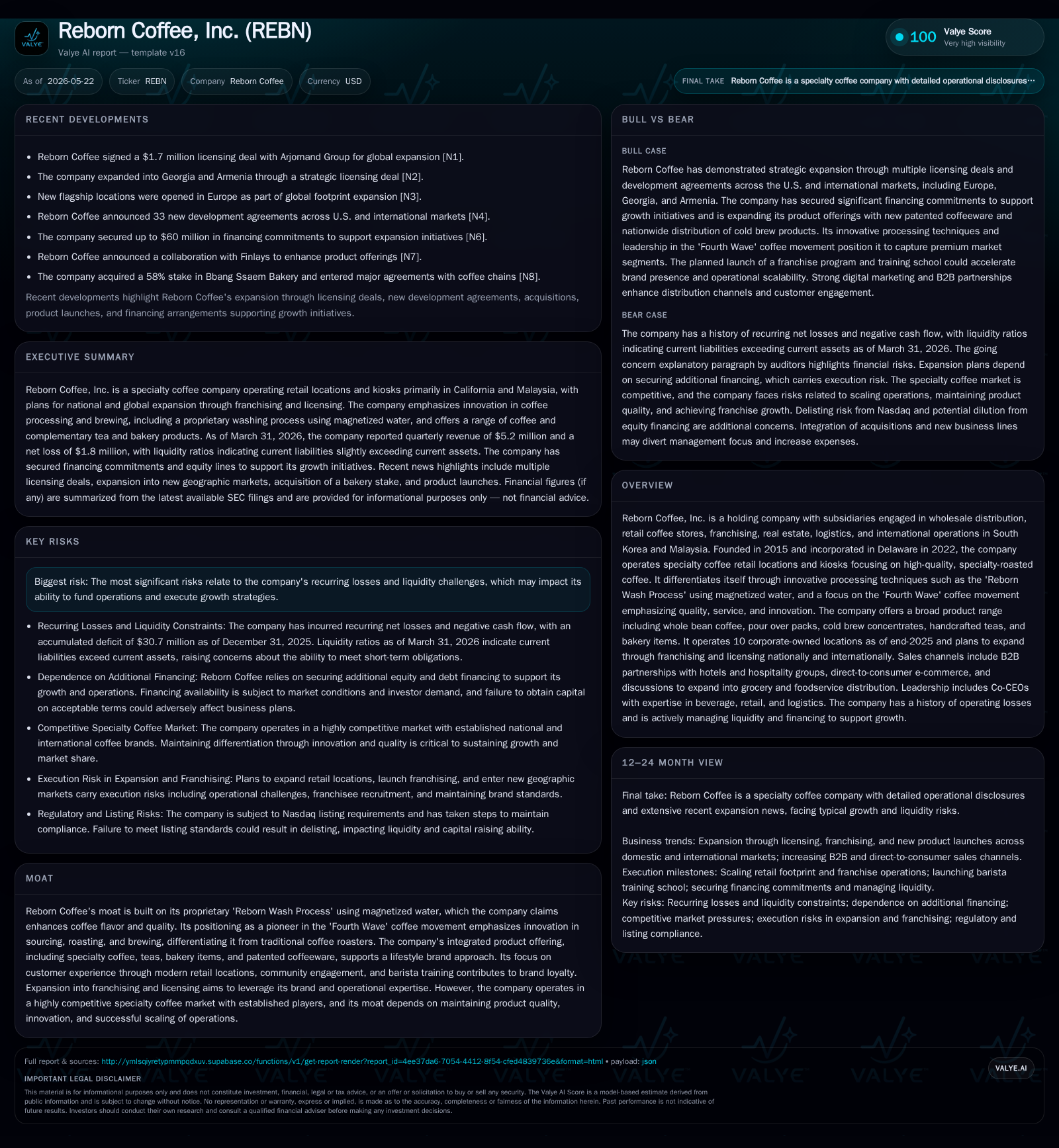
In its most recent quarterly filing, Reborn Coffee, Inc. secured private placement proceeds to enhance flagship store expansion, brand development, and multi-channel distribution. This injection supports scaling ambitions amidst a challenging cash-flow and liquidity landscape marked by recurring losses and a current ratio below one. The company’s proprietary 'Reborn Wash Process' and alignment with the ‘Fourth Wave’ coffee movement underpin its differentiated product offering across wholesale, retail, franchising, and international operations. However, substantial profitability pressures and a narrow capital runway frame near-term execution risks. Upcoming milestones center on successful franchise launches, market penetration, and access to additional financing to sustain growth momentum.
Latest Quarterly Developments and their Strategic Implications
Reborn Coffee’s May 22, 2026 quarterly filing anchors the near-term operating picture with key developments around a private placement that raised material proceeds targeted towards expanding corporate-owned flagship stores in select metropolitan markets [S2][S3]. The proceeds also underwrite investments in supply chain capabilities aimed at lifting operational efficiency and scaling capacity across the platform.
Importantly, these capital raises build on earlier debt restructuring measures that included a forbearance agreement with convertible debenture holders (Arena Investors) stipulating scheduled repayments through September 30, 2026 [S4]. This structured plan mitigates immediate default risk but underscores the constrained liquidity environment the company operates within.
These developments collectively signal a strategic prioritization to bridge short-term financial stability while advancing growth ambitions through expanded physical presence and franchising/licensing efforts. The direct impact on operational flexibility is notable given the need to preserve cash amid recurring operating losses.
Reborn Coffee’s Business Model and Product Differentiation
Reborn Coffee functions as a holding entity with subsidiaries actively engaged across multiple facets of specialty coffee through wholesale distribution channels and retail operations that primarily target high-quality specialty-roasted coffee products. Its footprint includes ten corporate-owned store locations as of end-2025 with plans to expand both domestically and internationally via franchising/licensing streams [S1]
The company’s revenue mix is diverse: it derives income from wholesale contracts supplying hotels (including bespoke gift sets enhancing B2B relationships), retail store sales of beverages (coffee/tea/cold brew concentrates), packaged goods (whole bean coffee, pour over packs), bakery items, and patented coffeeware which incorporate its hallmark innovation—the proprietary 'Reborn Wash Process'—a magnetized water technique claimed to elevate flavor profiles distinctly aligned with Fourth Wave coffee ethos emphasizing freshness, quality sourcing, innovative roasting methods and superior brewing techniques [S1][F1]
Additionally, Reborn owns Reborn Logistics which provides trucking and transportation services contributing operational synergies supporting internal supply chain needs — a relatively uncommon vertical integration path within specialty coffee firms that can enhance control over distribution speed and cost efficiency.
On the consumer front, community engagement strategies involving co-marketing events (e.g., yoga sessions with Lululemon) help strengthen brand affinity consistent with a lifestyle orientation rather than purely transactional interactions [S1]. These tactics underpin customer retention amid a fragmented specialty market.
Industry Positioning within Specialty Coffee and Competitive Dynamics
Operating in the crowded specialty coffee segment involves challenging competitive dynamics where large incumbents possess scale advantages yet emerging brands differentiate on quality innovation and experiential retailing. Reborn’s proprietary ‘Reborn Wash Process’ positions it uniquely but must be buttressed by consistent quality delivery to prevent commoditization risk.
Geographically diverse operations spanning California domestic markets alongside nascent international ventures in South Korea (Daejeon) and Malaysia (Kuala Lumpur) reflect early globalization ambitions uncommon for similarly sized specialty chains but introduce complexities around managing regulatory environments, cultural preferences, branding consistency, and supply chain resilience internationally [S1].
The competitive set includes established roasters emphasizing “Third Wave” / “Fourth Wave” concepts who command loyal consumers yet face challenges such as price sensitivity given premium positioning. Reborn's multi-channel approach—corporate stores plus franchising/licensing—is essential to scale but demands robust franchisee recruitment capability alongside control systems to safeguard brand standards.
Customer switching costs within specialty coffees tend to be moderate; thus sustained innovation pipeline updates remain critical along with compelling service experience at retail points; these elements constitute structural barriers when executed effectively.
Growth Drivers: Innovation, Franchising, and Geographic Expansion
Reborn’s primary growth levers involve leveraging proprietary innovations like the magnetized water wash process to underpin premium pricing strategies while expanding physical footprints through company-owned flagships complemented by franchising/licenses designed to accelerate national/international footprint growth [S3][S1]
Franchise adoption remains at an embryonic stage with no franchisees reported as of December 31, 2025 but represents significant potential upside if execution risks are managed conservatively [S1]. The introduction of logistics capabilities via Reborn Logistics also aims at operational scalability underpinning faster supply delivery cycles which can support rapid network expansion
Further diversification into B2B channels such as hotel partnerships—providing pour-over packs or cold brew offerings—and planned entry into grocery retail spaces via kiosks addresses volume growth objectives while broadening consumer access beyond traditional café formats [S1]
Altogether these vectors align well with fourth wave principles emphasizing product quality innovation combined with flexible distribution aligned toward both lifestyle branding customers and enterprise buyers.
Risks and Constraints: Profitability, Liquidity, and Market Competition
Despite strategic initiatives targeting growth trajectories, Reborn carries significant financial headwinds that constrain near-term flexibility. The company posted a net loss of $9.1 million for fiscal year 2025 on revenues of approximately $8.1 million highlighting ongoing negative operating leverage trends [F1]. Accumulated deficit totals $30.7 million reinforcing legacy earnings pressures [S1].
Liquidity remains tight with cash & equivalents at $266K against current liabilities of $8.8 million yielding a current ratio below one at approximately 0.89—a metric signaling short-term funding risk without successful external capitalization or improved cash flow from operations [F1]. Total debt stands at $500K balanced partially by recent equity raises but underscores leverage constraints especially given obligations tied to convertible debentures requiring structured repayments scheduled through Q3 2026 [F1][S4][S5].
Moreover, industry conditions intensify competition-driven pressure on margins given price-sensitive specialty consumers balancing between convenience channels versus premium experience seeking behaviors [S10][S22]. The risk narrative explicitly references evolving consumer preferences that may adversely affect product acceptance especially if price adjustments are necessary owing to input cost inflation or operational scaling burdens.
Regulatory compliance demands driven by data privacy laws add incremental complexity around marketing data capture essential for customer targeting compounding administrative overhead in an already resource-constrained environment [S22]. Lastly the dependence on capital markets access represents a material execution watchpoint given market volatility could impact funding availability [S4][S5].
Investor Watchpoints: Upcoming Milestones and Financing
Key metrics warrant close monitoring going forward including successful recruitment of franchised operators translating into open locations contributing revenue streams beyond corporate stores. Same-store sales trends at flagship stores will give signals about customer retention effectiveness amidst price/mix changes.
Marketing initiatives aiming at strengthening brand resonance particularly in nascent international markets – South Korea and Malaysia – demand validation through sales lift or broader brand awareness measurements.
Equally important is timeline clarity regarding next tranches of equity or debt financing above the structured repayments due by September 2026; failure to secure sufficient timely capital could impede expansion plans or necessitate cutbacks compromising brand positioning or store count goals.
Execution here acts as a barometer for whether Reborn can convert its unique product proposition into sustainable commercial momentum under persistent financial constraints [S3][S2][S1].
Concise Financial Overview: Current Capital Structure and Performance
As of March 31, 2026 balance sheet data reports cash & equivalents near $266K against total debt approximating $500K resulting in net debt close to $234K indicating moderate leverage despite recent capital infusions [F1]. Current assets stand at about $7.8 million versus current liabilities nearing $8.8 million creating liquidity pressure described quantitatively by a sub-1 current ratio (~0.89) [F1].
Operating results retain substantial negativity with net loss around $9.14 million for fiscal year ended December 31, 2025 underscoring negative earnings momentum reflected in accumulated deficit near $30.7 million and unsuitable cash flows from operating activities delaying self-sustaining free cash flow generation prospects [F1][S4][S8]
Recent arrangements like amended forbearance agreements for convertible debentures set clear short-term repayment schedules aiding default risk mitigation but highlight dependency on equity raises evidenced by private placements aggregating several million dollars intended to underpin working capital needs while fueling growth projects during this stressed cycle [S2][S4][S3]. Longer term viability hinges on transitioning from cash consumption phase into positive operating leverage regimes driven by higher-margin franchising revenue streams coupled with operational efficiencies supported by logistics integration.
Disclaimer: This analysis is based solely on public filings up through May 22, 2026 and does not constitute investment advice or research views.
Disclaimer: This is research-only, informational analysis and not investment advice. It may include AI-generated interpretation and general industry context. Always verify important details using primary sources.

Comments