
Carrier Global's Strategic Pivot: Navigating Innovation and Macroeconomic Hurdles in Climate Solutions
Carrier Global reshaped its portfolio toward focused climate leadership amid mixed Q4 results, leveraging innovation and global reach to address evolving market dynamics.
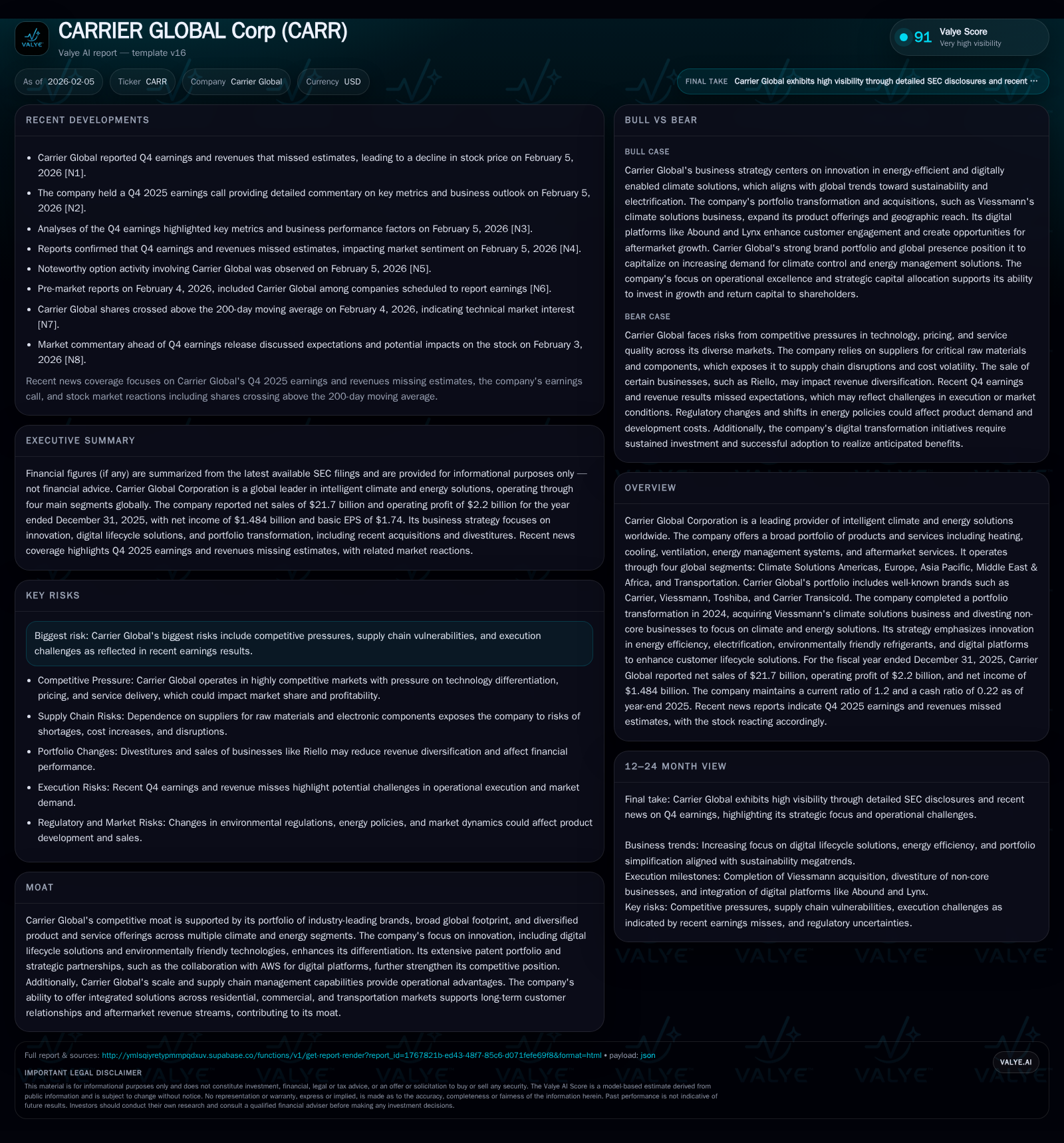
Carrier Global completed a decisive portfolio transformation in 2024, acquiring Viessmann’s climate business and divesting non-core units to become a pure-play climate and energy solutions leader. Despite a fourth-quarter earnings miss in 2025, the company’s innovation in digital lifecycle platforms and commitment to sustainability underpin its long-term growth thesis. Carrier’s four regional segments enable focused customer engagement globally while navigating supply chain and macroeconomic headwinds. Its competitive moat is fortified by strong brands, extensive patents, strategic partnerships, and recurring aftermarket revenues.
Carrier’s Portfolio Realignment: From Diversification to Focused Climate Leadership
In early 2024, Carrier Global executed one of its most consequential strategic moves since becoming independent post-UTC separation: the acquisition of Viessmann's climate solutions business coupled with systematic divestitures of non-core units including fire & security businesses and commercial refrigeration. This repositioned Carrier squarely into a pure-play climate and energy solutions provider [S1]. The acquisition of Viessmann added a premier European heating, ventilation, and air conditioning (HVAC) portfolio — significantly broadening Carrier’s global footprint while enriching its product offerings with sustainable building technologies.
This streamlining reflects an acknowledgment of increasing secular momentum behind electrification, digitalization, and environmental stewardship. By shedding legacy businesses outside its core expertise, Carrier sharpened operational focus around climate-related solutions vital for homes, commercial buildings, and cold chain transportation.
Moreover, post-transaction segment reorganization rationalized the reportable segments into three regional HVAC hubs alongside the Transportation segment. This restructuring fosters accountability through discrete management teams aligned with specific geographies’ distinct customer needs and regulatory environments [S1]. The organizational clarity supports agile resource allocation necessary amidst rapid technological shifts.
Decoding Q4 2025: Earnings Miss and Market Reaction
The Q4 2025 earnings release revealed an undeniable friction between transformative strategy execution and persistent macroeconomic challenges. Both earnings per share and revenue figures fell short of consensus expectations [N1][N4]. The earnings call transcript sheds light on key pressure points: supply chain disruptions constraining component availability; inflationary cost burdens despite price increases; mixed demand patterns amid global economic softness; plus increased investments in innovation diluting near-term margins [N2].
Market reaction was swift—with share prices reacting negatively on the announcement day reflecting short-term investor caution [N1]. However, management emphasized that these headwinds are largely transient. Strategic initiatives launched in prior years—especially those tied to digital platform rollouts and sustainability-driven products—remain intact. Hence the earnings disappointment should be contextualized as a pause during an active investment cycle rather than an indication of fundamental deterioration.
Four Regional Segments Driving Global Reach and Customer-Centricity
Post-transformation reporting divides Carrier's operations into Climate Solutions Americas; Europe; Asia Pacific, Middle East & Africa (APAC & MEA); plus Transportation — geographic segments with dedicated management teams reporting directly to executive leadership [S1]. Each reflects divergent market dynamics:
- Americas: Heavyweight in new equipment sales with a robust aftermarket services ecosystem.
- Europe: Strong integration of Viessmann product lines focusing on residential/light commercial innovation.
- APAC & MEA: Fast-growing but heterogeneous markets balancing emerging infrastructure needs with rising electrification trends.
- Transportation: Specialized cold chain refrigeration supporting food safety globally.
This architecture allows tailoring go-to-market approaches according to regional regulations (e.g., EU decarbonization mandates), customer preferences (urban density models in Asia vs. single-family home predominance in the U.S.), and competitive landscapes. It also diversifies macroeconomic risk exposures across continents.
Innovation at the Core: Digital Lifecycle and Energy Management Breakthroughs
Carrier leverages strategic partnerships—most notably with AWS—to accelerate cloud-native digital lifecycle management solutions that embed intelligence throughout equipment operation [S1][N2]. These platforms promise to capture data streams from installed bases globally enabling predictive maintenance services which boost aftermarket revenue stability while enhancing customer satisfaction.
Simultaneously, Carrier Energy initiatives develop intelligent energy management systems that optimize home energy use through grid interaction capabilities. Such technologies align with utilities' grid flexibility needs fostering synergistic relationships beyond simple hardware sales. This digitally-enabled lifecycle approach differentiates Carrier from competitors offering primarily transactional product sales.
Sustainability and Electrification Trends Fueling Strategic Initiatives
Acute regulatory pressures worldwide for reduced greenhouse gas emissions propel carrier's push into environmentally friendly refrigerants that comply with evolving standards such as Kigali Amendment frameworks [S1]. Electrification of HVAC systems further reduces carbon footprints replacing legacy fossil fuel-based heaters.
Product development focuses intensively on energy efficiency improvements alongside CO2 refrigerant adoption which represents both compliance necessity and market opportunity due to rising corporate ESG concerns among customers particularly in commercial real estate sectors.
Navigating Supply Chain, Tariffs, and Macroeconomic Headwinds
Carrier's operations remain susceptible to ongoing supply chain complexity exacerbated by geopolitical tensions affecting key component access [S1][N2]. However, proactive supply chain reconfiguration plus approximately $200 million incremental pricing actions implemented across 2025 successfully offset tariff impacts preventing material erosion in gross margin [S1].
Inflationary pressures persist but are partially tempered through productivity initiatives that include automation investments enabled by digital transformation strategies. Currency fluctuations present an additional challenge mitigated via hedging programs embedded in financial risk frameworks.
Competitive Moat Analysis: Brands, Partnerships, and Aftermarket Revenues
The company’s moat derives from multiple interlocking facets:
- Historic brand power from names like Carrier itself alongside newly integrated high-quality Viessmann enhances trust in residential/commercial clientele [S1].
- Extensive patent portfolios provide intellectual property protection supporting ongoing product differentiation.
- A collaborative relationship with AWS accelerates internal innovation capacity expanding digitalized service offerings more efficiently than many peers.
- Scale economies from global manufacturing footprint underpin competitive cost structures while steady aftermarket parts & service revenues generate recurring cash flow streams that stabilize business cyclicality.
Together these elements fortify Carrier’s positioning within tightly contested climate technology markets increasingly driven by sustainability imperatives.
Risks in an Evolving Market Landscape: Execution and External Pressures
Despite strengths, risks are nontrivial [S1][N1]:
- Integration risk persists from recent acquisitions alongside complexities divesting former core segments potentially distracting management focus.
- Macro volatility stemming from inflation spikes or economic slowdowns threatens installation volumes central to new equipment sales.
- Cybersecurity remains a high-stakes vulnerability given growing operational technology digitization requiring substantial ongoing investment to mitigate breaches that could disrupt services or damage reputation.
- Labor relations dynamics could impact manufacturing continuity or inflate compensation costs amid tight industrial markets.
- Raw material price swings or trade policy shifts could abruptly raise input costs challenging margin preservation even as pricing power attempts to keep pace.
Financial Health Snapshot: Capital Structure, Profitability, and Liquidity
Fiscal 2025 showed solid financial footing underpinning strategic investments [F1][S1]:
- Net income totaled $1.48 billion reflecting resilience despite margin pressures.
- Operating profit reached about $2.2 billion founded on price discipline plus productivity enhancements.
- Cash & equivalents approximated $1.55 billion supporting liquidity for capital expenditures including R&D ramp-up for next-gen sustainable products.
- Current ratio near 1.2 evidences reasonable short-term asset-to-liability coverage signaling effective working capital management amidst economic uncertainties.
These metrics collectively portray a balance sheet robust enough to sustain ongoing portfolio refinement efforts essential for long-run competitiveness.
Outlook: Positioned to Harness Urbanization and Digitalization Mega-Trends
Looking ahead, Carrier is strategically aligned to capitalize on pervasive mega-trends shaping urban landscapes worldwide [S1][N7]. Expansion of dense urban populations drives increased demand for reliable indoor environmental control solutions targeting energy efficiency hence sustainability compliance. Concurrently accelerated digital transformation within buildings enables embedded intelligence fostering new revenue avenues via service contracts beyond conventional hardware sales.
Management’s focus on innovation-led growth combined with geographic diversification mitigates concentrated regional downturn exposures while fostering cross-segment synergies. Execution risks remain but measured capital allocation towards scalable clean technologies and lifecycle software platforms form the bedrock for enduring competitive advantage amid shifting industry paradigms.
This analysis is intended solely for informational purposes reflecting data available as of February 2026. It does not constitute investment advice or recommendations regarding any securities or companies discussed herein.
Disclaimer: This is research-only, informational analysis and not investment advice. It may include AI-generated interpretation and general industry context. Always verify important details using primary sources.

Comments