
Chubb Ltd Strengthens Underwriting Profits and Liquidity Amid Global Insurance Market Challenges
The latest quarter reveals improved underwriting performance and robust cash flows supporting Chubb's diversified global insurance operations.
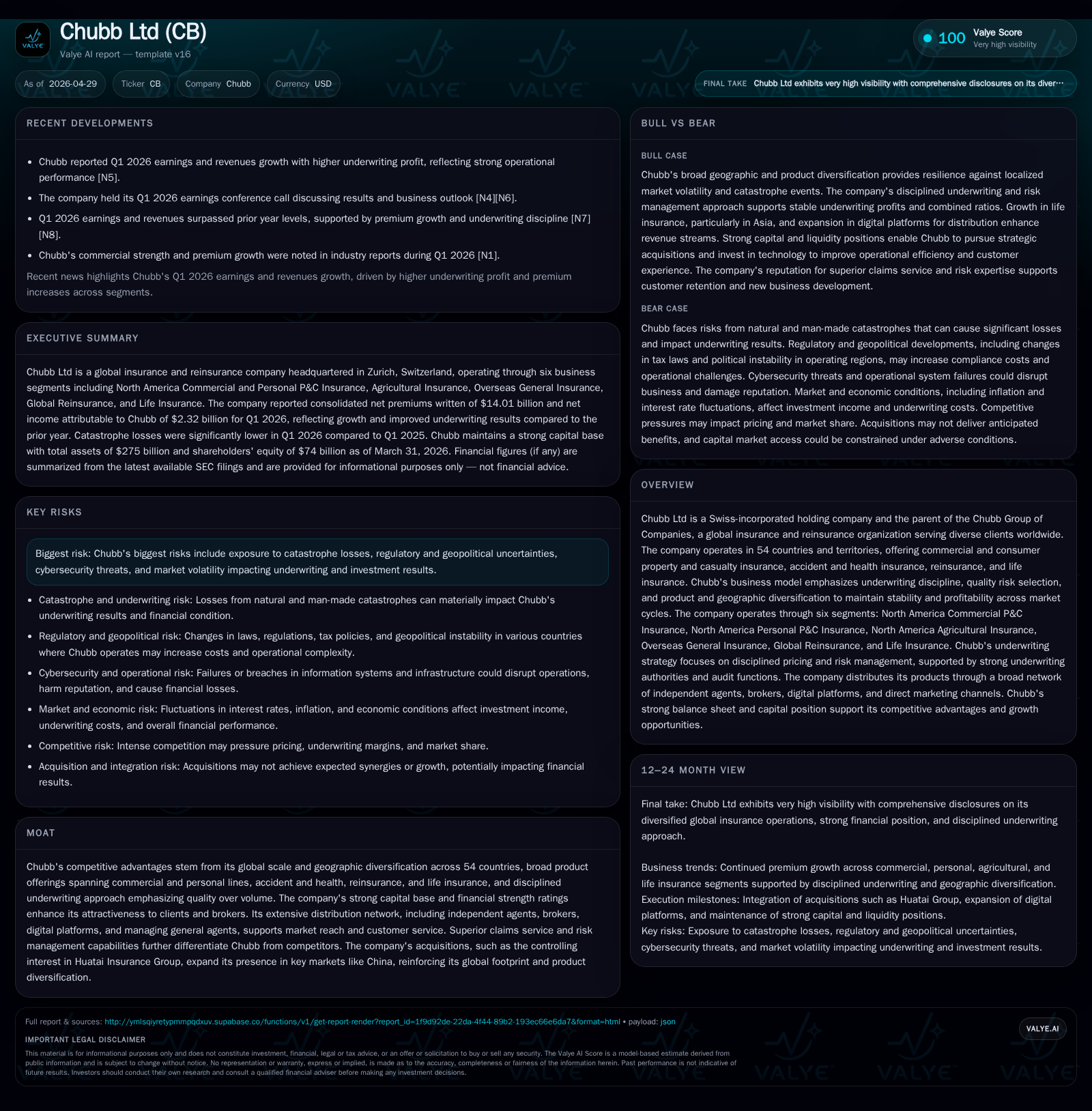
Chubb Ltd's Q1 2026 results show higher net premiums and underwriting income driven by disciplined pricing and risk selection across its diversified lines, supported by strong investment income. Operating cash flows surged, bolstering liquidity to comfortably cover expected losses. The company's global footprint and multi-product platform underpin its resilience, although catastrophe exposure and regulatory complexities remain pertinent risks. Monitoring premium momentum, claims trends, geographic mix, and regulatory developments will be key in assessing ongoing performance.
Recent Operating Update
Chubb Ltd reported its Q1 2026 results in the April 28 filing [S2], highlighting an increase in operating cash flow to $3.9 billion compared to $1.6 billion year over year. This uplift was primarily due to higher net premiums collected during disciplined underwriting combined with lower claims payouts during the period. Net investment income also rose to approximately $1.7 billion, boosted by gains in fixed maturity securities and private equity holdings despite a modest decline in other interest revenues.
Dividend payouts remained consistent with the prior quarter at $0.97 per common share [S2]. Management anticipates that positive cash flows from operations (underwriting activities and investment income) should be sufficient to cover cash outflows under most loss scenarios for the near term [S2].
Total debt amounted to nearly $16 billion with an estimated net debt of $13.7 billion after considering cash reserves as of March 31, 2026 [F1]. Notably, the company guarantees several senior notes issued by Chubb INA Holdings LLC across maturities through 2038 [S3], underscoring financial interdependence within its group structure.
Business Model
Chubb operates as a major global property and casualty (P&C) insurer backed by comprehensive accident & health (A&H), reinsurance, and life insurance capabilities [S1]. The company generates revenue primarily through premiums earned on insurance policies underwritten worldwide. Its business model prioritizes stringent underwriting discipline — focusing on rigorously selected risks priced consistently to build a stable and profitable portfolio rather than chasing market share via volume alone.
Revenue mechanics center on premium pricing aligned with assessed risk profiles across diverse products: commercial lines (covering complex liability exposures), personal lines (homeowners, auto), specialty casualty (aviation, energy sectors), agricultural insurance in North America, overseas general insurance operations across multiple countries, global reinsurance treaties supporting broader risk transfer needs, and life insurance products targeting select markets particularly in Asia post-acquisition of Cigna's Asian businesses.
Margin drivers include loss ratio management enabled by robust claims adjudication expertise and risk mitigation services such as loss control programs. Expense efficiency benefits from scale economies within operating segments spread geographically while maintaining localized underwriting authority through clear governance frameworks including global product boards overseeing consistency of approach. The firm's investment function also contributes meaningful income predominantly from high-quality fixed income securities supplemented by equity interests.
Customer payment behavior is predominantly contractually recurrent premiums with renewal dynamics critical to maintaining booked revenue trajectories. Distribution works through a broad network encompassing independent agents, brokers specialized managing general agents (MGAs), digital sales platforms enhancing accessibility especially in personal lines, and direct corporate client engagement for large accounts.
Industry Structure and Competitive Position
The global P&C industry is highly competitive but benefits from significant barriers tied to capital requirements, regulatory approvals, brand trustworthiness, underwriting expertise breadth, and claim servicing quality — all areas where Chubb asserts strong positioning. Its operations span developed markets alongside emerging economies providing geographical diversification that cushions against localized adverse events or policy changes.
Its product breadth differentiates it from niche competitors focused solely on specialty lines or geographies; meanwhile integrated accident & health plus life offerings provide cross-selling opportunities enhancing client retention.
The company's reputation for superior claims service is a recognized moat fostering customer loyalty — a critical factor given the commoditized nature of standard insurance coverage elsewhere.
The acquisition of Huatai Insurance Group widened Chubb’s Asia presence notably in China where demand for diversified insurance solutions is evolving rapidly [S1]. This strategic expansion complements organic growth prospects within existing markets.
Growth Drivers
- Geographic Expansion: Emerging markets exposure particularly via Huatai acquisition taps growing middle-class insurance demand with rising awareness of protection products.
- Product Diversification: Extension into life, accident & health products alongside core P&C offerings caters to comprehensive customer risk management needs.
- Underwriting Discipline: Maintaining pricing power through rigorous risk evaluation counters inflationary pressure on claims costs while preserving profitability stability.
- Digital Initiatives: Investment in technology platforms enhances customer experience through streamlined policy issuance and claims processing accelerating servicing speed.
- Distribution Network Strengthening: Expansion of broker relationships and MGAs increases access to specialized business segments that require tailored coverage solutions.
- Investment Income Enhancement: Active portfolio management targeting high-quality fixed income plus selective equity stakes generating incremental returns supporting overall earnings mix.
Risks / Watchpoints / Growth Constraints
- Catastrophe Exposure: Natural disasters cause unpredictable claim surges impacting combined ratios sharply; while reinsurance mitigates some impact it remains a key volatility source.
- Regulatory Environment: Operating under multiple jurisdictional regimes involves complex compliance burdens; evolving regulation including solvency standards could limit operational flexibility or raise capital costs.
- Cybersecurity Threats: Increasing reliance on digital infrastructure heightens vulnerability to attacks potentially disrupting business continuity or compromising data integrity.
- Macroeconomic Influences: Inflation escalates claim severity; interest rate fluctuations affect investment yields; geopolitical instability influences international operations particularly in developing regions.
- Competition Intensity: Price competition from regional and global insurers could pressure underwriting margins if Chubb relaxes discipline.
- Acquisition Execution Risk: Integration challenges post-Huatai purchase may delay synergy realization or introduce operational inefficiencies.
What to Watch Next
Key milestones include quarterly premium renewal rates signaling retention strength amid competitive conditions; trend analysis of loss ratios illuminating claims environment stability; updates on catastrophe event impacts; quarterly investment portfolio performance including any mark-to-market volatility; regulatory changes especially in high-growth jurisdictions like China; operational progress integrating Huatai's subsidiaries further into Chubb’s global framework; ongoing enhancements of digital channels affecting retail segment penetration; impact of currency fluctuations on earnings mix as international business grows; disclosures around cyber risk management effectiveness.
Guidance updates if explicitly provided will offer directional clarity on expected underwriting margins or earnings forecasts beyond Q1 results currently highlighted.
Financial Profile Summary
Chubb's liquidity profile is supported by substantial operating cash flow surge to $3.9 billion in Q1 2026 from $1.6 billion year-over-year due mainly to premium collection improvement coupled with better loss payout timing [S2]. Net investment income advanced moderately benefiting from increased holdings in fixed maturities ($1.56 billion earnings) plus gains in private equities [$39 million] supporting overall profitability.
Shares paid dividends consistently at $0.97 per quarter maintaining shareholder distributions without disruption indicating stable cash availability [S2]. Total debt registers at nearly $16 billion with net debt approximated at $13.7 billion given offsetting cash balances as of March 31, 2026 [F1].
Overall capital resources underpin the firm’s ability to absorb shocks stemming from catastrophe losses or market turbulence without immediate liquidity stress helping maintain strong financial strength ratings beneficial for competitive positioning.
This analysis is based on publicly available filings and does not constitute investment advice. Readers should conduct additional due diligence before making any financial decisions regarding Chubb Ltd.
Disclaimer: This is research-only, informational analysis and not investment advice. It may include AI-generated interpretation and general industry context. Always verify important details using primary sources.

Comments