
Cumulus Media Inc Faces Chapter 11 Restructuring Amid Declining Revenue and Digital Shift
The latest quarterly filing highlights revenue declines and restructuring efforts shaping Cumulus Media’s path forward in a competitive broadcast landscape.
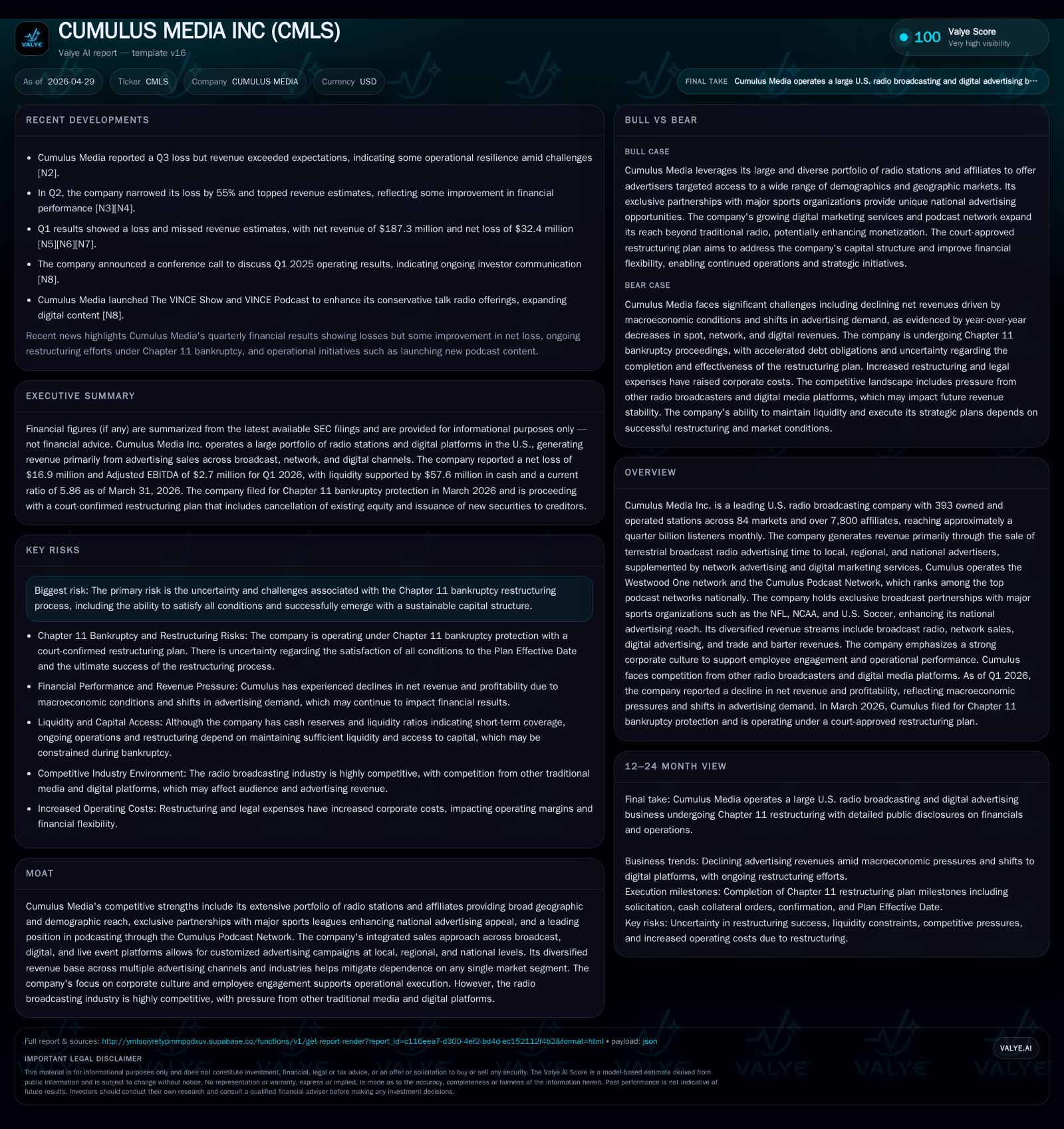
In its Q1 2026 filing, Cumulus Media reported a 12.2% revenue decline driven by macroeconomic headwinds impacting traditional spot and network advertising, compounded by softness in digital podcasting and streaming revenues. The company is operating under Chapter 11 bankruptcy protection as it executes a court-approved restructuring plan that will wipe out existing equity and significantly alter its capital structure. Despite scale advantages including broad station ownership and exclusive sports partnerships, the firm faces structural challenges from evolving media consumption habits and intensifying digital competition. Management is focused on cost reductions, leveraging diversified ad channels, and emerging with an amended balance sheet to pursue growth. Key risk remains execution of the restructuring plan along with stabilizing revenue trends across its terrestrial and digital platforms.
Recent Operating Update
Cumulus Media’s most recent quarterly report for Q1 2026 [S2],[S25] underscores significant near-term challenges amidst an ongoing Chapter 11 restructuring process initiated in early March 2026. The company reported net revenue of $164.4 million for the quarter ended March 31, 2026—a steep decline of 12.2% year-over-year—largely attributed to reductions in both spot and network advertising revenues totaling a combined $24.1 million decline during challenging macroeconomic conditions. Digital revenue also suffered a $3 million drop due primarily to decreases in podcasting and streaming income; however, this was partially offset by higher revenues from local digital marketing services such as geo-targeted ads and social media management.
Cost wise, content expenses were down nearly 17%, benefiting from renegotiated broadcast rights contracts, lower third-party station costs, and workforce reductions reflective of management’s cost containment initiatives during the bankruptcy period. Despite these savings, operating loss expanded sharply to $26.4 million from $14.8 million last year’s same quarter, while adjusted EBITDA declined by almost one quarter to $2.7 million, highlighting pressure on core profitability.
Corporate expenses skyrocketed nearly 96%, driven by non-recurring reorganization expenses associated with Chapter 11 proceedings—including legal fees and professional costs—which are expected given the complex financial restructuring underway.
Business Model Overview
Cumulus Media operates as one of the largest radio broadcasting companies in the U.S., owning or operating approximately 393 terrestrial radio stations across 84 markets plus maintaining more than 7,800 affiliates reaching roughly a quarter billion listeners monthly [S1]. Its primary revenue source remains the sale of terrestrial broadcast advertising slots sold locally, regionally, and nationally to a wide range of advertisers including automotive, entertainment, retail, financial services, telecommunications, restaurants, and professional sectors.
Complementing traditional broadcast sales is Cumulus' network sales via its Westwood One division providing syndicated programming alongside an expanding portfolio in digital marketing services encompassing email marketing campaigns, geo-targeted display/video ads, SEO/SEM solutions, reputation/review management software bundles and website hosting geared toward local businesses [S1]. Additionally, its Cumulus Podcast Network stands as one of the top national podcast operators offering advertisers national reach through highly targeted audio content.
Strategically important are exclusive sports broadcasting partnerships with high-profile organizations such as NFL games, NCAA events, and U.S. Soccer matches that add premium inventory for national advertisers seeking broad demographic reach coupled with engaged audiences.
Industry Structure & Competitive Position
The U.S. radio broadcasting industry remains highly fragmented yet fiercely competitive not only amongst legacy broadcasters but also increasingly competing against pure digital audio platforms like Spotify, Pandora (iHeartMedia), Apple Podcasts, YouTube audio streams and live streaming video platforms offering alternate advertising opportunities. Radio's traditionally strongholds in local markets are fading somewhat as consumer listening habits pivot towards on-demand digital audio or video content accessible on smart devices.
However, secular trends challenge Cumulus’ legacy terrestrial model especially among younger demographics shifting away from radio towards mobile-first streaming audio experiences limiting future growth potential on traditional channels despite stable core audience segments.
Growth Drivers
- Digital Marketing Services Expansion: Cumulus has increasingly pushed local digital marketing product suites designed for small-to-medium businesses requiring integrated digital presence management beyond simple radio spots—the steady expansion of these offerings may cushion declines in traditional ad sales if effectively executed.
- Podcast Network Scale: Being among top podcast networks nationally provides access to growing podcast advertising budgets if platform monetization can accelerate through advanced ad targeting technologies and client acquisition strategies.
- Sports Broadcast Partnerships: Maintaining exclusivity with major sports properties fuels national advertising deals supporting premium pricing power outside commoditized local spots.
- Cost Reductions & Operational Efficiency: Bankruptcy-driven restructuring enables cost base rationalization including lease rejections approved by courts removes unprofitable overhead burden enhancing operating leverage potential post-restructuring.
- Emergence From Chapter 11: The planned balance sheet deleveraging through cancellation of old equity combined with issuance of new convertible notes strengthens financial flexibility critical to invest selectively into growth initiatives without overhang from excessive debt service obligations.
Risks & Watchpoints
- Chapter 11 Outcome: The single largest risk centers on timely completion of the court-confirmed restructuring plan that extinguishes old shares while converting much debt into reorganized equity stakes; any failure or delays could imperil liquidity causing operational disruptions or creditor disputes [S2,S19].
- Revenue Declines Persistency: Continued weakness in core spot/network ad sales exacerbated by macroeconomic uncertainty could prevent margin recovery despite cost savings realized up front.
- Digital Monetization Challenges: Losing ground or failing to gain sufficient market share within podcasts or advanced local digital services may further compress top-line growth prospects given accelerating industry shifts towards non-broadcast channels.
- Competitive Pressures: Larger integrated media companies (including iHeartMedia) benefit from scale combining broadcast assets alongside extensive digital platforms potentially crowding out mid-tier competitors like Cumulus.
- Regulatory Constraints: FCC licensing limitations restrict how aggressively market consolidation can occur or spectrum changes implemented slowing potential market repositioning post-restructuring.
- Audience Demographics & Behavior Shifts: Persistent migration away from linear radio consumption towards mobile on-demand content threatens long-term relevance absent innovation adoption converging traditional audio delivery methods with digital engagement tools.
What To Watch Next
- Progress milestones on restructuring plan implementation including issuance timing of new common stock and convertible notes scheduled under the March-confirmed Bankruptcy Court order remain critical near-term catalysts [S18,S19].
- Quarterly results following Q1 should be closely monitored for signs of stabilization or acceleration in total revenues especially within the digital segment reflecting management’s ability to offset terrestrial ad erosion.
- Updates on subscriber/listener metrics or relationships tied to key sports broadcast contracts could provide signals around sustaining premium advertiser demand amid tightening budgets.
- Cost rationalization outcomes including lease rejections or headcount changes influencing SG&A expense lines will indicate operational discipline measures effectively supporting margin improvement goals.
- Competitive positioning shifts such as partnership announcements or technology investments aimed at enhancing multi-platform integration would reveal strategic intent response addressing evolving consumer preferences across audio ecosystems.
Financial Profile Summary
Latest financial snapshot
| Metric | Value | Period |
|---|---|---|
| Cash & equivalents | $58mm | |
| 2026-03-31 | ||
| Current assets | $214mm | |
| 2026-03-31 | ||
| Current liabilities | $36mm | |
| 2026-03-31 | ||
| Current ratio | 5.86x | |
| 2026-03-31 |
Source: SEC companyfacts cache [F1].
Cumulus displays a stretched financial position shaped by legacy leverage amid restructuring efforts: As of March 31, 2026 there were approximately $213.8 million in current assets against just $36.5 million current liabilities yielding a robust current ratio near 5.86 which indicates short-term liquidity sufficiency [F1]. Cash reserves stood at about $57.6 million.[F1] However, the company continues to manage significant long-term indebtedness obligations under various term loans and senior notes partly addressed through Chapter 11 adjustments.
This analysis is based solely on data extracted from recent SEC filings through April 29, 2026 and does not incorporate any external information or projections beyond stated sources.
Disclaimer: This is research-only, informational analysis and not investment advice. It may include AI-generated interpretation and general industry context. Always verify important details using primary sources.

Comments