
ZenaTech Accelerates Global Expansion and Defense Innovation
The April 2026 quarterly update highlights ZenaTech’s strategic geographic growth, advanced defense drone projects, and key acquisitions fortifying its market leadership.
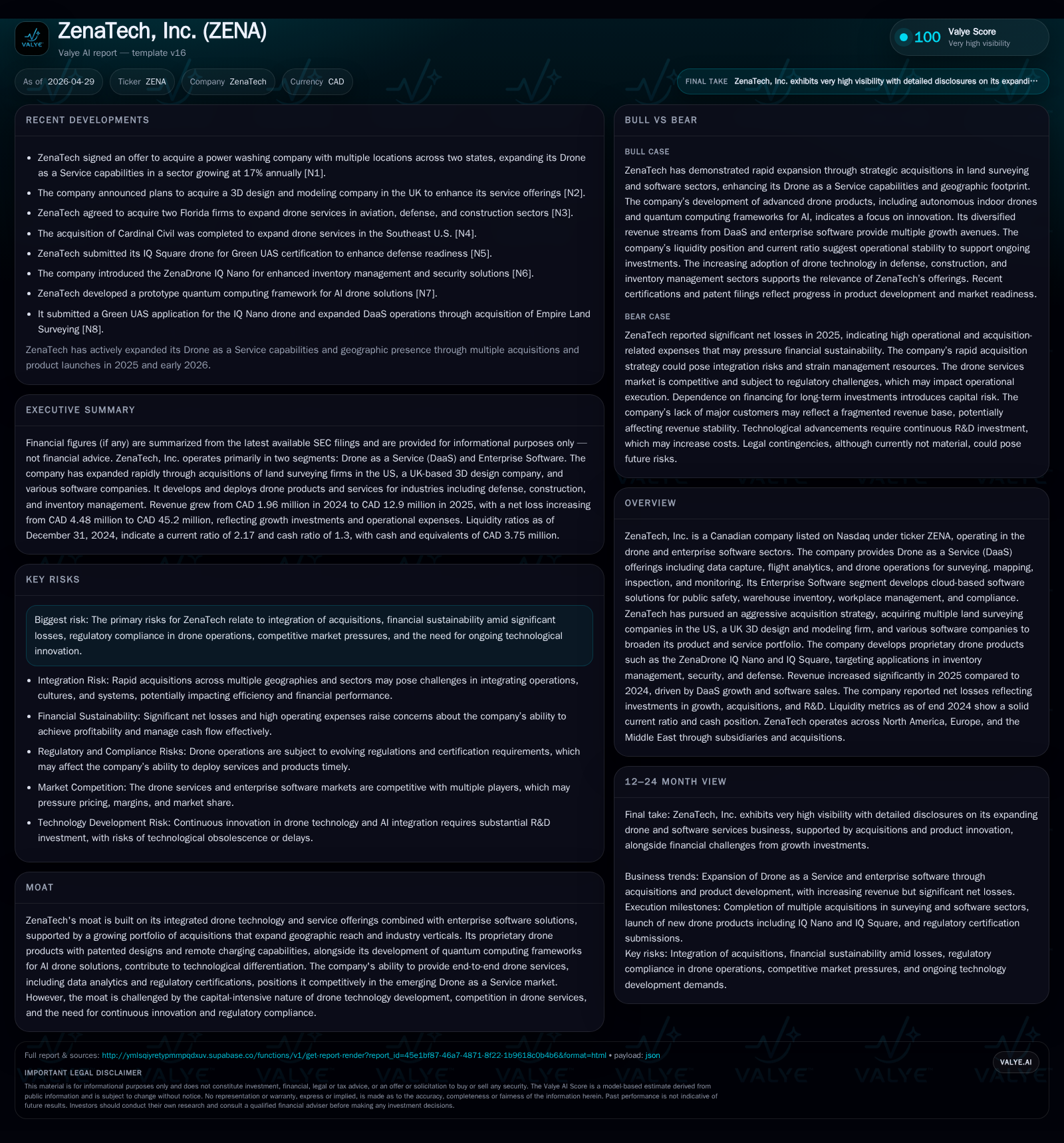
ZenaTech’s latest filings reveal aggressive expansion into Latin America via the DeskFlex software launch in Brazil and a strengthened partnership with HR leader Achieve Engagement. Meanwhile, the company advances its autonomous AI drone power washing platform and defense-focused maritime interceptor, enhancing its technology edge. Recent acquisitions of land surveying and enterprise software firms expand ZenaTech’s integrated Drone as a Service and SaaS portfolio, positioning it for accelerated multi-sector growth despite ongoing financial losses. The company maintains a strong liquidity position backed by equity raises and related-party credit lines but faces integration and regulatory execution risks.
Latest Operating Highlights: Market Expansion and Technology Progress
ZenaTech’s April 2026 quarterly Form 6-K filing underscores multiple parallel growth vectors reflecting purposeful scale-up across core business segments. The company launched its accessible workplace management software, DeskFlex, in Brazil marking its inaugural Latin American market entry — a critical step expanding beyond North America and European footholds [S2]. Complementing this regional expansion, Othership, ZenaTech's UK-based subsidiary specializing in collaborative workplace solutions, announced a partnership with Achieve Engagement, an HR industry leader aimed at delivering smarter workspace management platforms leveraging HR intelligence data [S2].
This dual move enhances the company’s enterprise software capabilities while broadening geographic presence.
On the Drone as a Service (DaaS) front, March filings detailed opening the 23rd global operational site in Orlando, Florida, strategically targeting increased contracts within government agencies [S3]. Such public sector alignment signals a stable demand base less sensitive to economic cycles. Additionally, ZenaTech advanced development on its autonomous AI drone power washing platform—a novel service automation solution—and unveiled progress on the defense-oriented ZenaDrone 2000 maritime interceptor designed as an affordable sea- and land-based asymmetric warfare system [S3]. These initiatives represent tangible innovations augmenting both commercial utility and defense sector relevancy.
Recent completed acquisitions bolstered capabilities further: the April acquisition of Andy Paris & Associates (Oregon-based land survey firm) for US$1.2 million integrates specialist expertise directly into DaaS operations; nearly concurrently, NOW Solutions was acquired to enhance government/public sector enterprise software offerings in human capital management (HCM) and ERP domains [S6]. Additional purchase agreements with Epazz-affiliated parties secured Provitrac HR software platform and K9 Sky drone assets expanding technology stack breadth [S6].
Comprehensive Business Model: Drone as a Service and Enterprise Software Integration
ZenaTech operates primarily through two differentiated yet complementary segments: Drone as a Service (DaaS) and Enterprise Software. The DaaS segment generates revenue via contract-driven field services—surveying, mapping, complex inspections—utilizing proprietary drones such as the ZenaDrone IQ series known for remote charging capability enabled by patented designs acquired from Epazz [S1]. These services typically involve government bodies, construction firms, land developers, utilities requiring precise geospatial data capture.
The company monetizes through usage-based service contracts combined with sales or leases of hardware platforms. This hybrid model allows recurring revenues from data analytics subscriptions or maintenance contracts alongside one-time hardware revenue inflows.
Enterprise Software addresses workforce scheduling/compliance challenges via cloud SaaS offerings like DeskFlex along with specialized HCM/ERP suites following strategic acquisitions like NOW Solutions [S6]. This segment targets corporate clients needing compliance tracking or remote workforce management tools increasingly vital post-pandemic.
Importantly, integration of DaaS data into enterprise platforms creates cross-selling synergies that can raise switching costs for customers relying on an end-to-end ecosystem connecting physical asset monitoring (via drones) to back-office analytics.
Competitive Edge Amid Industry Dynamics: Acquisitions and Proprietary Tech
ZenaTech’s competitive positioning is anchored on an acquisitive strategy dramatically extending geographic coverage—evident in multiple U.S. land surveying firm acquisitions across Oregon (Andy Paris), California (L.D. King Engineering), Washington state (Holt Surveying), Virginia (Cardinal Civil Resources), Florida (A&J Land Surveyor), and more during 2025-2026—as well as selective European ventures through UK entities like Othership and Casado Design Ltd. [S18,S22,S23].
Technologically, the company benefits from its patented drone innovations including design patents for increased lift payloads on its ZenaDrone 1000 series plus pioneering remote wireless charging technologies—a feature rare among peers that reduces operational downtime for continuous field deployments [S1,S8]. Concurrently, it invests in cutting-edge quantum computing frameworks powering AI navigation systems addressing GPS-denied environments critical for defense and tactical use cases; these high barriers to entry position ZenaTech distinctively relative to commoditized drone service providers reliant on generic hardware/software stacks [S3].
However, this moat demands ongoing capital allocation since drone R&D remains capital intensive with rapid innovation cycles. Meanwhile integration complexity amid continuous bolt-on acquisitions poses operational risks.
Key Growth Catalysts: Autonomous Systems, Geographic Penetration, and Software Solutions
Several measurable KPIs underpin near-term growth expectations:
- The addition of 23 global DaaS locations culminating with Orlando’s government agency-focused site expands addressable market access while diversifying client bases away from purely commercial sectors [S3].
- Launch of DeskFlex in Brazil represents initial LATAM entrance projected to tap growing demand for advanced workspace management solutions in emerging markets while Othership’s partnerships strengthen value propositions enhancing user adoption rates via HR industry alignment [S2].
- Autonomous AI systems development—such as drone-powered cleaning platforms—and the maritime interceptor prototype target differentiated high-margin niches within commercial maintenance and defense procurement respectively [S3].
These initiatives provide identifiable milestones correlating with bookings ramp-up and contract wins validating market penetration.
Risks and Constraints: Financial Sustainability, Acquisition Integration, and Regulatory Compliance
Despite fundamental opportunities, significant challenges persist:
- Financials reflect continuing steep net losses—increasing from CAD -4.48M in 2024 to CAD -45.2M in 2025 driven by heavy investment in acquisitions, product development expenses including amortization of loan fees as well as stock-based compensation—and finance costs particularly related to loan derivative expenses [F1,S5,S24]. This loss trajectory demands careful cash management.
- Governance disclosures note material weaknesses in internal controls over financial reporting pointing to potential reliability issues requiring remediation which may distract management focus or delay financial clarity [S1].
- Acquisition integration risk is non-trivial given twenty-one land surveying companies are now consolidated—with divergent cultures/systems needing alignment—as well as new acquisitions pending full operational assimilation including Andy Paris & Associates and NOW Solutions [S6,S18]. Failure here could erode margins or hamper service quality.
- Regulatory environment for drones especially autonomous defense-capable devices is rapidly evolving imposing certification hurdles that could delay commercialization timelines or increase compliance costs notably for the maritime interceptor platform targeting asymmetric warfare markets requiring stringent empirical validation [S3].
- Intense competition from both established aerospace manufacturers expanding into DaaS plus nimble startups offering customizable analytics challenges pricing power necessitating consistent technological leadership.
Monitoring Trajectory: Upcoming Milestones and Market Demand Indicators
Critical forward-looking execution points include:
- Successful integration progress indicators post-April 2026 acquisitions particularly Andy Paris & Associates examining revenue ramp contribution within DaaS divisions will be closely watched by analysts looking for evidence of accretive synergy realization [S6].
- Operational scale-up timelines for the ZenaDrone 2000 maritime interceptor program with early test results or contract awards from U.S./Allied defense entities would validate ambitious autonomous defense ambitions [S3].
- Rate of adoption metrics for DeskFlex across LATAM markets gauged via subscription numbers or renewal rates signal traction outside traditional North American bases underscoring international scalability potential [S2].
- Regulatory milestones such as approvals under BVLOS pilot programs or approvals related to quantum navigation tech integration can act as inflection points enabling broader commercial deployments.
- Further announcements around funding utilization sourced from ongoing ATM equity issuance will clarify capital deployment effectiveness fueling growth engines primarily acquisition pipeline versus organic R&D spend balance [S6,S15].
Stakeholders will benefit from vigilant tracking of these execution markers tied directly to measurable revenue recognition shifts or backlog expansions.
Condensed Financial Overview: Liquidity, Capital Structure, and Investment Implications
Despite aggressive expansion-driven losses reported at CAD -45.2 million for the year ended December 31, 2025 compared to CAD -4.48 million prior year indicating elevated cash consumption levels impacting net income margins significantly [F1,S5], ZenaTech maintains a broadly reassuring liquidity profile. As of December 31, 2024—the latest date with available official figures—the company held approximately CAD $3.75 million cash plus equivalents against minimal debt totaling CAD $152k resulting in a favorable net cash position around negative CAD $3.6 million net debt figure coupled with a healthy current ratio of about 2.17 suggesting solid short-term solvency capacity[F1].
However investment stakeholders should weigh that extended negative earnings generate persistent call on cash flows necessitating sustained access to external equity issuances or related-party debt backstops as evidenced by active ATM share offerings starting February 2026 designed to bolster working capital reserves alongside meeting corporate obligations amid scaling activities[S15]. Consequentially fiscal discipline surrounding capital allocation efficiency amidst rapid scale pursuit is essential.
Disclaimer: This analysis is provided solely for informational purposes without any express or implied investment advice or recommendations regarding securities mentioned herein. All information is based on publicly available SEC filings dated through April 29, 2026. Readers should perform their own due diligence before making any financial decisions.
Disclaimer: This is research-only, informational analysis and not investment advice. It may include AI-generated interpretation and general industry context. Always verify important details using primary sources.

Comments