
CBAK Energy Advances Sodium-Ion Production While Targeting African Battery Packs
CBAK Energy Technology pivots toward sodium-ion battery manufacturing and pack assembly for African EV infrastructure, balancing innovation with competitive pressures.
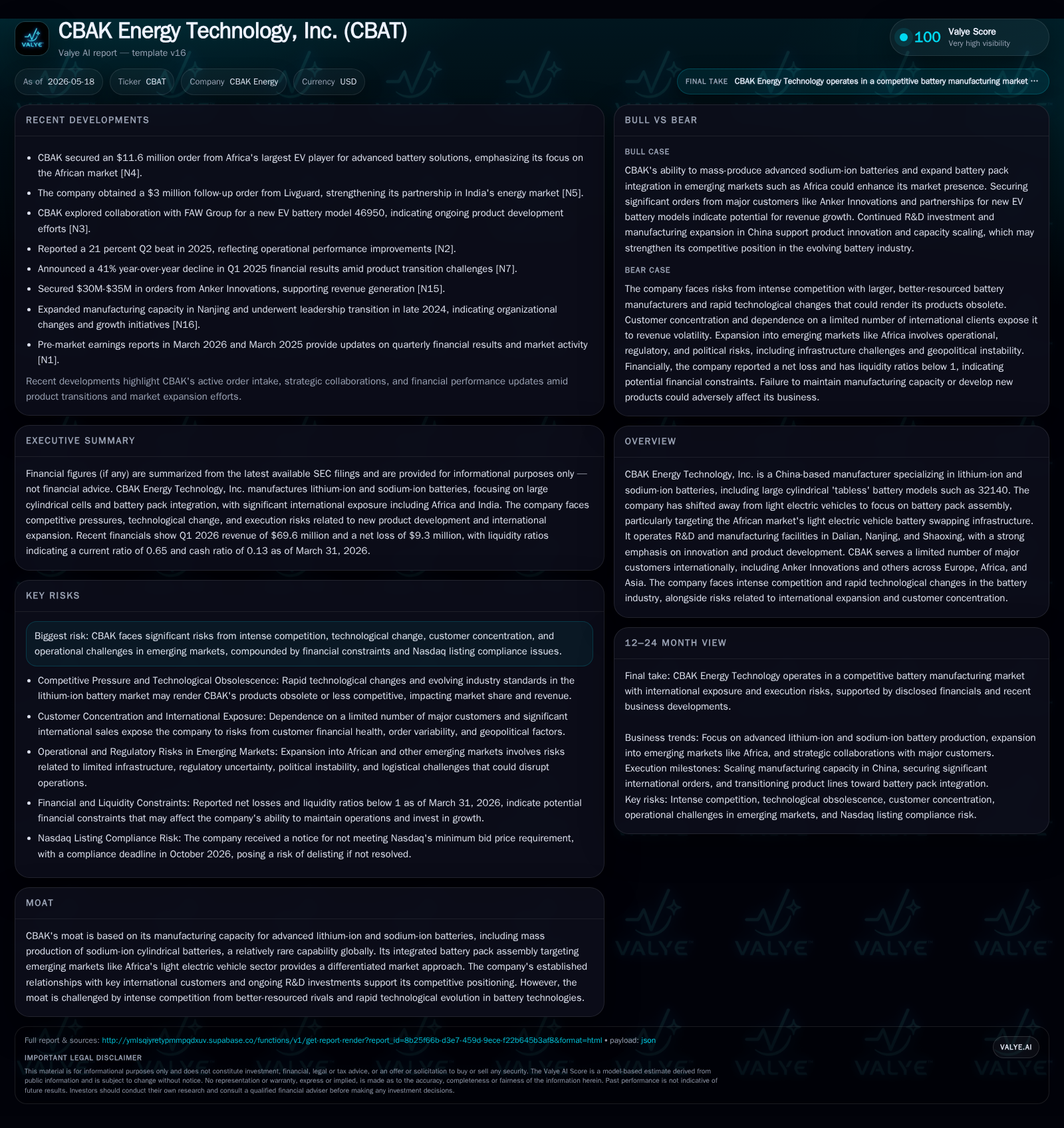
In its latest quarterly update, CBAK Energy Technology has reinforced its strategic shift away from light electric vehicles to focus on assembling integrated battery packs, particularly targeting the African light electric vehicle battery swapping market. The company continues ramping production of its advanced cylindrical tabless lithium-ion and sodium-ion batteries, including the model 32140, standing out as one of few with mass-scale sodium-ion capabilities globally. Despite these growth initiatives, CBAK faces considerable risks from technological disruption, customer concentration, and operational hurdles inherent in emerging markets. Liquidity remains tight with a current ratio below one, though net cash positioning offers some financial cushion as it invests in new production lines and system integration capabilities.
Latest Quarterly Operating Update: Manufacturing Expansion and Market Focus Shift
CBAK Energy Technology's latest 10-Q filing for the quarter ended March 31, 2026 confirms the company’s continued strategic shift away from the development and manufacture of light electric vehicles toward specialized battery pack assembly operations. Production facilities in Dalian, Nanjing, and Shaoxing have been scaling up output of their large cylindrical “tabless” lithium-ion batteries, specifically the model 32140 series capable of both lithium-ion and newly mass-produced sodium-ion chemistries. This expansion includes two production lines at the Nanjing facility as well as a new large-format model 40135 line commissioned at Dalian.
The pivot to battery pack assembly is most notable. Since 2025, CBAK’s Nanjing subsidiary has concentrated efforts on integrating individual cells into complete plug-and-play battery systems rather than manufacturing conventional light electric vehicles themselves. This move aims to cut out intermediary integrators by serving end customers directly. Initial deployment focus targets the light electric vehicle battery swapping ecosystem across African markets—a strategy that both exploits emerging demand and exposes CBAK to inherent geopolitical and operational risks tied to infrastructure maturity in this region [S2], [S3].
Business Model and Product Portfolio: From Cells to Battery Packs
CBAK’s revenue model revolves around producing advanced battery cells—specifically cylindrical “tabless” types like the 32140—and vertically integrating these into assembled battery packs tailored for final application needs. Its product portfolio spans lithium-ion chemistry batteries widely used in consumer electronics and energy storage as well as a rarer offering: mass-produced sodium-ion cylindrical batteries which remain scarce globally. Sodium-ion technology provides a cost-effective alternative with potentially greater raw material security versus lithium-ion.
Customers operate across Asia, Europe, North America, and increasingly Africa. Notable international customers include Anker Innovations among others. By transitioning from cell sales alone to assembled battery systems designed specifically for robust end-user solutions like EV swapping stations, CBAK elevates its value chain involvement. This approach may support higher gross margins if execution risks surrounding system integration quality assurance and supply chain coordination are managed effectively [S1], [F1].
Industry Positioning: Technology, Capacity, and Competitive Dynamics
Within the global lithium-ion industry—dominated by large-cap manufacturers scaling up gigawatt-hour capacities—CBAK occupies a specialized niche notable for its ability to mass produce sodium-ion cylindrical cells at scale. This positions it uniquely against peers who either focus on lithium-ion or utilize powder-based pouch or prismatic forms without tabless cylindrical designs.
However, competitive pressures remain acute. Rivals backed by substantial capital investments pursue rapid innovation cycles with newer chemistries or form factors that could potentially eclipse older generation cylindrical cells. Moreover, pricing power appears constrained by commoditized elements of cell manufacturing and shrinking margins due to raw material cost volatility.
Switching costs are somewhat elevated on the battery pack side due to technical customization and integration complexities forming a partial moat; yet industry participants’ capacity expansions continually challenge pricing stability [S1]. Continuous R&D targeting next-generation cells (models 60115 etc.) is crucial for sustaining competitive edge amid evolving demand profiles
Targeting Emerging Markets: Africa’s EV Battery Swapping Infrastructure
A distinctive aspect of CBAK’s commercial strategy is its targeting of emerging markets—particularly Africa—by supplying integrated battery packs engineered for light electric vehicle (LEV) battery swap stations. This segment represents an evolving urban mobility solution aimed at overcoming charging duration barriers in LEVs by standardizing swappable batteries.
This geographic shift reflects both growth ambitions beyond established Asian or European markets and recognition of burgeoning LEV adoption rates where grid charging infrastructure is lacking or insufficiently reliable.
Yet such expansion carries pronounced execution risk linked to limited local infrastructure maturity, fragmented regulatory frameworks still adapting to EV technologies, political instability in certain regions creating supply chain interruptions, currency devaluation risk impacting foreign revenues when converted back into CNY or USD terms, plus logistical hurdles for distribution and after-sales service networks within diverse African countries [S1]
Growth Drivers: Production Capacity, Innovation, and Geographic Expansion
Several key factors underpin potential growth for CBAK over the medium term:
- Capacity scaling: The operation of multiple high-volume production lines including two Model 32140 lines at Nanjing plus a Model 40135 line at Dalian supports significant output increases aligned with projected demand ramps.
- Technology development: Accelerated R&D efforts focused on next-generation cylindrical cells models (60115 series onward) aim not only to improve energy density but also reduce production costs enhancing competitive positioning.
- Vertical integration: Moving further downstream from cell manufacture into assembled battery packs tailored for specific customer applications facilitates capture of additional margin pools while fostering closer end-customer relationships.
- Geographic diversification: Expanding presence in emerging African LEV markets combined with an existing footprint across Asia and Europe hedges concentration risk geographically while tapping multiple growth vectors simultaneously.
These drivers collectively present measurable KPIs such as increasing gigawatt-hours produced monthly across model lines; evaluation milestones for commercial rollouts of battery swap infrastructures; incremental bookings or backlog expansion reported by major customers outside China; plus progress indicators on new chemical formulations originated from internal labs or partnerships [S1], [F1].
Challenges and Risks: Competitive Pressure, Customer Concentration, and Market Risks
The firm faces notable headwinds:
- Technological disruption risk: Rapid advances from better-capitalized competitors developing alternative chemistries (solid-state cells) or optimized form factors threaten obsolescence;
- Customer concentration: Reliance on a limited set of international buyers enhances vulnerability should contracts lapse or market dynamics shift unexpectedly;
- Emerging market operational challenges: Execution difficulty penetrating African markets characterized by infrastructural gaps complicates scalable deployment;
- Regulatory/audit scrutiny: Historical PCAOB inspection access issues relating to auditors based in Hong Kong/China triggered non-compliance risks under the HFCAA legislation affecting Nasdaq listing status—a potential cause of investor uncertainty;
- Liquidity constraints: Current assets fall short relative to current liabilities implying short-term funding pressures during heavy investment periods;
- Currency volatility: Exposure to foreign exchange fluctuations given multinational revenues increases financial unpredictability [S1], [S2].
These factors require ongoing mitigation via enhanced innovation velocity; broadening customer bases; careful political risk assessment; transparent audit reporting; prudent working capital management.[S2]
Key Developments to Monitor: Milestones, Demand Signals, and Regulatory Factors
Investors monitoring CBAK should look for:
- Production ramps: Upticks in utilization rates especially across Model 32140 sodium-ion production lines indicate successful output scale-up;
- Commercial uptake: Validation milestones around deployed integrated battery packs powering African LEV swap stations serve as crucial market acceptance proxies;
- Audit regulation updates: PCAOB announcements regarding inspection regimes over Hong Kong/China auditors directly impact exchange compliance status;
- Order book growth: Noticeable expansion or diversification of international client orders beyond flagship customers signals improving market penetration;
- R&D breakthroughs: Public disclosures related to performance improvements or cost reductions within next-gen cylindrical cell families signal competitive advancements;
- Operating metrics: Margins progression reflecting improved vertical integration effectiveness along with enhancements in working capital conversion cycles offer insight into financial health trends.[S2], [S3]
Brief Financial Overview: Liquidity, Capital Structure, and Performance Indicators
As of March 31st, 2026, CBAK reported cash reserves of approximately $9.3 million against total debt last estimated near $625 thousand mid-2023 — positioning it with net cash on hand although dated debt data advises cautious interpretation.[F1] Despite this net cash stance balance-sheet liquidity remains mixed with current assets totaling roughly $238 million shadowed by higher current liabilities near $368 million resulting in a below-one current ratio (~0.65).[F1] This suggests short-term funding pressures likely driven by ongoing heavy capital expenditures associated with production ramp-ups and R&D activities.[S2]
Operating losses remain elevated consistent with the strategic repositioning phase as increased spending targets capacity expansion alongside entry into challenging new geographic segments.[F1] Sustaining investment momentum while controlling operating leverage will be critical during upcoming quarters.
Disclaimer: This analysis reflects information available as of May 18th, 2026 derived primarily from SEC filings and company disclosures without speculating beyond verified data points. It does not constitute investment advice but aims to provide an informed perspective on CBAK Energy Technology’s operational shifts within the evolving battery industry landscape.
Financial position in context
As of 2026-03-31, companyfacts shows $9mm in cash and equivalents [F1]. Current assets of $238mm and current liabilities of $368mm imply a current ratio near 0.65x for 2026-03-31 [F1].
Disclaimer: This is research-only, informational analysis and not investment advice. It may include AI-generated interpretation and general industry context. Always verify important details using primary sources.

Comments